Sign up here.
But the prospect of another year of such brinkmanship and repeated sideswipes at international alliances and trade relations may yet prompt a more careful approach to the overwhelming market consensus that greeted the year.
Often viewed as a contrarian signal, the BofA readout on the survey said it was the most bullish in almost five years – even though U.S. and global stocks are already at record highs.
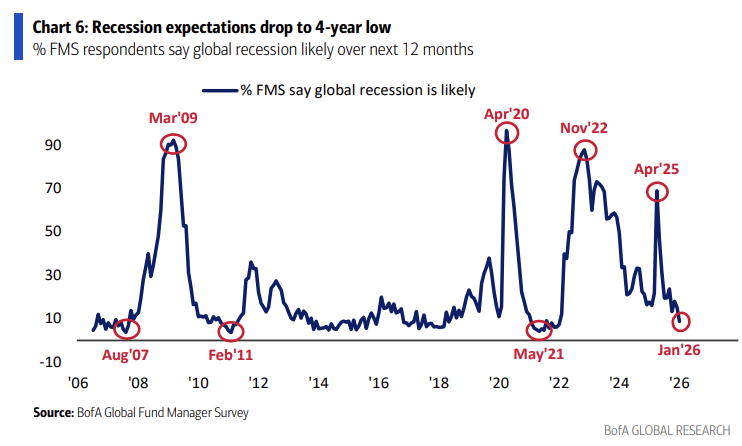
With about half of all investors polled seeing a “no landing” for the world economy over the next 12 months – as opposed to a soft or hard landing – global growth optimism was at its highest since July 2021. Funds expecting a global economic “boom” this year were at their highest in four years as well.

That macro view was amply reflected in the survey’s relative asset holdings, with the net number of funds overweight stocks also close to 50% and the highest since just after the U.S. election in late 2024. Overweight holdings of commodities were their highest in more than three years and cyclical bank stocks were the most favored sector.
Cash levels had never been lower in the 25 years or so of the survey, putting BofA’s overall bull-and-bear gauge at what it called “hyper bull” – a reading that it says warrants an increase in risk hedges and safe havens.

Most alarming for contrarians is that almost half of the funds surveyed have not taken out protection against a big stock drawdown over the next three months – the biggest hedge-less count in eight years.

LEAPING THE ‘HYPER BULL’
But this is where the picture gets complicated.
Even though cash levels are historically low, investors clearly identified “geopolitical conflict” as the biggest tail risk and portfolios are already brimming with gold to reflect that – so much so that funds identified “long gold” as the most crowded trade in the Street as the precious metal continues soaring to new records.
What’s more, one potential transmission mechanism of any renewed row with Europe over Greenland is via the bond markets. The prospect of another Trump tariff salvo potentially irks the U.S. inflation picture again, and any retaliation from Europe could even put gigantic European holdings of U.S. Treasuries in the crosshairs.
But due largely to their take on blistering world growth, funds are already more underweight bonds than they have been at any point since September 2022 and more than 50% of global investors still think the dollar is overvalued after its losses last year.
Fragile bond markets could well be the route to wider market disturbance, but at least asset managers are already shy of fixed income to account for some of that.
Long-standing fears of an artificial-intelligence bubble burst may be more impactful. But, even here, the alarm bells seem to have quietened somewhat.

The IMF’s global economic update seemed relatively sanguine about the durability of elevated tech valuations, citing models that suggest broad equity index overvaluation is still half that at the peak of the dotcom bubble in 2000.

However, the IMF did flag that any AI-related earnings disappointment or sudden correction in U.S. megacap tech stocks could be cause for concern for the world economy at large.
“Given the decade-long increase in foreign ownership of U.S. equities, this sharp correction could also trigger sizable wealth losses outside the United States and exert a drag on consumption, spreading the downturn more globally,” it wrote.
And it’s the stability of historically unprecedented foreign ownership of U.S. equities and bonds that’s increasingly being cited as the biggest risk to this year’s outlook – from many angles.
A confluence of AI and tech risks with any fracturing of world relations would scare the horses – and the “hyper bull.”
by Mike Dolan; Editing by Marguerita Choy
Our Standards: The Thomson Reuters Trust Principles.
Opinions expressed are those of the author. They do not reflect the views of Reuters News, which, under the Trust Principles, is committed to integrity, independence, and freedom from bias.