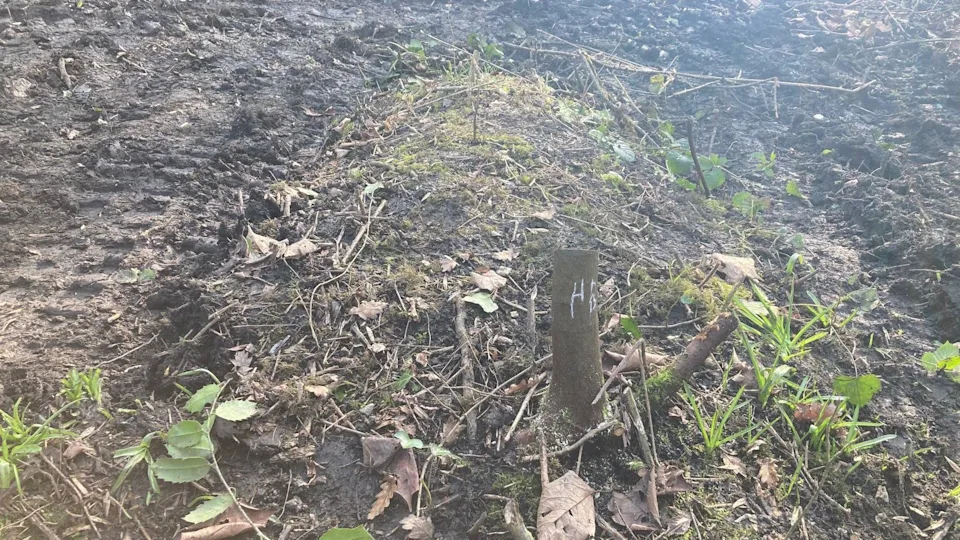
The grave of an infamous shopkeeper who killed more than 20 people after selling sweets laced with arsenic in 19th Century Bradford has been unearthed.
Volunteers from Undercliffe Cemetery Charity worked with grave digger Graham Swain and local historian and author John Lawless to find the final resting place of ‘Humbug Billy’.
They traced the unmarked grave of Kirkgate Market stall holder William Hardaker, who became notorious in 1858 after the accidental poisoning which claimed 21 lives and left at least 200 seriously ill.
The charity plans to turn the site into an educational and visitor attraction as part of its efforts to maintain the Grade II* listed Victorian cemetery.
Tim Hardy, the charity’s chairman, said: “It’s an incredible find.
“It’s never been as clear as this and that is thanks to the work of our volunteers and certainly Graham… who managed to clear the vegetation out.
“We’ve now got a really evident grave.
“The fact that it’s got a mound does tell us that it has got more than one body in it.
“And amazingly it hasn’t sunk, because a lot of the graves with multiple bodies tend to sink.”
The charity has recently compiled a computer database of the 125,000 bodies in the cemetery and used this to aid its search.
They found plot 106, Hardaker’s unmarked grave, by tracing it to the nearest marked plot which had a headstone.
Each plot in the burial ground, which opened in 1854 and is still a working cemetery, is exactly eight feet by four and laid out in a grid system.

HB written in chalk on a tree stump marks the foot of the unmarked grave which contains five family members, including William Hardaker [BBC]
Swain and friend Riaz Ahmed used a small excavator to remove decades of vegetation to expose the site.
Swain said: “We are going to put a headstone on it and a kerb set all the way round.
“And put the names of the five people who were in the grave and, not taking anything away from them, but at the bottom we’re hoping to put Humbug Billy on.
“We’re hoping to find a stone which looks the same shape as a humbug and try to show everybody that we can the story of the Humbug.”
A mix-up at a pharmacy, rooted in trying to save a few pennies on sugar, was eventually found to be the cause of the contaminated peppermint lozenges.
Hardaker was never prosecuted but he was left paralysed down one side from the effects of eating one of his deadly sweets and died in 1866.
Lawless is writing a book about Hardaker and helped with the research.
He said: “This grave has been long forgotten for more than 150 years.
“To me this is just restoring some of the dignity that Humbug Billy deserved and a lot of the other people that were involved in these type of incidents.”
Listen to highlights from West Yorkshire on BBC Sounds, catch up with the latest episode of Look North.