Uncategorized

Goldman’s Flood Sees Potential for ‘Extreme’ Rally in Stocks

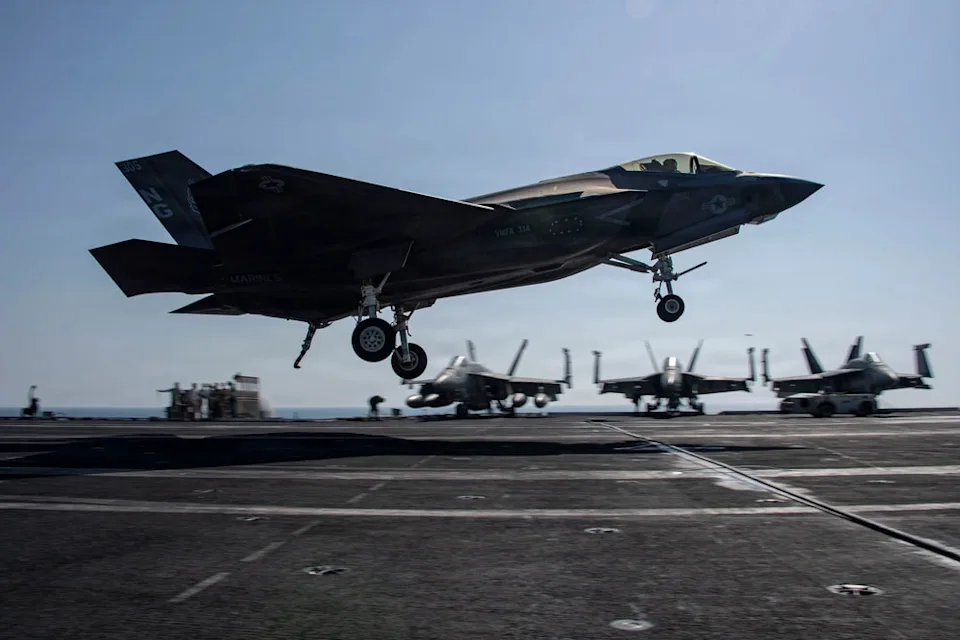
Source: US Navy

Hedge fund positioning across US equities has created a setup for stocks to rip higher after their recent wobble, according to Goldman Sachs Group Inc.’s trading desk.

Speculative investors have largely held on to their bullish positions in individual stocks while building hedges through bearish bets on products such as exchange-traded funds and index futures. That short exposure now stands at the highest level since September 2022, data from the bank’s prime brokerage team show.

Most Read from Bloomberg

The dynamic reflects a market grappling with uncertainty stemming from the Iran war, as well as credit fears and worries over artificial intelligence. It could also, however, fuel outsized gains if good news pushes investors to unwind those hedges, according to John Flood, Goldman’s head of Americas equities execution services and partner.

“If we were to get a headline declaring the conflict over, you could see a sharp move higher at the index level,” Flood said in an interview. “It could be 2% to 3% in a straight line, and most of that would be that macro product covering.”

Goldman SachsSource: Goldman Sachs

Gross exposure among hedge funds, which measures the total value of long and short positions, is currently near an all-time high at 307%, the bank said.

However, “right tail risk is more extreme than left tail risk right now,” Flood said, referring to the potential for a sharper upside move. “Because gross exposure is so high and we’ve seen so much shorting in macro products, any positive headline could trigger aggressive covering.”

Investors had a taste of that type of action on Monday, when President Donald Trump said the war with Iran would resolve “very soon.” The S&P 500 closed 0.8% higher after an earlier 1.5% drop, with traders attributing much of the move to market participants buying back the securities they had shorted. The index remains nearly 3% off its highs, though losses in many individual stocks are far larger.

‘No-Man’s Land’

The volatile backdrop has already taken a toll on investors. Fundamental long-short hedge funds lost about 4% of their year-to-date performance last week amid sharp rotations across sectors, according to Goldman.

Other types of hedge funds have yet to make decisive moves. Long-only asset managers — including traditional money managers and sovereign wealth funds — are largely in wait-and-see mode, Flood said.
“Long-onlys have had strong performance from the start of this year, up until the conflict started,” Flood said. “Given the macro uncertainty and increased volatility, many are now on the sidelines waiting for more clarity to emerge.”

The market has also received support from companies using the recent pullback to buy their own shares: Goldman’s corporate buyback desk last week saw one of its busiest periods for executing share repurchases in three years.

Meanwhile, although retail investors remain an important source of demand for stocks, their support could fade if the labor market weakens materially.

“If we start to see multiple negative job prints, that would be a cause for concern that the retail bid could walk away and that the market could sell off,” Flood said. “We do not think that’s happening right now on one negative jobs print,” he said referring to last week’s payrolls report.

Volatility Ahead

At the same time, sparser liquidity across markets is likely to make stocks more volatile in the weeks ahead, Flood said. While trading volumes have surged to more than 20 billion shares a day this year, depth of liquidity — which gauges the ease of executing large trades — has fallen sharply.

Goldman estimates the amount of S&P 500 futures that can be traded at the best bid or offer — known as top-of-book depth — is around $4 million, far below the historical average of roughly $14 million. Levels below $7 million typically signal stress in the market.

“That means every time an institution tries to buy or sell something in size, they’re having a much larger impact on the price,” Flood said.

Which way that impact goes could depend in part on how the geopolitical backdrop is resolved. For now, investors are still counting on the broad uncertainty sparked by the conflict to dissipate soon, Flood said.

“The market is counting on some signal of a resolution within the next two weeks,” he said. “If this carries on for longer with no positive progress we will have a problem from an equities perspective at the index level.”

Most Read from Bloomberg Businessweek

©2026 Bloomberg L.P.

Source link

Visited 1 times, 1 visit(s) today

Leave a Reply

Your email address will not be published. Required fields are marked *