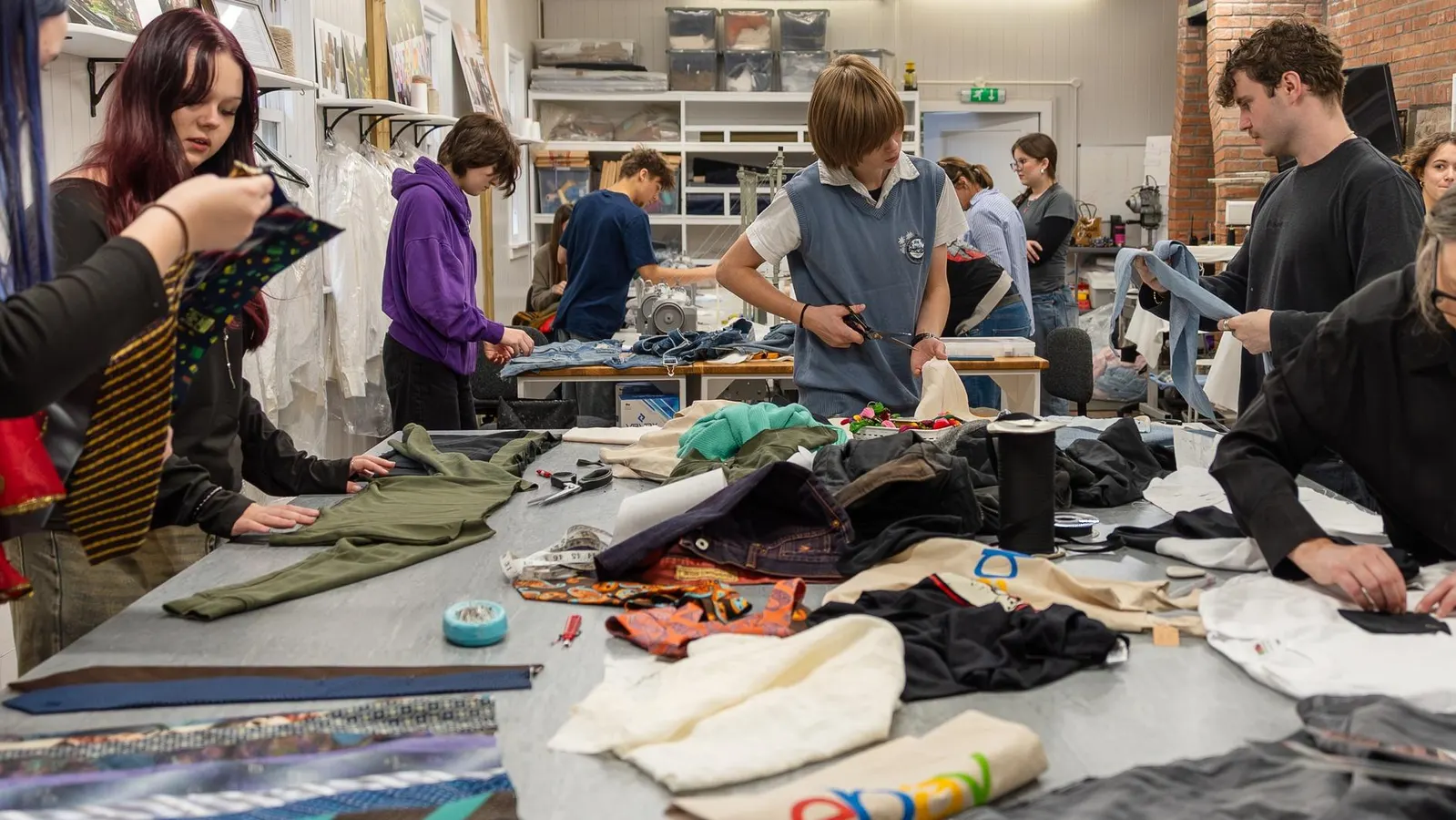
Students on an up cycling workshop organised for Germany Fashion Council’s Fashion Zukunft conference in Scotland 2025.
Eleanor Kenny
Scott Lipinski is on a mission to change the way people dress. As CEO of Fashion Council Germany, that might be expected. What stands out, however, is his insistence on disrupting the fashion consumption cycle at its roots: by reaching the very young before mindless shopping habits become entrenched.
In November, Fashion Council Germany held its annual Fashion Zukunft (Fashion Future) conference in Scotland. The event brought together 48 teenagers from Germany, 38 students from the United Kingdom, industry representatives and graduates to spark imaginations with discussions, talks and round-table sessions on topics ranging from sustainable production and craftsmanship to materials science and the impact of consumer behaviour on the environment.
The ongoing initiative—backed by major partners including the PVH Foundation and eBay—targets 14- to 16-year-olds. As Lipinski noted, it is the cohort most deeply embedded in fast-fashion culture through retailers such as Primark and China’s Shein. “Now it’s all about buying new things constantly. That’s why we have all these fast-fashion retailers coming up,” he said in an interview.
PARIS, FRANCE – NOVEMBER 05: Shoppers carry bags of the Asian fast fashion brand Shein after visiting their first physical store on it’s opening day, in the BHV Marais Department Store, on November 05, 2025 in Paris, France. The Parternship between the brand and the Paris Department store has provoked criticisms by politicians, unions and top fashion brands. (Photo by Kiran Ridley/Getty Images)
Getty Images
The Chinese ultra-fast-fashion e-tailer has drastically shortened production timelines and slashed margins, expanding access to disposable clothing online. Its $2 billion net-income guidance for 2025 suggests profits could nearly double from last year’s $1.1 billion, according to Bloomberg. In an effort to build its offline presence, Shein opened its first physical store in the upscale BHV department store in Paris on November 5. The opening drew scrutiny and controversy, yet Frédéric Merlin, president of BHV owner Société des Grands Magasins, said more than 50,000 shoppers visited the store on opening day.
Lipinski’s counter-vision is unambiguous: “We [the industry] have to work collectively to challenge attitudes.” One focus he suggests is “to make upcycling and recycling cool.” This can be seen in the conference programming which foregrounded these practices.
An upcycling workshop offered students the chance to transform pre-selected second-hand garments sourced via eBay, guided by participants from the Costume & Craft programme. James McGuinness, a student on the programme, said that today’s teenagers are far more aware of the environmental impact of their consumption than he was growing up in the 2000s.
A student at the Fashion Zukunft conference in Scotland
Eleanor Kenny
McGuinness argued that sustainability is a fundamental life skill and should play a central role in education. “When I was in school, courses like Home Economics included some mending, but the curriculum hasn’t caught up with the escalation of fast fashion driven by e-commerce,” he said.
As part of this effort to reset attitudes, students heard from designers including Ines Rust of Berlin-based Dawn Denim, which manufactures responsibly in a small factory in Vietnam, and Nikie de Schryver, founder of ethical shopping platform Cosh that offers location-based sustainable shopping advice. Scottish designer Siobhan Mackenzie discussed reinterpreting traditional craft fabrics such as tartan.
Fashion Zukunft’s focus on teenagers is timely. A survey conducted on the day showed that 54% of respondents believe sustainability should be a key value for the fashion industry going forward—below fairness (70%), diversity (63%) and creativity (69%). Fifteen-year-old Jonathan Eliah Dokters, who attends Gymnasium Martinum Emsdetten near Münster, said the most important lesson he took from the conference was “to choose wisely and wear what you like with confidence.” He said that while his peers often dress to signal brand loyalty or fit in with a social group, he felt some leeway, stating: “Now it’s more about having your own style. The clothes that you wear should represent you.”
Music to Lipinski’s ears, no doubt.
Sustainability activist Nikie de Schryver, founder of ethical shopping platform Cosh!, during a round table at Fashion Zukunft in Scotland.
Eleanor Kenny
Shein’s expansion has also prompted backlash. Several French labels, including womenswear brand Agnès B., withdrew their products from BHV in protest over the partnership. Meanwhile, Shein’s attempt to go public hangs in the balance after unsuccessful efforts to list in New York and London. Currently, the company is seeking a Hong Kong debut while it awaits regulatory approval from Beijing (despite being headquartered in Singapore).
Fashion Council Germany—having recently announced its Autumn/Winter 2026 schedule for Berlin Fashion Week—plans to translate its school-education programme and e-learning tools into English in an effort to partner with cross-border organisations and fashion councils globally. It is all part of Lipinski’s magnanimous vision to reshape fashion behaviour. “We can share our experiences because we’ve done this for four years now. We hope others will pick it up even outside fashion organisations because, after all, we all wear clothes. Without knowledge, you cannot change—and change is necessary.”