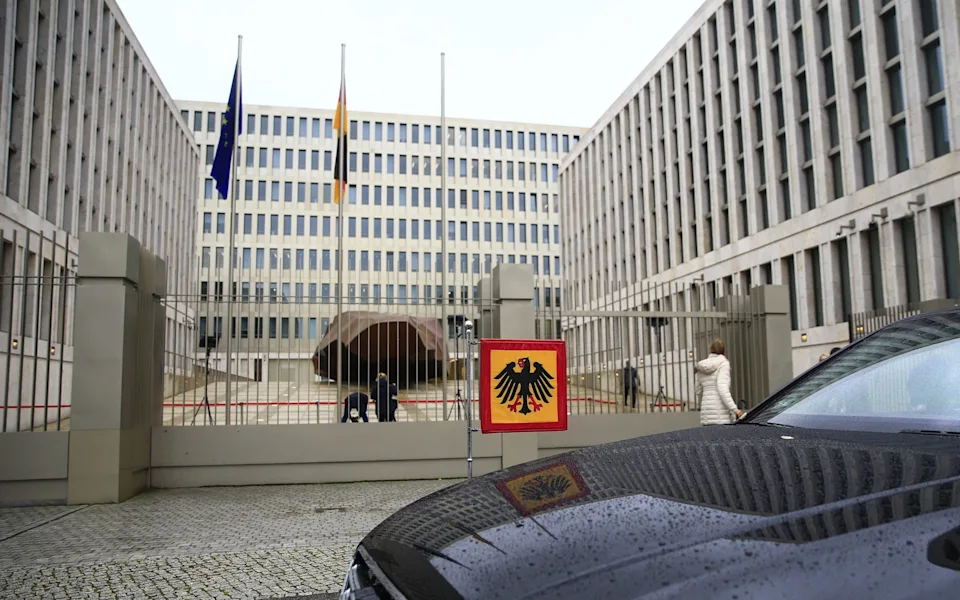
Spies from Germany’s foreign intelligence agency will be given powers to attack and sabotage enemies of the state, as Berlin toughens up its security posture.
Since its founding in 1956 in West Germany, the Federal Intelligence Service (BND) has only been permitted to gather and analyse intelligence. But a new law, drawn up by chancellor Friedrich Merz’s coalition, will give BND spies additional powers to launch cyber-attacks, carry out sabotage abroad and covertly enter the homes of enemies of the state.
Spies would also be allowed to take down suspicious drones flying over sensitive locations and track suspects under Mr Merz’s “wish list” with facial recognition software.
A copy of the drafted BND law, seen by German media, says that its spies will soon be permitted to go on operations and take “measures which could weaken the enemy’s capabilities”.
The agency would only be allowed to carry out direct action if it could demonstrate an “intelligence emergency” or a “systematic threat” to national security, the German news programme Tagesschau reported.
Spies will also be allowed to install spyware on computers belonging to enemy suspects and secretly enter their homes. When operating overseas, spies will be allowed to install tracking devices on enemy technology or weaponry – or destroy it altogether.

The BND, founded in 1956, has only been permitted to gather and analyse intelligence thus far – Anadolu
Germany has proven to be one of Russia’s main targets in its ongoing hybrid war campaign in Europe, which seeks to punish the West for arming Ukraine.
Over the past two years, suspected Russian spies have set fire to arms factories, caused travel chaos by flying drones over airports, and even plotted to assassinate Armin Papperger, the head of German tank producer Rheinmetall.
German intelligence sources have told The Telegraph that they suspect Russia might also have played a role in a spate of terror attacks committed by asylum seekers in the run-up to the February federal elections.
The new powers were revealed this week by Martin Jäger, the new president of the BND, as he joked: “It doesn’t mean we’re going to turn into James Bond, don’t worry.”
The reforms to the BND are at an early stage and it is unclear when they will be put to a vote in the Bundestag, the German parliament.
Mr Merz has pledged to transform Germany into a major European security power in response to the growing threat from Russia.
Declaring that “Germany is back”, he has passed historic reforms on government debt which will allow potentially unlimited spending on major defence projects.
Earlier this month, the German parliament also approved a new, voluntary military service scheme which will require young male Germans to take part in an army medical exam from next year. Young men can then choose whether to join the army if the exam declares them fit for service.

Sergei Naryshkin, the head of the Russian foreign intelligence service, was accused of bullying by Blaise Metreweli, the new head of MI6 – ALEXEY NIKOLSKY/AFP
In Britain, Blaise Metreweli, the new head of MI6, has warned that the Russian threat is accelerating, and that the UK is in a state “between peace and war”.
“Russia is testing us in the grey zone, with tactics that are just below the threshold of war,” she said.
“It’s important to understand their attempts to bully, fearmonger and manipulate, because it affects us all.”
Ms Metreweli recently spoke by phone to the head of the Russian foreign intelligence service, Sergei Naryshkin, who is a close ally of Russian leader Vladimir Putin.
Mr Naryshkin later told Russian media that the call, which followed her accusation of bullying, was “rather lengthy”.