Will resits effect prompt exam reform?
Of those resitting English GCSE this year, only 23.1 per cent achieved at least a grade 4 (equivalent to a C), and for maths it was 18.2 per cent. The vast majority will have to continue retaking the subjects as a condition of staying on their further education courses or apprenticeships.
This will only lend weight to the argument that it is a waste of time, money and morale putting thousands of teenagers through repeated resits of English and maths GCSEs. As more 16-year-olds failed both subjects this year, the cycle is likely to continue.
• Read in full: Endless resits in maths and English drag down GCSE pass rates
Milly Johnson, a pupil at Tarleton Academy near Preston, brought her sheep, Kevin, along to collect her GCSE results.
Milly, 16, recently took first place in the over-11s young handler’s class at the Trawden Agricultural Show.
“Juggling farm work while studying for my GCSEs hasn’t always been easy, but I wouldn’t have it any other way,” she said. “Working with animals is what I love most, and I’m proud to help preserve these rare breeds and back British farming.’’
Unhappy with your grades? Here’s what to do now
GCSE results day is emotional (Shaun Fenton writes). For many, it’s a moment of celebration. For others, it can be difficult and uncertain both for young people and their family. If your results weren’t what you hoped for, or if you’re now rethinking your subject choices, I want to offer some reassurance: you are not alone, and you have options.
Hundreds of thousands of young people across the country now face big decisions about what to do next. Remember that in 2024, 32 per cent of entries did not reach a grade 5 strong pass, and only around 60 per cent of grades were a grade 4 or above in English and maths. So please do not worry; I’ve seen many go on to great success after a stumble at this point.
So, what should you do? Remember that many people are on your side, including your head teacher and your teachers, your parents and your good friends. So speak to your school quickly, explore resits or appeals where appropriate, consider alternative pathways like BTecs or apprenticeships, and act early if you want to change subjects.
• Read article in full: What to do now if you didn’t get the GCSE results you wanted
Stark regional variance in grades
The results expose big regional differences in England — 28.4 per cent of those in London were awarded the top grades of 7 (equivalent to an A) or above, down slightly from 28.5 per cent last year.
This is about ten percentage points higher than the North West, North East, West Midlands and the East Midlands.
The North East was the lowest performing region by this measure, at 17.8 per cent, the same as last year.
However the proportion achieving a grade 4/C in London fell from 73.1 per cent last year to 71.6 per cent this year, even though it was the highest performing region.
Nick Harrison, chief executive of the Sutton Trust, a social mobility charity, said: “Regional differences in attainment remain stubbornly entrenched, with London continuing to streak ahead in terms of top grades. If the government is serious about breaking down barriers to opportunity, it needs a laser focus on closing the attainment gap and tackling regional inequalities.”
Gender gap at top grades is smallest in 25 years
Girls continued their lead over boys this year but with a slightly smaller gap at the top grades, from 5.7 to 5.1 percentage points. Exam board chiefs said this was the smallest gap since the year 2000.
For all UK candidates of all ages, the proportion of girls achieving the top grades fell from 24.7 per cent last year to 24.5 percent and for boys it rose from 19 to 19.4 per cent.
The proportion of UK boys achieving at least a C or grade 4 increased slightly from 64.2 per cent to 64.3 per cent, and for girls it fell from 71 per cent to 70.5 per cent.
Separate figures, published by the exams regulator Ofqual, showed that 1,302 16-year-olds taking at least seven GCSEs in England got grade 9 in all their subjects. Of these, 61.7 per cent were girls.
Spanish becomes most popular language
Spanish has overtaken French to become the most popular GCSE language for the first time.
Vicky Gough, schools adviser at the British Council, said of the 2.6 per cent growth in Spanish: “Its growing popularity and cultural appeal show there is real appetite for language learning — when pupils see the benefits it can bring. We need the success of Spanish reflected across all languages through exchanges, cultural programmes, and real-world connections that demonstrate why languages matter.
“Our research also reveals that pupils in the top fifth of the most advantaged state schools in England are around a third more likely to take a language GCSE than their peers elsewhere, meaning many young people from less privileged backgrounds miss out on opportunities their peers benefit from.
“At a time of increasing global tension, helping young people connect across borders, build friendships, and foster trust has never been more important. We must ensure access to language learning for all, it remains a powerful gateway to opportunity and a more connected future.”
Statistics on the rise, but humanities take a hit
The top ten most popular GCSE subjects stayed consistent this year, with double science, maths, English language, English literature, history, geography, religious studies, art & design, biology and chemistry holding their ground.
However, while the list remained the same, there were some notable shifts in subject popularity. The statistics GCSE had the biggest surge, up by 9.5 per cent, mirroring A-level figures.
Music entries also climbed 6.1 per cent in what Myles McGinley, the director of the OCR exam board, described as a “post-Covid bounce-back”.
Business studies and PE saw modest increases of 2.1 per cent and 2 per cent, respectively.
Meanwhile, the sciences presented a mixed picture. Biology entries dropped by 5.8 per cent and chemistry by 6 per cent, while more students opted for the double award in science, up 0.9 per cent.
Humanities subjects took a hit, with history entries down 5.7 per cent, religious studies by 3.1 per cent, and even English literature seeing a slight one per cent dip.
PM promises a future ‘shaped by your talent, not your background’
Sir Keir Starmer has congratulated students across the country as they receive their GCSE and vocational qualification results.
The prime minister wrote on X: “To everyone receiving their results today, a huge congratulations, you should be proud of all you’ve achieved. My government will ensure that your future is shaped by your talent and ambition, not your background.”
Culture of endless resits of English and maths ‘must end’
Pepe Di’Iasio, general secretary of the Association of School and College Leaders, said the culture of endless resits of English and maths must end.
He said: “Once again we see that the majority of students who retake GCSE English and maths in post-16 education under a government policy of mandatory resits continue to fall short of a Grade 4 standard pass. It is utterly demoralising for these young people and there has to be a better way of supporting literacy and numeracy. We urge the curriculum and assessment review to grasp this nettle.”
Surge in resits expected after fail rates in English and Maths increase
This year 39.8 per cent of all candidates failed to achieve a grade 4 or C in English and 41.7 per cent in maths, up from 38.1 per cent last year in English and 40.5 per cent in maths.
This could lead to a surge in retakes and appeals next year in the core subjects, which are needed for those taking A-levels or other further education and by many employers.
The results of older candidates doing resits, which increased by 12.1 per cent in a year, brought down grades this year, although fewer 16-year-olds attained a 4/C in English and maths than last year.
Twenty-three per cent of all 16-year-olds achieved at least an A/7 across all subjects, up from 22.7 per cent last year. However, for those 17 and above this fell from 6.1 to 5.2 per cent.
The pass rate at 4/C increased for 16-year-olds from 70.3 to 70.5 per cent but fell for 17-year-olds from 29.6 to 28.6 per cent.
Results were much higher in 2020 and 2021, under school and teacher-assessed grades during Covid. Exam boards were this year aiming for 2019 grading, similar to 2023, but results were slightly higher.
Trend of higher grades continues

Students at Boroughbridge High School in North Yorkshire open their GCSE results
TIMES PHOTOGRAPHER JAMES GLOSSOP
The percentage of top grades awarded, at A/7 or above, rose to 21.9 per cent, up from 21.8 per cent last year and 20.8 per cent in 2019, the last year before the pandemic.
In England it was 21.8 per cent, in Northern Ireland 31.6 per cent and in Wales 19.5 per cent.
Overall, 67.4 per cent per cent of exams were graded a pass at 4/C or above across the UK, down from 67.6 per cent last year but — again — higher than 2019 when this was awarded to 67.3 per cent.
Figures published by the Joint Council for Qualifications covered GCSE entries from pupils in England, Wales and Northern Ireland.
While traditional A*-G grades are used in Wales, in England these have been replaced in with a 9-1 system, where 9 is the highest, and Northern Ireland uses a mixture including a C* grade.
Top grades rise, but more fail maths and English
Hundreds of thousands of teenagers received their GCSEs this morning with a rise in top grades, continuing the trend of higher results since the pandemic.
However, more teenagers failed to pass English and maths, and more of those taking resits also did not achieve at least a grade 4 or C. Critics say the model of repeatedly taking resits in core subjects is not working.
The gap between boys and girls narrowed, echoing last week’s A-level results when boys pulled ahead of girls at the top grades for the first time in eight years. Overall results at 7/A have been depressed by the grades achieved by those resitting English and maths, which are down considerably on last year.
This cohort of 16-year-olds switched from primary to secondary school in 2020, experiencing pandemic lockdowns, school closures and social distancing in both their final year of primary and their first year of secondary. They were also affected by national strikes and the crumbling concrete crisis two years ago.
Barriers for poorer students mean results ‘don’t tell full story’
This year’s results will “show that the gap” between richer and poorer backgrounds continues to grow since the pandemic, an education expert has said.
James Toop, the chief executive of Teach First, said that while results day should be a milestone in every young person’s life, “success is not evenly spread and for too many pupils, the barriers they face mean their results don’t always tell the full story”.
“Teachers and students in these schools work even harder than those in more affluent areas to overcome challenges — such as children arriving at school hungry, or without the space or technology at home to study and revise effectively.
“There is simply no level playing field when they are competing with peers from wealthier areas who have every advantage. Despite this, nationally, children from poorer backgrounds are typically half as likely to get a grade 5 in English and Maths as other children.”
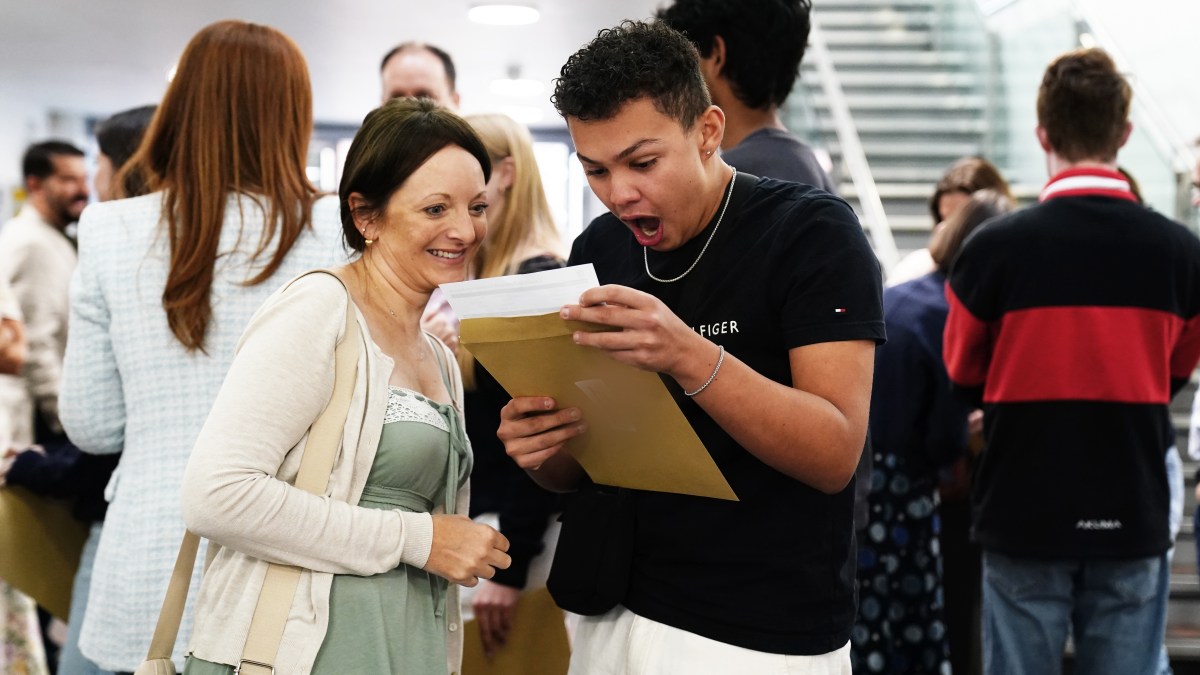
Pictured: shock, joy and relief as teens receive their results

Pupils celebrate their results at Putney High School in London
JONATHAN BRADY/PA

At Boroughbridge High School in North Yorkshire
TIMES PHOTOGRAPHER JAMES GLOSSOP

… and at Solihull School, West Midlands
JACOB KING/PA

Elite sixth forms require university-style personal statements
Dozens of highly selective sixth forms across the UK expect applicants to submit university-style essays outlining their background, academic ambitions and extracurricular activities.
Newham Collegiate Sixth Form, based in one of London’s most disadvantaged boroughs and renowned for its Oxbridge success rates, is among those adopting this approach as part of its selection process.
Similar practices are reported at Rendcomb College in Gloucestershire, Peter Symonds College in Winchester, and Cardiff Sixth Form, among others.
Kate Allan, the head of admissions at Hills Road Sixth Form College in Cambridge, said that these statements were a chance for pupils to express their ambitions “in their own words”, and while it was not a deciding factor in admissions, it helped the college to guide their subject choices where applicable and to support their progression. “It’s also about seeing the whole person, not just their grades,” she added.
GCSEs ‘a mirror to our deeply divided society’
Lee Elliot Major, professor of social mobility at the University of Exeter, has called for a national corps of undergraduate tutors to help pupils improve their literacy and numeracy in school.
He told the PA news agency: “Every August, we accept a grand illusion that GCSEs are a level playing field. In reality, they are a mirror of the deeply divided society we’ve created, a measure of how much extra support students receive, as much as their academic capability.”
He added: “Stark socio-economic divides in GCSE results are a legacy of the Covid disruption and the crisis in school absenteeism, which threaten to scar a whole generation.”
Major suggested competition for the most selective sixth forms will be “fiercer than ever” this year as more families may seek out state sector places after Labour’s VAT change on private school fees was introduced in January.
‘Whatever the results, there will be support available’
Catherine McKinnell, the schools standards minister, said students would have support available to them no matter what their GCSE results are today.
She said it was an “exciting day” for students, their families and schools.
“I think whatever the outcome for these young people, they have worked incredibly hard, as have the schools, as have the teachers,” she told Times Radio. “So, it really is a day to recognise that and to celebrate, and also to mark how important it is that this is a springboard into whatever comes next.
“So, for young people who are awaiting their results, whatever the outcome, there will be support available, whether it’s to go on to an apprenticeship, to A-levels, to T-levels, to vocational qualities.”
What can pupils do if they are unhappy with their results?
Pupils are encouraged to speak with their chosen school or college about flexibility on entry requirements if they narrowly miss their grades.
In England, pupils unhappy with their results can ask their school or college to request a review of marking from the exam board. If concerns persist, an appeal can be made through the school or college.
Pupils may also resit any GCSE exam the following summer. However, English language and maths GCSEs can be retaken from this autumn. It is mandatory for pupils who do not achieve at least a grade 4 in these subjects to retake them during post-16 education.
Pupils are funded to retake maths and/or English until they achieve a GCSE grade between 9 and 4. For those with a grade 2 or below, they can either study towards a pass in Functional Skills level 2 or towards a GCSE grade 9 to 4.
GCSE pupils to receive results via app in pilot scheme
Tens of thousands of GCSE pupils in England will receive their results through an app today, as part of a government pilot designed to modernise how young people access and share their qualifications.
More than 95,000 pupils across Greater Manchester and the West Midlands are trialling the new Education Record app before the planned introduction of the scheme nationwide.

The app brings together a pupil’s exam results and certificates in one secure digital location, intended to streamline the transition to further education, apprenticeships or employment.
The Department for Education said the move could eventually replace paper certificates and reduce the need for schools and colleges to manage physical records, saving up to £30 million annually.
Stephen Morgan, an education minister, said: “This pilot will allow schools and colleges to focus on what they do best: teaching the next generation rather than being bogged down in bureaucracy.”
The grading system explained
In England, GCSEs are graded on a numerical scale from 9 to 1, introduced in 2017 and fully implemented by 2020.
A grade 9 represents the highest achievement (equivalent to an A*), while a grade 4 is considered a “standard pass”, broadly equivalent to the former grade C. Grades 7 and above align roughly with an A or higher.
However, government performance measures focus on those attaining a grade 5 or above in English and maths, comparable to a strong C or low B.
Elsewhere in the UK, traditional lettered grading systems remain.
Northern Ireland continues to use a nine-point scale from A* to G, including a C* grade (introduced in 2019). However, exam boards such as AQA and OCR also operate there and employ the 9-1 grading scale; pupils may receive letters or numbers depending on the exam board used.
Meanwhile, Wales retains the familiar A* to G format.
In Scotland, pupils received their National 5 results earlier this month under a separate qualification framework.
Education secretary congratulates pupils
Bridget Phillipson has congratulated pupils across England, Wales and Northern Ireland receiving their GCSE and BTec results today, praising their “remarkable resilience” after years of pandemic disruption.
Before more than half a million pupils receive their results today, the education secretary said: “Huge congratulations to everyone receiving their results today — you should be incredibly proud of what you’ve achieved. To the brilliant teachers, school and college staff, and parents who have been there every step of the way, thank you for your unwavering support.

Bridget Phillipson
TERRY HARRIS FOR THE TIMES
“These young people moved from primary to secondary school right in the midst of the pandemic, showing remarkable resilience despite the disruption to those crucial years of education. Their options now are better than ever, whether it’s A-levels, T-levels, or an apprenticeship.
“While it’s a moment to celebrate, today’s results will expose the inequalities that are entrenched in our education system. Too many young people continue to have their life chances defined by their background and where they live, and while we are beginning to see promising signs in critical areas like attendance and teacher recruitment, I am determined to … truly break the link between background and success once and for all.”