- The GBP/USD forecast edges lower as risk sentiment deteriorates, leading to increased flows to the safe-haven dollar.
- Pound’s downside remains limited amid Cautious BoE and accommodative Fed.
- Technically, 100-MA holds from further losses, but bearish pressure remains intact.
After a brief bearish gap, GBP/USD began the new week cautiously, slightly falling below the mid-1.3400s. Although the action suggests a resurgence of demand for US dollars, there has been little selling pressure thus far. The market’s uncertainty, rather than an apparent change in direction, is highlighted by the pair’s continued hold above last week’s lows.
–Are you interested in learning more about forex indicators? Check our detailed guide-
One short-term factor has been geopolitics. Some investors are turning back to the dollar as a defensive asset due to the ongoing conflict in Ukraine, the unrest in the Middle East, and the recent US military action in Venezuela. GBP/USD is under short-term pressure due to the dollar index’s continued recovery from multi-month lows. But demand for safe havens on its own hasn’t been strong enough to force a broader repricing, particularly with US rate expectations still tilted toward easing.
The primary counterweight to the strength of the dollar remains the outlook for interest rates. With at least one more move later in the year still priced in, markets are still debating whether the Fed will make its first cut as early as March. Any concrete proof of a slowing US labor market would support that theory and limit future dollar gains, particularly when compared to currencies where central banks seem more hesitant to ease.
In the UK, the relative repricing of Bank of England expectations continues to support the pound. Although the December rate cut by the BoE to 3.75% was widely anticipated, the close 5-4 vote split drew notice. Investors were compelled to lower their expectations for swift follow-up cuts, as it indicated continued concern about the persistence of inflation. Although UK growth remains muted, this change has provided sterling with some support.
From a broader perspective, the US dollar’s decline, rather than the pound’s outright strength, was the main driver of the pound rally last year. Sterling underperformed several other major currencies in 2025, despite the cable rising by more than 6%. This is significant for 2026 because it implies that more upside will need support tailored to the UK rather than just a weaker dollar.
The UK fundamentals scenario is not entirely clear. Growth remains modest, the labor market is gradually opening up, and inflation has cooled more quickly than anticipated. When taken as a whole, these factors allow the BoE to further lower rates if conditions worsen. However, political unpredictability and fiscal fragility are still unresolved risks that could quickly reappear if gilt markets become unstable.
The GBP/USD price is currently close to a critical zone. While 1.30 continues to determine whether pullbacks remain corrective or initial reversal, the 1.35 area remains a distinct barrier that has consistently capped rallies. The cable is likely to remain range-bound, with direction determined more by the dollar than by domestic UK momentum, until future US labor data prompts a clearer repricing of rate expectations.
GBP/USD Technical Forecast: 100-MA holding losses
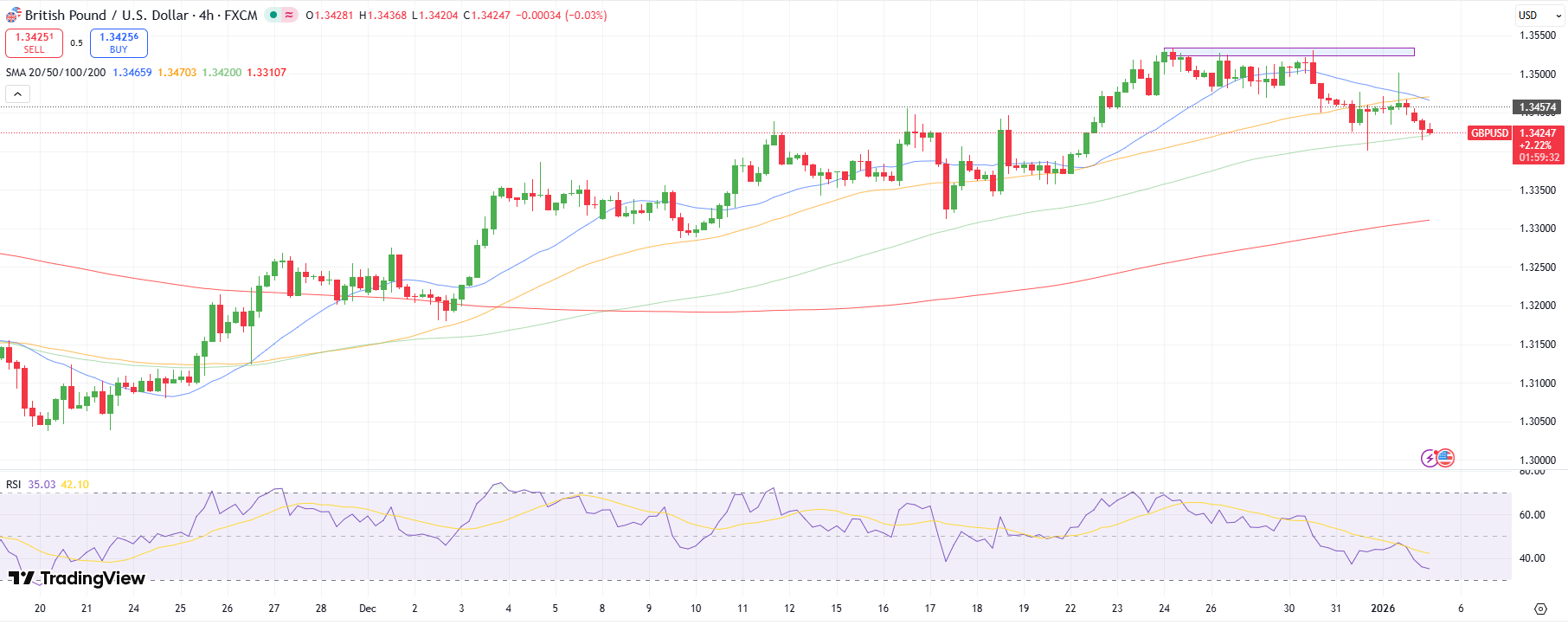
The GBP/USD downside found a strong support near the 100-period MA around 1.3420. However, a Friday’s bearish pin bar and a bearish crossover of 20- and 50-period MAs reveal a building bearish pressure. Only moving above the 20-period MA, near 1.3455, could alleviate the bearish pressure and lead to a test of the supply zone near 1.3550.
–Are you interested in learning more about next cryptocurrency to explode? Check our detailed guide-
On the other hand, breaking below the 10-period MA could trigger a deeper correction to a swing low of December, with confluence at the 200-period MA near 1.3300. The RSI below 50.0 also supports the bearish narrative.
Looking to trade forex now? Invest at eToro!
68% of retail investor accounts lose money when trading CFDs with this provider. You should consider whether you can afford to take the high risk of losing your money.