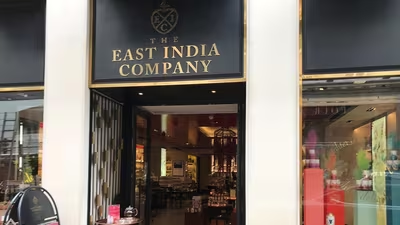
The East India Company was once a force to reckon with, wielding immense economic influence and political might that paved the way for the British colonisation of India. Now, the company has shut down again, its most recent incarnation having operated as a luxury retailer in London.

The East India Company had been revived in 2010 as a luxury food and drink retailer, the modern incarnation sought to trade on heritage rather than empire. But this second life proved short-lived.
The company has now been placed into liquidation, The Sunday Times has revealed, a far quieter ending than the upheaval that defined its original dissolution.
But before the liquidation, it had survived another demise. This was in 1857.
The East India Company, called by some historians as one of the world’s first multinational corporation was first dissolved after the 1857 Indian rebellion. The British Crown had then absorbed the corruption-tainted company and dismantled its private army, bringing to a close a rule marked by commerce, conquest, and controversy.
Also Read | East India Company now has an Indian owner
East India Company 2.0
The revival itself was made possible by Sanjiv Mehta, an Indian entrepreneur who acquired the rights to the storied name in the early 2000s from shareholders hoping to relaunch it as a wholesale venture.
For a brief period, he became the latter-day custodian of one of history’s most controversial corporate legacies.
In 2010, Mehta opened a 2,000 sq ft store in Mayfair, offering teas, confectionery and other premium goods reminiscent of Fortnum & Mason. In interviews, he portrayed the revival as symbolic, an Indian reclaiming a brand long associated with colonialism.
“Put yourself in my shoes for a moment: On a rational plane, when I bought the company I saw gold at the end of the rainbow,” he told HT in 2010. “But, at an emotional level as an Indian, when you think with your heart as I do, I had this huge feeling of redemption — this indescribable feeling of owning a company that once owned us.”
Companies House filings show that East India Company Limited appointed liquidators last October. The firm owed more than £600,000 to its parent company, East India Company Group, registered in the British Virgin Islands, alongside £193,789 in tax liabilities and £163,105 owed to employees. Several connected companies bearing the East India name have also been dissolved.
Liquidation is the end of the chapter for EIC
The brand’s website is no longer active. Its former store at 97 New Bond Street stands empty and is being marketed by property agency CBRE. Another remaining entity, East India Company Collections Limited, was last week served with a winding-up petition, a legal step typically taken by creditors as a last resort.
At the time of writing, a single East India Company tea gift box remained listed on Selfridges’ website.
The liquidation marks the close of an unusual chapter for a company whose original incarnation once controlled vast territories in India, backed by a private army of around 250,000 men by the early 19th century.
Though it transformed global trade, the company’s legacy remains deeply contested. Historians link it to systemic exploitation, involvement in the slave trade, and policies blamed for exacerbating famines that claimed millions of lives. Its dominion ended after Indian soldiers rose against it in 1857.
A third revival now appears unlikely.