A Supreme Court case being heard Monday could give Donald Trump unprecedented influence over federal regulators by allowing presidents to fire the heads of independent agencies at will—upending a 90-year-old constraint on presidential power.
The dispute in Trump v. Slaughter directly targets Humphrey’s Executor, the 1935 ruling that has long insulated agencies like the FTC from presidential removal.
Newsweek contacted the DOJ and administrative law scholars for comment via email outside of normal working hours on Monday.
Why It Matters
The Supreme Court’s review of Trump v. Slaughter could reshape the federal government by reconsidering Humphrey’s Executor, the precedent that shields leaders of independent agencies from at-will removal by the president.
If the justices narrow or overturn the ruling, presidents could gain broad authority to refashion regulatory bodies such as the FTC, National Labor Relations Board (NLRB), and Securities and Exchange Commission (SEC), raising the likelihood of rapid policy swings and weakening guardrails meant to insulate oversight from political pressure.
The Court is also weighing whether judges may reinstate unlawfully removed officials—a separate question that could significantly limit judicial checks on presidential power.
What To Know
In the widening constitutional clash over control of the bureaucracy, Humphrey’s Executor sits at the center.
The Justice Department has told Congress it now views for-cause protections for members of multimember commissions as unconstitutional and will “urge the Supreme Court to overrule” the 1935 decision, clearing the way for presidents to remove the heads of independent agencies at will.
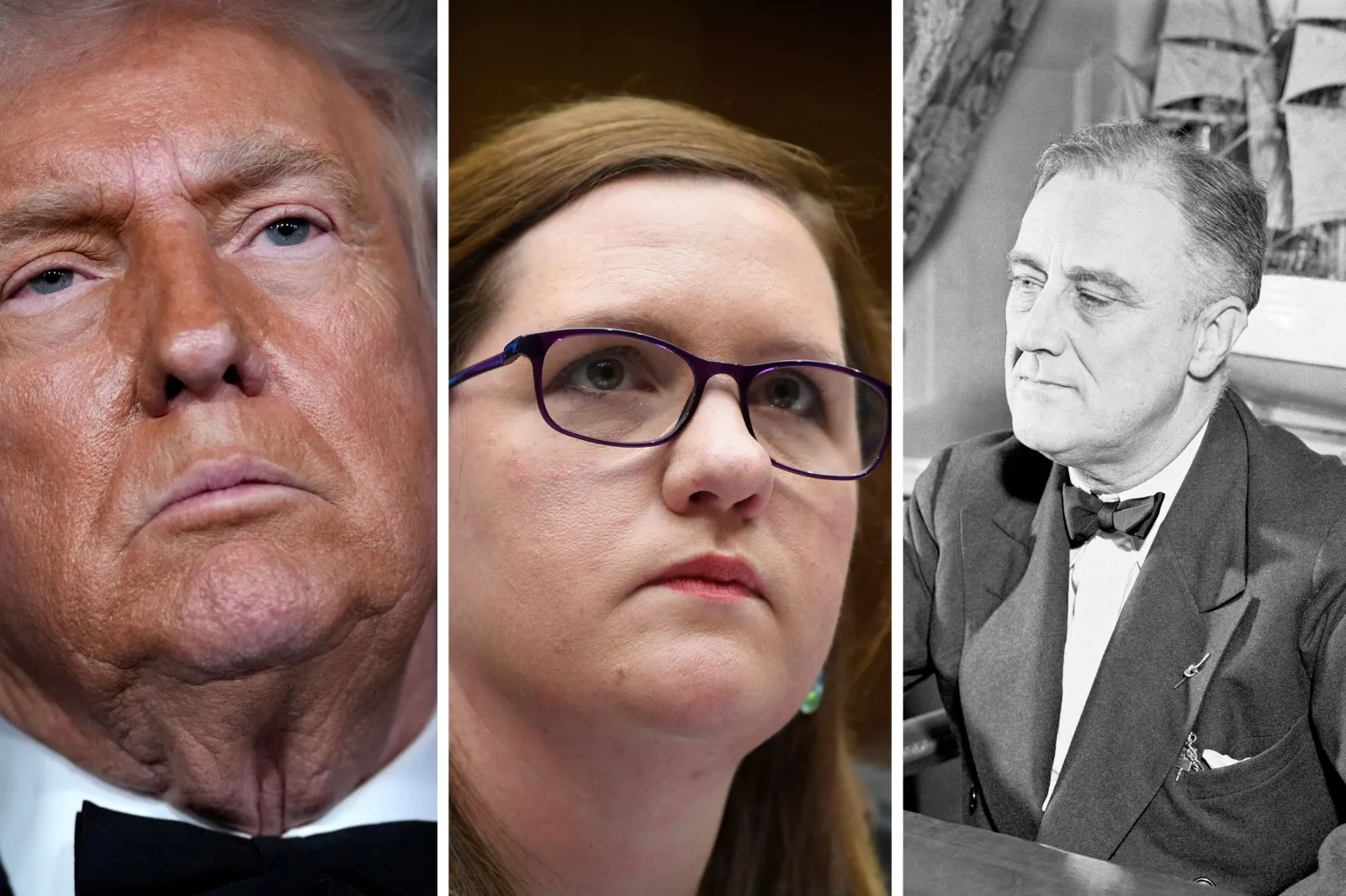
Trump v. Slaughter arose from Trump’s removal of Rebecca Kelly Slaughter, a Democratic FTC commissioner, earlier this year.
She was dismissed without the “inefficiency, neglect of duty, or malfeasance in office” finding required by statute.
Her challenge asks whether Congress may constitutionally shield FTC commissioners from at-will removal, as Humphrey’s Executor has long allowed.
Throughout 2025, the Court has repeatedly permitted Trump to remove officials at other independent agencies, including the NLRB and the Merit Systems Protection Board.
In Trump v. Wilcox, the Court stayed orders reinstating two removed members, concluding that “the Government is likely to show that both the NLRB and MSPB exercise considerable executive power” and that the president therefore “may remove without cause executive officers who exercise that power on his behalf.”
What Humphrey’s Executor Held
The Court’s 1935 decision involved President Franklin Roosevelt’s attempt to remove FTC commissioner William E. Humphrey, who resisted New Deal policies.
The Court held that Congress could restrict the president’s removal authority when dealing with an agency “charged with duties neither political nor executive, but predominantly quasi-judicial and quasi-legislative,” and that the FTC was meant to operate “free from executive control.”
By distinguishing such officers from purely executive officials—who remain removable at will—the ruling became a constitutional foundation for modern independent agencies.
A Long-Running Conservative Target
The Justice Department now argues that Humphrey’s Executor should be overruled, asserting that Article II grants the president “conclusive and preclusive” removal authority.
Solicitor General D. John Sauer wrote that the 1935 ruling “was always egregiously wrong.”
The position aligns with the Court’s recent trajectory.
In Seila Law (2020), the Court emphasized that “the president’s removal power is the rule, not the exception,” allowing only narrow limitations.
Trump’s brief in the present case builds on that framework, arguing that multimember agencies such as the FTC exercise “considerable executive power” through rulemaking, enforcement, and adjudication.
The Opposition’s Argument
Slaughter’s lawyers rely on constitutional history and the doctrine established in 1935.
Their opposition brief states that “Humphrey’s Executor controls this case,” arguing that the FTC’s removal protections remain valid because its functions still include quasi-legislative and quasi-judicial responsibilities.
The brief also notes that the Court has repeatedly described the 1935 decision as good law.
Justice Elena Kagan, writing earlier this year, stressed that past limits on removal restrictions do not extend to multimember boards with structures like the FTC’s.
A Second Question: Can Courts Reinstate Officials?
A separate issue concerns judicial remedies.
Petitioners argue that courts lack authority to order reinstatement of a removed officer, saying such orders intrude on Article II.
Justice Neil Gorsuch wrote earlier this year that wrongfully removed officials may be entitled to back pay but “not reinstatement.”
The question also bears on the separate removal of Federal Reserve Governor Lisa Cook.
The Court has signaled that the Federal Reserve’s structure may warrant different treatment because of its unique historical position.
How Important Is Humphrey’s Executor Now?
Scholars are divided over the precedent’s continued relevance.
Nicholas Barrow argues that Humphrey’s Executor originally permitted tenure protections only for officers whose “duties are neither political nor executive” and that its extension to today’s broad regulatory commissions is “ironic,” because it now insulates officials who wield core executive power.
Daniel Crane similarly concludes that the case’s factual premises have eroded, arguing the FTC is no longer a nonpartisan, uniquely expert body but “essentially a law enforcement agency beholden to the will of Congress.”
By contrast, Aditya Bamzai and Peter Shane argue that Humphrey’s Executor remains a foundational constraint on executive power.
Bamzai emphasizes early constitutional practice favoring presidential control, while Shane stresses Congress’s authority to design agencies and cautions—invoking Justice Story—that removing such limits risks turning administrators into “mere tools and creatures of the president.”
A Potential Turning Point
If the Court overturns Humphrey’s Executor, presidents could gain near-total discretion over independent-agency leadership, reshaping regulatory policy across the federal government.
Supporters say such authority is constitutionally required; opponents warn it would erode the separation of powers that has guided federal governance for generations.
What People Are Saying
John Yoo, UC Berkeley law professor said: “The future of the independence of the administrative state is at issue.”
Brian Fitzpatrick, Vanderbilt law professor said: “It’s very likely the Supreme Court is going to say that…he has to have control of the people helping him execute those laws.”
Slaughter’s attorneys, in a response brief (via National Constitution Center) said: “The case asks ‘has this Court gotten it wrong for the last 90 years?'”
What Happens Next
The Court’s upcoming ruling in Trump v. Slaughter will decide whether presidents can dismiss independent-agency leaders at will and whether judges can reinstate them, a judgment that could restructure major regulators and alter the balance of power in Washington.