“Death has come for me three times. I have evaded it, but it will find me, as it does everyone.”
Levante head coach Julian Calero is in a philosophical mood at the club’s training ground in the Spanish city of Valencia. There is good reason for that. The 55-year-old is surely a football manager without equal, given his past.
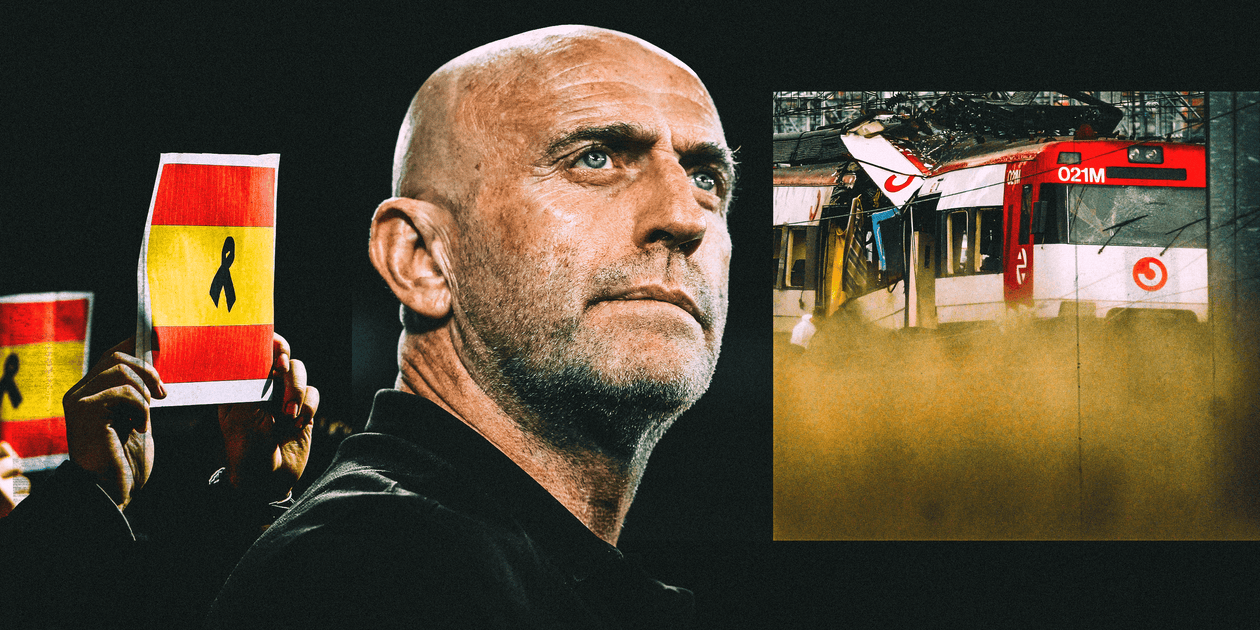
Calero was among the first police officers on the scene when 193 people were murdered in the Madrid terrorist attacks of March 2004. He was in Valencia last year when Spain’s worst natural disaster of this generation hit the area, with flash floods killing 232. He saw first-hand the devastation that is still being felt.
All of this after a childhood in Parla, a town to the south of Madrid where drugs were rife and two of his friends died of overdoses.
This is the extraordinary story of Calero’s life, and a remarkable football career that has taken him from working in law enforcement to La Liga and a World Cup.
In his youth, Calero juggled a modest playing career in Spain’s third division with his law studies, before becoming a police officer.
He hung up his boots at 29 and removed football from the centre of his life, acting as if it was no longer for him. But that wasn’t the case. When his first club, AD Parla, then in the fourth tier, asked him to coach their youth teams, he eagerly signed up.
In 2004, at the age of 33, he was still coaching at Parla, while also working as a police officer, when, one spring morning, he witnessed unimaginable horror.
On March 11, Spain woke up to news of a terrorist attack on Madrid’s train network. Between 7.36am and 7.40am, during a Thursday rush hour, 10 explosive devices detonated at four locations across the Spanish capital. The epicentre was Atocha station, the most important in the city.
Calero had arrived at Atocha at about 6am, as he did every day on his way to work.
“I was getting coffee with a (police) colleague when I heard the radio alarm,” he tells The Athletic. “They said there had been an explosion at Atocha and all patrols were heading there.
“We were 800 metres (half a mile) away. My colleague and I were the first to arrive. No other police, no fire brigade, no one, nothing. As we approached, we could already see the black smoke. When we got there, we saw people coming out. We suspected it was a terrorist attack.
“The people coming out were the living dead. They were in shock, traumatised, their jeans torn to shreds. They couldn’t hear, they couldn’t think, they were like zombies.
“We went in and went down a small escalator that was still working. We asked someone, ‘What happened?’ and they weren’t even able to answer. We went down to the first mezzanine level, from where you can see the platforms. We saw the hole in the train. We could already see many dead people.”
About 15m (50ft) away, under a bench, Calero and his colleague spotted a rucksack. He remembered being taught at the police academy that terrorists often leave a second device, rigged to explode at the time emergency services would be arriving.
“We warned the bomb-disposal experts that there could be another bomb. We went down to the platform and there we saw the most horrific sight imaginable, with arms and flesh scattered everywhere,” Calero says.
“It was like a horror film, but a badly-made one, with the smell of burnt rubber and burnt flesh. Four minutes later, the medics arrived. I grabbed a paramedic and took the defibrillator from him. We went from carriage to carriage, person to person, and decided who had a chance of living.
“There were people in agony, asking for help, and when you tried to help them, their arm would fall off. It was barbaric. People were dying in our arms.
“We were there for about five hours, trying to help as many people as we could. We saved many people, but many, many others died in a very short time. It was a huge shock, one that changes your life and your perspective on it.”
Atocha train station in Madrid, on March 11, 2004 (Ricardo Cases/AFP via Getty Images)
Incredibly, that weekend, Calero went with his youth team to play a match in Getafe, another town south of Madrid. After they scored their first goal in what finished as a 3-3 draw, all his players ran straight over to hug him. Although he hadn’t told them anything about his experience a few days earlier, they all knew. “That group of lads will stay in my memory forever,” Calero says now.
That day at Atocha was the second time in his life he came face to face with death. The first was during his adolescence in the 1980s, when drugs were descending on Madrid and surrounding towns. The decade saw a sharp rise in heroin use in particular.
“Many friends and acquaintances died,” Calero says. “My mother played an incredible role, because she saved my life without even knowing it. She made me break off some friendships.
“One day, she saw me coming home from school, crossing the football field with two friends. When I got home, she said, ‘That’s the last time I’ll see you with those two’. I was a child, and I said, ‘But why, Mum? They’re really nice lads’. She insisted. She threatened to make me give up football, so I distanced myself.
“Those boys both died four or five years later, from drug overdoses. I am convinced that, if not for my mother, I would have too.”
The third time was last year.
Calero was appointed Levante manager in June 2024 — his biggest job in football to date and the high point so far of a fascinating sporting career we will soon explain in more detail.
Four months later, tragedy struck again.
On October 29, torrential rains hit the Valencia region. Flash flooding left thousands of families homeless and killed 232 people in the area. The town where Calero lives, Chiva, was one of the worst affected. About a year’s worth of rain fell in eight hours. The nearby river burst its banks, entire houses were swept away, a bridge was destroyed.
Calero had crossed that same bridge earlier in the day.
“The road where the river overflowed is the one I drive to work,” he says. “Because we were going to Pontevedra (in the northern province of Galicia) to play in the Copa del Rey the next day, we had to leave early and take a plane.
“I passed, an hour and a half earlier, through the place where many people later died. The river washed away the bridge, and I believe that leaving early was fate for me. When we passed by the next day, there were hundreds of overturned cars at the exact spot.
“I don’t know if death was looking for me again, but I managed to dodge it.”
That cup match against Pontevedra was eventually postponed once the extent of the disaster became clear. When Calero got home, his experience as a police officer came into play as he helped the recovery efforts, distributing food and medicine in villages buried by mud.

The scene in Chiva after the deadly floods (Jose Jordan/AFP via Getty Images)
Levante’s next home match, on November 16, was a hugely emotional occasion. “Returning to competition after the storm was very difficult, and we had a dip in the league table because we had been in shock for so long,” Calero says.
They were second in the second division at the time of that fixture but fell to seventh, before climbing the standings again. They eventually finished as champions, winning promotion back to La Liga. That, too, was hugely emotional.
When Calero arrived at Levante, the club had financial constraints and the place was in a state of depression. They had been in the second tier since relegation in 2022, ending five years in the top flight. Promotion play-offs heartbreak — losing 1-0 against Alaves on aggregate in the final, to a penalty in the last-minute of extra time — defined their 2022-23. In the following season, they finished eighth, five points outside those play-offs.
Enter Calero.

Calero celebrating Levante’s promotion to La Liga last season (Jose Miguel Fernandez/NurPhoto via Getty Images)
At Levante, the skills he’d picked up in 20 years of coaching have been put to brilliant use.
His career started in those early days at Parla, combining his football with police work — and he continued with the latter when “things started to get bigger” in 2005 with an assistant coaching role at Madrid’s Rayo Vallecano.
After Rayo, he went to Real Madrid.
Calero initially became part of the academy setup, before joining reserve-team manager Julen Lopetegui’s staff, where he served until 2009. Between then and 2014, Calero combined several head-coach positions at lower-league Spanish sides (including Parla) with assistant roles abroad: in Russia with Volga Nizhny Novgorod and in the United Arab Emirates with Al Jazira. Then, he and Lopetegui linked up again, the future Spain national-team and Madrid head coach offering a job under him at leading Portuguese side Porto, where they would be on the bench together for 18 Champions League matches.
In 2016, Calero decided to leave and once again work as a manager in his own right.
“Six months went by, and I couldn’t find a head-coaching job,” he says. “Then Fernando Hierro called me (he became close with the Real Madrid legend during his time coaching there). He was going to manage Oviedo (in the northern region of Asturias), and asked me if I would go with him as his assistant.
“It wasn’t what I had in mind, because I wanted to lead myself, but I accepted, and a month and a half later, Lopetegui was appointed Spain manager. I was left thinking, ‘I will miss the World Cup because I wanted to be a head coach’.”
Calero left Hierro’s staff at Oviedo in summer 2017 to take charge at Navalcarnero, to the south-west of Madrid and not far from Parla, in Spain’s third tier. They finished sixth in his first season — which guaranteed a place in the following year’s Copa del Rey.
But something much bigger was in store.

Calero, second left, was parachuted into Spain’s coaching team at the 2018 World Cup just days before the tournament began (Chris Brunskill/Fantasista/Getty Images)
Three days before the 2018 World Cup began, the Spanish football federation’s then president Luis Rubiales sacked Lopetegui for agreeing to rejoin Madrid as first-team head coach once Spain’s involvement in the tournament in Russia was over.
Calero watched the press conference announcing Lopetegui’s exit in the police station where he was working at that time.
“Everyone was in shock,” he says. “‘What was he (Rubiales) going to do now?’ I thought that Fernando Hierro (by then sporting director at the Spanish federation) would be the logical choice. Then I got a call an hour and a half later. It was Fernando.”
Calero raised his voice in the office, pointing to the phone to show his colleagues who it was before answering, saying in jest: “Guys, I’m going to the World Cup!”
He insists now: “I can swear on my life, I said it as a joke. When I hung up, I looked at them and said, ‘I’m really going!’
“I asked for permission (for time off work), got my holidays, and I left for Russia. My police colleagues took the photo for my visa with their mobile phones.
“I got to a World Cup that I didn’t deserve and that I never would have dreamed of, because I was not that profile of coach. I hit the jackpot, because Fernando wanted me.”
All this time, Calero had been taking breaks away from his police job when he needed to. After that World Cup, he decided to take indefinite leave (so in theory, he could return and serve in the police again in the future).
His next coaching position was at another third-division side near Madrid, Rayo Majadahonda, for 2019-20. After missing out on the play-offs, he was sacked and moved to Burgos, north of the capital and also in that regionalised tier of domestic football.
Burgos went up as champions in his first season and Calero followed that with two mid-table finishes before deciding early in the 2023-24 season to join Cartagena, on the southern coast, in the same division. After guiding them to the safety of a 14th-place finish, he left for Levante — and won another debut-campaign promotion in May.
Calero’s side are spending this international break second-bottom of La Liga with nine points after 12 games, having lost seven times and won just twice. Staying up is their target for this season. Yet when champions Barcelona visited in August, they were given a real run for their money. Levante were two up at half-time before Hansi Flick’s side rallied to win 3-2, via a stoppage-time own goal.
Everyone who knows Calero describes him as an optimistic person — an attitude to life he has maintained despite having seen the worst things imaginable.
Where does he see himself at the end of this season?
“I see Levante staying up,” he says with conviction. “It’s not that I just think it will happen, I’m sure of it.
“As for me, I don’t bother. What’s the point? Sometimes I wonder, ‘Where will I be this time next year?’, but I never get it right.”