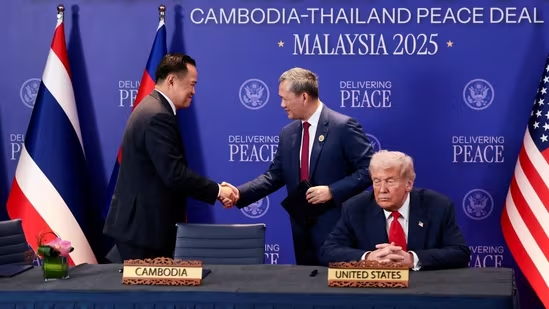
A new round of border clashes between Thailand and Cambodia and resurgent fighting in eastern Congo, two conflicts President Trump claimed to have resolved, have shown the constraints of his high-speed pursuit of peace.

Since the start of his second term, Trump has leveraged the economic and military might of the U.S. to get warring parties in several deep-rooted international conflicts to the negotiating table and extract hasty peace deals.
In June, the foreign ministers of the Democratic Republic of Congo and Rwanda signed an agreement meant to end a three-decade-long conflict, a deal Trump administration officials said would open the Congo’s mineral-rich east to potentially billions of dollars in U.S. investment.
Weeks later, Trump threatened to suspend talks on lowering high “reciprocal” tariffs for Thailand and Cambodia if the two nations continued fighting over their disputed border. The countries’ leaders, who faced 36% tariffs on all exports to the U.S., agreed to a cease-fire days later and signed a more detailed accord at a ceremony with Trump in October.
Analysts have hailed the high-level attention on conflicts that haven’t always been central to U.S. interests, but they also warn that the deals largely failed to resolve key issues driving the violence and lacked clear timelines or oversight mechanisms to ensure their implementation. Failed peace agreements risk further undermining trust between longtime adversaries and hurt the chances of a lasting end to hostilities, they said.
The White House didn’t respond to a request for comment.
Events this week suggest the caution had some merit.
On Monday, Thailand’s military launched airstrikes on targets across its border with Cambodia, saying it was responding to earlier fire from its neighbor. Last month, the Thai government suspended negotiations about the next steps in the cease-fire plan, including the release of 18 Cambodian prisoners of war, after two of its soldiers stepped on a land mine. Thai officials said the mine had recently been laid by Cambodia, which the government in Phnom Penh denies.
The dispute over the exact demarcation of the two countries’ border has its origins in a 1909 map drawn up by Cambodia’s then colonial power France that was later disputed by Thailand.
Trump said Wednesday that he would work to stop the latest fighting. By Wednesday, officials from both countries said at least 11 people had been killed in this round of clashes and scores injured. More than 500,000 people have fled their homes.
In eastern Congo, meanwhile, fighters from the M23 rebel group, which the U.S., other Western governments and the United Nations say is supported by Rwanda, stepped up an offensive to take control of even more territory. On Wednesday the group said it took the strategic town of Uvira, near the border with Burundi. At least 74 people have been killed and 200,000 displaced in recent days, the U.N. said, deepening what is already one of the world’s largest humanitarian crises.
The offensive came just days after the presidents of Congo and Rwanda—Félix Tshisekedi and Paul Kagame—met with Trump in Washington, D.C., to reaffirm their June peace deal and sign a range of economic agreements targeted mostly at Congo’s mineral wealth.
“Despite our good faith and the agreement recently endorsed, it is clear that Rwanda is already violating its commitments,” Tshisekedi said in televised remarks on Monday.
Tshisekedi said Rwandan troops continue to fight alongside M23, which says it is protecting the rights of ethnic Tutsis living in Congo. Rwandan officials, who have denied supporting M23, accused the Congolese military of violating the peace deal and drawing soldiers from neighboring Burundi into the conflict.
The war in eastern Congo dates back to the Rwandan genocide in 1994 and generations of diplomats have tried and failed to secure lasting peace. M23 wasn’t a party to the June peace deal or last week’s agreement, but both Rwanda and Congo had pledged to cease support for armed groups operating in the region.
The U.S., along with eight European governments, on Tuesday called on M23 and the Rwandan military to “immediately halt offensive operations” in eastern Congo. There was no immediate reaction to the escalating violence from the White House.
Trump told reporters he was due to speak to the Thai and Cambodian prime ministers on Thursday. “I found they were two great leaders, two great people, and I’ve settled it once,” Trump said. “I think I can get them to stop fighting.”
But there are signs that doing so might be more complicated this time.
Thai Prime Minister Anutin Charnvirakul has rejected negotiations with the government in Phnom Penh, and military commanders have said they want to weaken the Cambodian military to the point where it will no longer pose a threat. “From now on, Cambodia must comply with Thailand’s conditions if they want the fighting to stop,” he said on Monday.
Suos Yara, an adviser to Cambodian Prime Minister Hun Manet, said that the cease-fire agreement should be supported by international peacekeepers from the U.N. or the Association of Southeast Asian Nations. “At this moment we really need that,” he said in an interview Wednesday.
There also have been setbacks with Trump’s most prominent foreign-policy success—the cease-fire in Israel’s war against Hamas. The October truce halted intensive fighting in Gaza and led to the release of all living Israeli hostages. But violence has flared up since, with each side accusing the other of violating the agreement. Since the start of the truce, Israel has killed 379 Gazans, according to Palestinian health authorities, who don’t say how many were combatants, while Palestinian militants have killed three Israeli soldiers. A planned transition to a more permanent second phase of the peace agreement has stalled amid disagreements, including Hamas’s resistance to disarming.
These stumbles show that efforts to achieve lasting peace can’t be rushed and require more than political breakthroughs, says Kevin Chen, an associate research fellow at Singapore’s S. Rajaratnam School of International Studies.
“President Trump’s embrace of peace diplomacy risks applying Band-Aids to much deeper geopolitical wounds and calling it a day,” Chen said. “The results, especially if small countries find themselves presented with unacceptable terms, could have serious consequences for regional stability.”
Write to Gabriele Steinhauser at Gabriele.Steinhauser@wsj.com and Nicholas Bariyo at nicholas.bariyo@wsj.com