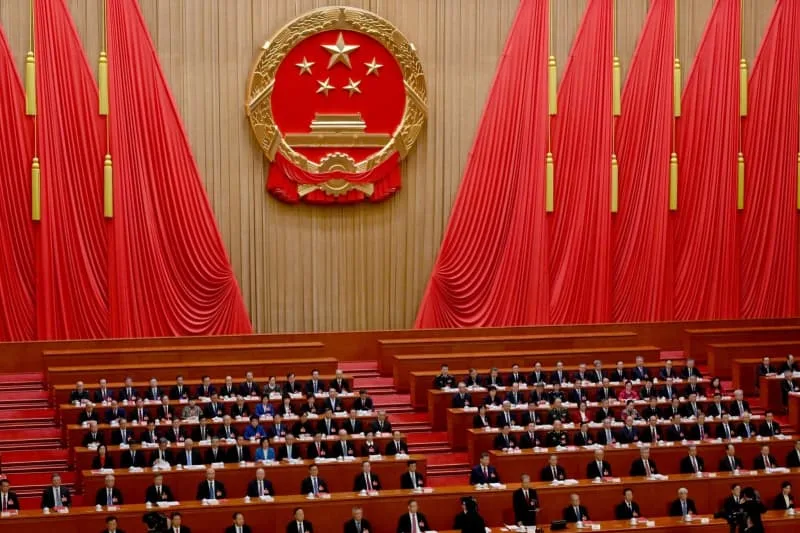
China’s National People’s Congress on Thursday approved a new five-year plan for 2026-2030, which will see Beijing accelerate the development of key technologies including semiconductors and artificial intelligence (AI).
Adopted at the closing session of the annual meeting, the plan prioritizes sectors such as robotics and biotechnology as part of China’s push to strengthen its technological capabilities.
Five-year plans are considered the Chinese government’s most important economic policy programmes and specify which industries are to receive particular support as well as the country’s goals for the coming period.
Under the plan, spending on research and development will continue to expand by more than 7% annually. China also aims to increase the digital economy’s share of economic output to 12.5% by 2030, up from its recent 10.5%.
The document highlights several longer-term strategic technologies, including nuclear fusion, quantum technologies, space travel and so-called brain-computer interfaces – which are intended to enable signals from the brain to be transmitted directly to machines or computers.
It also contains targets to boost consumption and improve quality of life in an attempt to respond to structural problems such as an ageing population and weaker domestic demand.
Beijing has been trying for years to reduce its dependence on foreign technology, not least amid export restrictions imposed by the United States. Competition between China and the US is growing in areas such as AI and semiconductors.
Observers see the programme primarily as a continuation of previous industrial policy, though some economists warn that strong government support could lead to new overcapacity which may intensify competition on global markets and fuel trade conflicts.
The National People’s Congress is China’s parliament and meets once a year in Beijing. The nearly 2,800 delegates are not freely elected and political decisions are usually considered to have been agreed upon in advance within the Communist Party.
Ethnic unity law approved
Delegates also voted on government work reports and laws on the final day of the session.
These included the “Law on the Promotion of Ethnic Unity and Progress,” which was approved with just three votes against and three abstentions.
The law mandates the use of Mandarin (standard Chinese) in schools and states that parents should teach their children to appreciate the Communist Party.
Other passages call for the promotion of changes in customs and state that marriage may no longer be prevented on the basis of religious beliefs.
Human rights activists fear the legislation could lead to further restrictions on China’s ethnic minorities. Deputy Asia director at Human Rights Watch, Maya Wang, said the law creates a legal framework to justify oppression and force assimilation.
Critics have also pointed to provisions stating that organizations and people outside China who take actions that “undermine national unity” or cause “ethnic division” are to be prosecuted.
China recognizes a total of 56 ethnic groups. Around 90% of the country’s approximately 1.4 billion inhabitants are Han Chinese, while minorities include Mongols, Tibetans and the Muslim Uyghurs, many of whom live in China’s largest but relatively sparsely populated border provinces such as Tibet, Xinjiang and Inner Mongolia.
Many minority groups have their own languages and writing systems. Especially in Xinjiang and Tibet, organizations have been accusing Beijing of human rights violations for years.

Deputies sit in the plenary hall of the Great Hall of the People during the closing ceremony of the National People’s Congress. Johannes Neudecker/dpa

Chinese President and National People’s party leader Xi Jinping (L) sits next to Premier Li Qiang during a session of the National People’s Congress. Johannes Neudecker/dpa