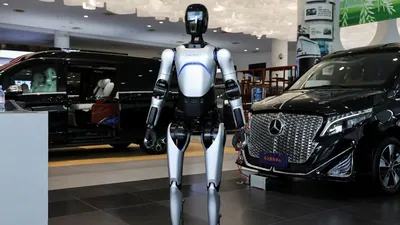
The Spring Festival Gala is a showcase both of China’s cultural riches and its technological might. The four-hour state television programme, staged in Beijing on the eve of each Lunar New Year, often features goose-stepping phalanxes of singing soldiers. On February 16th the centrepiece was a troupe of sword-brandishing humanoid robots performing an elaborate martial-arts routine. It was one of four humanoid-embellished acts that wowed viewers around the world.

China’s humanoid robotics industry is bustling. More than 14,500 automatons were delivered last year worldwide, up from around 3,000 in 2024, according to company reports and estimates from Omdia, a research firm. Nearly all came from China (see chart). The country’s two leading humanoid-makers, Agibot and Unitree, accounted for more than 10,000 of the total; Elon Musk’s Tesla, which produces the Optimus bot, shipped just 150. What is more, China is also home to the world’s deepest supply chain for humanoids, which is churning out components.
This worries some in the West who believe that humanoids will eventually become one of the largest industries in the world. Morgan Stanley, an investment bank, reckons that 1bn could be wandering about by 2050, with annual spending exceeding $7.5trn. For now, however, the path from back-flipping bots to a viable business is unclear. Like those at the gala, the vast majority of humanoids being purchased are purely for show. Few do any real work.
China’s state will probably remain the biggest source of demand for some time. Without local governments buying the bots, it would be difficult to keep the more than 100 Chinese humanoid-makers alive—along with the thousands of suppliers that increasingly rely on them. It is not the first time China has lavished money on a new technology before there is much of a market for it. But doing so in the case of humanoids could prove a costly waste.
Behind China’s dancing robots is a rapidly expanding supply chain. Consider the Wujin district in the city of Changzhou. Its businessmen brag that around 90% of the parts needed to assemble a humanoid can be sourced there. Several known suppliers for Tesla’s Optimus hail from the district. RealMan, one of China’s largest makers of robot arms, quadrupled its production capacity in February when it opened a new factory in the area. At the sprawling facility a manager notes how the supply of land has tightened in the past year owing to new robotics plants opening up.
Wujin is just one node in a vast supply cluster for humanoid robots that stretches from Shanghai on the coast inwards to the lower parts of Jiangsu province (including Changzhou) and the upper parts of Zheijang province (including its capital Hangzhou). The region, known as the Yangtze River Delta, is home to Agibot, Unitree and many other humanoid-makers. Of the top 30 listed Chinese suppliers of parts used in robots, three-quarters by market capitalisation are also based in the area (see map). The cluster is home as well to artificial-intelligence labs such as DeepSeek, which is located in Hangzhou. Also based in that city is Alibaba, a tech giant which this month released RynnBrain, an advanced AI model for powering robots.
The region’s success reflects its role as an electric-vehicle (EV) hub, accounting for two-fifths of China’s production. High-torque motors, power inverters, lithium batteries, lidar sensors and many other components are used in both EVs and humanoids, though their size often differs. In the past few years many suppliers to the EV industry, which is awash in overcapacity, have shifted at least in part to serving robot-makers. The region’s suppliers have also been investing in technologies previously dominated by foreign firms. Fine Motion Technology, a maker of gearboxes, raised its share of the Chinese market for the rotating-vector reducers used in robots from a tenth in 2021 to a quarter in 2024, squeezing overseas competitors such as Japan’s Nippon Gear.
Show your metal
Visit the Yangtze River Delta and you will not have to look particularly hard to find a robot. One stands at a kiosk in downtown Hangzhou, serving coffee and other beverages. Botshare, a humanoid-rental service launched in Shanghai in December, supplies automatons to retailers who station them at their entrances to wave at guests as they enter. An Agibot costs more than 100,000 yuan ($14,500) but can be rented for as little as 2,200 yuan.
The trouble is that, to become more than novel entertainment, robots need to be regularly deployed in settings where they do the same jobs as humans, allowing them to gather data on which they can be trained. That is why finding situations where robots can perform real work is so important for the industry, notes Alicia Veneziani of Sharpa, a Singaporean maker of robot hands that manufactures in Shanghai. A tiny fraction of the humanoids sold today end up in factories, where they often carry boxes—and are about 30-40% as efficient as a human at doing so.
China’s state is eager to help. Local governments have been setting up centres that allow companies to put their robots to work on various tasks and collect data. Some is then pooled and shared. Shanghai has set up one such centre that can accommodate 100 humanoids. The state’s role is so pivotal that venture investors are picking robotics companies based not just on their technological capabilities but also on the local-government resources available to them, says one investor in Hangzhou.
The state has also thrown money at the industry. Robotics has become a priority for local officials across the country, who hope to get a share of the industry within their tax jurisdiction. But the government’s most important role by far is as a buyer. It was the biggest purchaser of humanoids last year, according to industry insiders, and will probably remain so this year and next. Most are being used as frivolous showpieces. Agibots have lately become a staple of government parties in Shanghai.
China’s strategy carries risks. Accompanying the robotics buzz is a sense among executives and investors that the industry is starting to get ahead of itself. Wang Zhongyuan of the Beijing Academy of Artificial Intelligence, a state-backed research lab, said in a speech last year that if mass production is not underpinned by real-world demand, public enthusiasm will be short-lived. If robots become widespread before they become useful, he explained, the humanoid bubble will burst.

