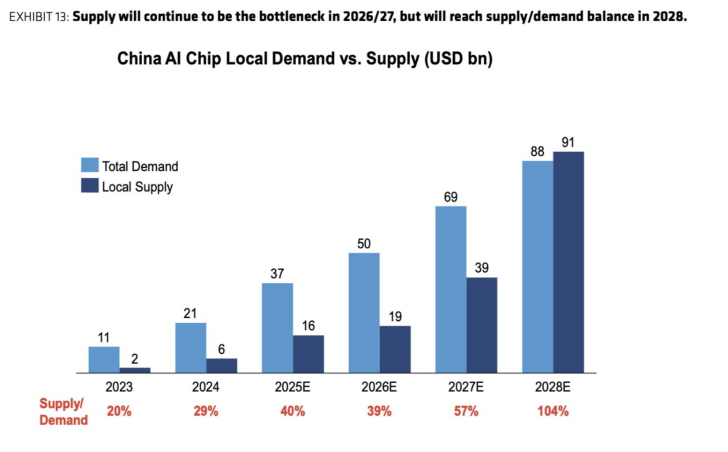
China’s AI industry is evolving at a rapid pace, to the point where domestic chip manufacturers are expected to outproduce regional demand, and NVIDIA CEO has warned about the ‘Chinese AI diffusion’ in place.
Chinese AI Firms Are Now Looking to Expand Their Presence, Causing a Huge Concern for American Technology
Ever since China has moved towards focusing on the adoption of domestic AI solutions, the region has seen a massive rise in chip production, since companies like Huawei, Cambricon, Biren, and many others are coming up with AI chips, with the ‘promise’ of replacing NVIDIA’s tech stack entirely. Based on an analysis by Bernstein (via Jukan), it is estimated that China’s AI chip supply is expected to rise significantly over the years, potentially surpassing domestic demand by 2028. This indicates that the nation has plans to move its tech stack towards the global market. NVIDIA’s CEO Jensen Huang has labeled this move as the AI ‘Belt & Road’ Initiative.

Out of all the Chinese AI firms competing, it is expected that Huawei will capture a whopping 50% share by 2026, significantly shrinking NVIDIA’s lead in the region. One of the main bottlenecks faced by firms like Huawei is the lack of semiconductor production capabilities. However, it appears that the firm plans to address this issue soon, through its own fab buildout, which will be facilitated by collaboration with local governments, as well as companies like SMIC. Similarly, Huawei also faces an HBM capacity problem, but based on Bernstein’s estimates, it is expected that all supply constraints will be addressed.
While talking at the Center for Strategic and International Studies in Washington, NVIDIA’s Jensen Huang was asked about the advancements of Chinese competitors like Huawei, to which he warned that, similar to what Huawei did with the 5G technology, the firm has an “AI Belt and Road” plan in place, which is a matter of enormous concern for the US. Here’s what he had to say:
We shouldn’t concede the entire [Chinese] market to them [Huawei]… we ought to go compete for it.
They’ll definitely diffuse the Chinese technology as quickly as possible, because they understand that the sooner you get there, the sooner you build the ecosystem on top, the sooner you become an essential part of that ecosystem.
There’s no doubt that NVIDIA’s lack of access to the Chinese AI market has bolstered the breakthroughs made by firms like Huawei in the realm of AI computing capabilities. Huawei has an entire roadmap in place, and the firm recently showcased an AI cluster that is capable of competing with NVIDIA’s Vera Rubin systems. For the US, its AI lead in the compute sector is defintely shrinking, but for now, it’s a matter of political tensions, and how both the US and China navigate their way.
Follow Wccftech on Google to get more of our news coverage in your feeds.