Toplines
The PRC is using the US capture of former Venezuelan President Nicolas Maduro to portray the United States as a hypocritical rogue actor and elevate its own global image. PRC Ministry of Foreign Affairs (MFA) spokesperson Lin Jian condemned the US operation and called it a violation of international law on January 5.[1] PRC MFA spokesperson Mao Ning echoed this sentiment on January 6, saying that the PRC would work with regional countries to promote peace.[2] The PRC and Russia called for the United States to release Maduro and cease military action at the UN Security Council on January 5.[3]
The PRC messaging about Venezuela is part of its ongoing effort to portray itself as a leader of the “Global South” while denigrating US foreign policy. The PRC made similar statements following US strikes on Iran in June 2025. ISW-CDOT assessed at the time that the PRC prioritized protecting its energy security and reputation over supporting Iran materially. The MFA statements suggest that the PRC perceives its relationship with Venezuela in a similar light.[4] The PRC is unlikely to take meaningful action against the United States in support of Maduro, even though the PRC has been one of Venezuela’s most important partners.
The PRC will likely prioritize protecting its key interests, including economic concerns and energy security, in Venezuela. The PRC may also try to de-risk its relationship with Venezuela while supporting Caracas rhetorically. The PRC response to the fall of the Bashar al Assad regime in Syria in December 2024 followed a similar trend where the PRC engaged cautiously with the al Shara regime to protect its key interest— the Syrian state crackdown against Uyghur militants. Venezuela has historically served as a key oil exporter for the PRC. Reuters reported that the PRC is the top importer of Venezuelan oil, receiving approximately 746,000 barrels per day in November 2025. The PRC will likely push to maintain this oil trade.[5] The PRC will likely seek to balance engagement in Venezuela with its other Latin America ties. MFA spokesperson Lin Jian said on January 5 that the PRC remained willing to cooperate with Venezuela when asked whether the PRC would continue to import Venezuelan oil.[6] US President Donald Trump emphasized that “other countries that want oil” from Venezuela would continue to receive it following the US capture of Maduro on January 3, although Trump did not specify how such trade would take place.[7] ABC reported on January 6 that the Trump administration asked Venezuela’s interim president, Dulcy Rodriguez, to cut economic ties with the PRC, Russia, Iran, and Cuba and partner exclusively with the United States in oil production, however.[8]
The PRC may attempt to distance itself from Venezuela economically if it perceives that the US military action will create a significant risk to Beijing’s relationship with Caracas, however. Bloomberg reported on January 5 that the PRC requested that its banks monitor credit risk associated with Venezuela and report their “lending exposure” to Venezuela.[9] The PRC previously engaged in a loans-for-oil deal with Venezuela, which reportedly still owes Beijing approximately 10 billion US dollars in oil.[10]
The PRC may take operational lessons from the US capture of Maduro in its war planning for Taiwan. The PRC has likely already considered and planned similar operations against Taiwan, however, so lessons from Venezuela will not significantly alter its overall strategy. The PRC has openly discussed and simulated strikes against Taiwanese leadership and has likely considered options similar to the US capture of Maduro.[11] PRC officials repeatedly claimed that recent PLA blockade exercises around Taiwan, including the Justice Mission 2025 exercise from December 29-30, are only targeted at an “extremely small number” of Taiwanese “separatists.”[12] PRC state media said that one of the goals of the exercises was to block the escape routes of “separatist” leaders.[13] PLA official newspaper PLA Daily and other PRC state media listed practicing “leadership decapitation” as one of four key goals of the exercise.[14] Beijing has also set informational conditions similar to how the United States justified its capture of Maduro. The PRC does not recognize the legitimacy of the Taiwanese government and regards Lai and his Democratic Progressive Party (DPP) to be separatist criminals under PRC law. It has intensified efforts to intimidate and prosecute Taiwanese “separatists,” including criminal proceedings in absentia against sitting Taiwanese legislator Puma Shen, that may be used as a model against Lai.
The PRC has also worked to develop and drill capabilities resembling those that enabled the US operation in Venezuela. These capabilities include blockading key ports, precision strikes on government and military targets, including destroying air defenses, cyberattacks to disable communications, and rapid troop insertions by helicopter. The PRC could use its Type 075 Landing Helicopter Docks (LHD) and similar vessels to launch helicopters from waters near Taiwan. The PRC has also worked to recruit spies and saboteurs inside the Taiwanese government and military; it could use them to support special operations against Taiwanese leaders, resembling how Venezuelan insiders supported the US operation against Maduro.[15] Such an operation would likely be much more challenging for the PRC than it was for the US military, however. It is unclear whether the PLA has special operations forces equivalent to the US Delta Force that would be capable of executing such an operation. The PLA also lacks actual combat experience and would face more robust defenses in Taiwan than what the United States faced in Venezuela.[16] Taiwanese Vice Minister of National Defense Hsu Szu-chien said on January 5 that Taiwan’s military was prepared for such a contingency.[17]
PRC military planning for Taiwan will very likely remain focused on blockade and invasion scenarios. A limited “decapitation” operation against Taiwanese leaders has a high chance of failure and is unlikely on its own to assure Taiwan’s surrender and integration into the PRC political system, unless backed by large-scale military force.
Taiwanese Vice Minister Hsu told lawmakers that the operation exposed the sophistication of US equipment compared to Venezuela’s Russian and PRC-made defense systems.[18] Much of Taiwan’s air defense equipment comes from US arms sales and military aid, and the US military is likely to be Taiwan’s chief foreign defender against a PRC attack. The failure of the PRC-made radars is not likely a strong indicator of how PLA equipment would perform in a Taiwan scenario, however. Hsu identified the lack of maintenance and support for Venezuelan systems to be core to their failure, however, rather than the inadequacy of the systems themselves.[19] A June 2025 report by the Miami Strategic Intelligence Institute said that Venezuela’s air defenses were in “critical condition,” with over 60 percent of the PRC-sourced radar fleet “out of commission” due to a lack of spare parts and minimal support from the suppliers.[20] Venezuela also used PRC-made JY-27A radar systems that it acquired around 20 years ago, which failed to detected the US incursion amid jamming and cyberattacks.[21] The PLA unveiled a much more sophisticated upgraded model called the JY-27V in May 2025, which is designed for tracking stealth aircraft.[22]
Taiwan’s Constitutional Court overruled legislation on December 19, 2025, that has prevented it from issuing rulings since 2024. The ruling restores one of the Lai administration’s few means of blocking opposition-passed legislation. The Legislative Yuan (LY), which is controlled by the opposition Kuomintang (KMT) and Taiwan People’s Party (TPP), amended the Constitutional Court Procedure Act (CCPA) in December 2024 to require at least ten judges to sit on the court to rule on issues of constitutionality out of fifteen total seats.[23] The law functionally “paralyzed” the court because it had only eight sitting justices at the time. The remaining seats have stayed vacant, as opposition legislators have blocked Lai’s nominations to fill the seats.[24] Five of the sitting eight justices overturned the CCPA amendment, arguing that it unconstitutionally prevented the court from doing its duty. Three of the justices abstained in compliance with the amendment and publicly criticized the ruling.[25]
KMT lawmakers filed a complaint on December 22 accusing the five Constitutional Court justices of rendering an “illegal ruling.”[26] KMT and TPP leaders expressed outraged at the court’s decision, but the opposition parties lack clear ways to block the court’s actions. The court has already begun issuing rulings on cases shelved by the amendment restrictions.[27]
The DPP has a minority in the LY and Taiwan lacks a presidential veto power, leaving the constitutional review process as the only institutional means to prevent the passage of opposition laws.[28]
Taiwan’s opposition-controlled legislature is pressuring members of the Lai administration to leave office amid impeachment proceedings against President Lai. The resumption of Constitutional Court rulings creates Taiwan’s second constitutional crisis in recent weeks and will likely deepen polarization and distrust in institutions in Taiwan. The LY passed two motions on January 2, one to censure Premier Cho Jung-tai and one to urge National Security Council (NSC) Secretary General Joseph Wu to resign.[29] Both motions are symbolic, as neither compels further legal action. The censure motion cited Cho’s alleged disregard for the constitution and listed “four primary failures” that prompted the censure.[30] The proposal also stated that Cho should be held accountable for the Cabinet’s overall performance.[31] The LY could hold a vote of no confidence to remove Cho but likely used these means instead because removing the premier in this way would allow President Lai to dissolve the LY and hold snap elections.[32] The LY previously passed motions to begin impeachment proceedings against President Lai and petition the Control Yuan to impeach Cho over Cho’s unprecedented refusal to sign two bills it had passed.[33]
The motion against Wu requested that he resign over one of his aides, Ho Jen-Chieh, leaking confidential information to the PRC while Wu was minister of foreign affairs.[34] It also cited Wu’s refusal to attend legislative committees.[35] The LY also blocked a motion that sought to condemn the Justice Mission 2025 military exercises around Taiwan after passing the motions against Cho and Wu, and the NSC responded in opposition to the action for sending the wrong signal to other countries.[36]
The Constitutional Court violating the amended CCPA quorum requirement to rule it unconstitutional and Cho refusing to sign bills both constitute constitutional crises that are likely to undermine faith in Taiwan’s institutions. Both the CCP and many domestic opponents of the DPP frequently accuse Lai of implementing authoritarianism to suppress political opposition in Taiwan. The constitutional crises, the opposition’s attempts to remove Lai and his Cabinet officials, the opposition’s paralysis of the court, and the mass legislative recall elections of 2025 are all symptoms of Taiwan’s political polarization and gridlock. The CCP can exploit this gridlock and general distrust in Taiwanese institutions to undermine the legitimacy of Taiwan’s government and present itself as a preferable alternative.
Key Takeaways
- PRC Anti-US Rhetoric: The PRC is using the capture of Venezuelan President Nicholas Maduro to portray the US negatively and present itself as a responsible actor and leader of the “Global South.”
- PRC-Venezuela Relations: The PRC may take efforts to de-risk its relationship with Venezuela economically, while continuing to support it rhetorically. The PRC will likely protect its economic and energy interests in Venezuela amid a possible regime change.
- PRC Lessons Learned from US Operation in Venezuela: The PRC may learn operational lessons from the US capture of Maduro to use in its war planning against Taiwan. It has very likely already considered the requirements for a “decapitation” strike against Taiwan, however, so this is unlikely to change the PRC’s strategy.
- Taiwanese Constitutional Crises: Taiwan is currently undergoing two constitutional crises following the Constitutional Court’s overturning of regulations paralyzing the Court from issuing rulings and opposition legislators pushing for the impeachment of Lai administration officials. Continued domestic political crises may lead to distrust in Taiwanese institutions and reduced government effectiveness.
Cross-Strait Relations
Taiwan
PRC state media circulated satellite images of Taipei that marked the locations of Taiwanese legislator Puma Shen’s home and office. The PRC uses threats of violence and imprisonment to intimidate Taiwanese political leaders into accepting its claims of sovereignty over Taiwan. PRC state-controlled social media channels circulated a post from PRC social media platform Weibo that contained the satellite images along with calls for Shen to be arrested for “separatism” on Facebook and YouTube on January 2.[37]
The PRC’s Taiwan Affairs Office (TAO) placed Shen on its list of “Taiwan Independence diehards” in 2024.[38] The list includes several other DPP politicians and government officials that the PRC has targeted with sanctions and threats of criminal prosecution for alleged “separatist crimes.”[39] Police in Chongqing, PRC announced an investigation into Shen in October 2025 for “separatist crimes,” including co-founding a “Taiwan independence separatist organization,” referring to the Taiwanese civil defense NGO Kuma Academy.[40] “Establishing a Taiwan independence separatist organization” is punishable by life imprisonment or execution under PRC guidelines released in June 2024.[41] PRC state news also aired a segment that called for a global manhunt to have Shen arrested and extradited to the PRC in November 2025.[42] Taiwan’s Ministry of Foreign Affairs (MFA) and Ministry of Digital Affairs (MDA) condemned the threatening PRC state media posts and requested that Meta and Google remove the images from Facebook and YouTube.[43] MDA stated that the posts had been removed in a press release on January 4.[44]
The state media accounts republished and amplified a post from an ostensibly independent blogger on Weibo, continuing a recent pattern of PRC propaganda targeting Taiwan by circulating and amplifying pro-annexation, anti-DPP, and anti-Taiwanese online content rather than creating this content through official propaganda channels.[45] PRC influence operations are also known to create and use fake accounts posing as independent internet users to promote PRC narratives about Taiwan.[46]
The posts represent an escalation in PRC efforts to intimidate Taiwanese political leaders, especially those associated with the DPP and the current Lai administration. The PRC seeks to silence Shen and other Taiwanese political leaders who have spoken out about the PRC’s coercive efforts against Taiwan by openly publishing a sitting Taiwanese legislator’s home address and implicitly threatening his safety. Three PRC diplomats in the Czech Republic reportedly planned (but did not carry out) a “demonstrative” car crash targeting then-Vice President-elect Hsiao Bi-khim during her visit in March 2024, likely intended to intimidate her and other Taiwanese leaders.[47]
The PRC TAO added Taiwanese Minister of the Interior Liu Shyh-fang and Minister of Education Cheng Ying-yao to its list of “diehard” Taiwan separatists on January 7.[48] The addition of more officials from President Lai’s administration signifies the PRC’s intensifying intimidation efforts to deter support for DPP policies and justify coercion in the name of “law enforcement.” TAO spokesperson Chen Binhua accused Liu and Cheng of implementing independence-minded policies in their respective ministries, such as obstructing cross-strait exchanges and promoting notions of Taiwan’s independence in its educational curriculum.[49]
The PRC created the list in 2021 and has expanded it in the years since to include more DPP officials and supporters.[50] The list now has fourteen names, including Taiwanese Vice President Hsiao Bi-khim, Cabinet officials, current and former legislators, and pro-independence billionaire Robert Tsao. The addition of Liu and Cheng to the list is part of a trend of PRC crackdowns on Taiwanese “separatism” following Lai Ching-te’s presidential election victory in January and inauguration in May 2024.
The TAO announcement on January 7 also designated Chen Shu-yi, a prosecutor in Taiwan’s High Prosecutors’ Office, as a “separatist accomplice.”[51] The PRC accused Chen of fabricating charges, making wrongful convictions, and persecuting people who support cross-strait cooperation. This is a label distinct from separatist “diehards” that the PRC uses for people it deems to be colluding with the DPP’s so-called independence policies. The PRC announced a reward notice in November 2025 for information about the “criminal activities” of two Taiwanese celebrities that it had labeled as separatist accomplices, using the same term.[52]
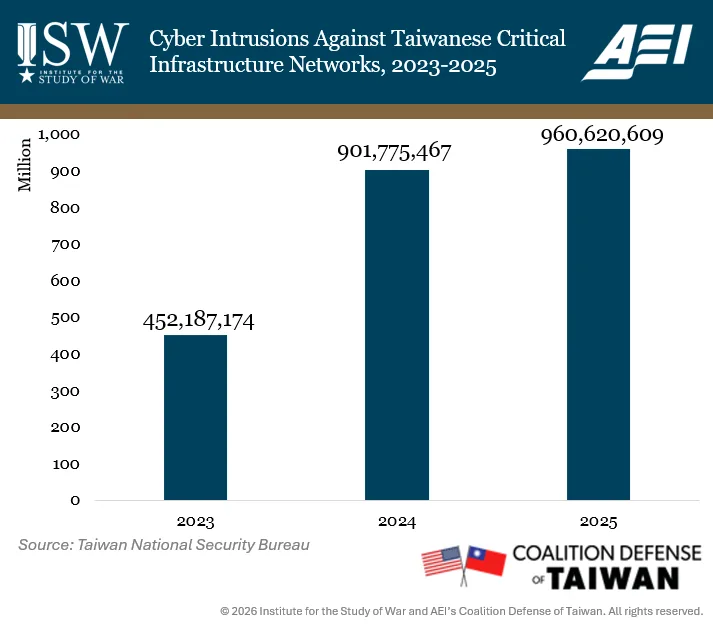
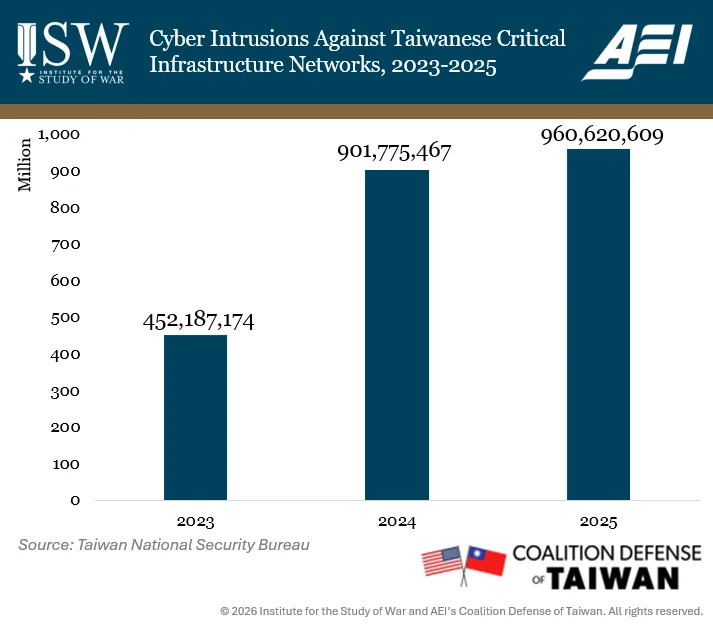
PRC cyber operations against Taiwan increased in 2025, especially against energy facilities, according to Taiwan’s National Security Bureau (NSB).[53] The NSB’s annual report on PRC cyber threats reported over 960 million intrusions in Taiwan’s networks across a variety of critical infrastructure sectors, representing a 6 percent increase from 2024.
The high intensity of disruptions to Taiwan’s critical infrastructure by PRC cyber threat actors during peacetime highlights the prominence of cyber operations in the PRC’s coercion toolkit. latest military exercise, which lasted from December 29 to 30, 2025.[54] These cyber operations primarily targeted Taiwanese government agency networks.[55]
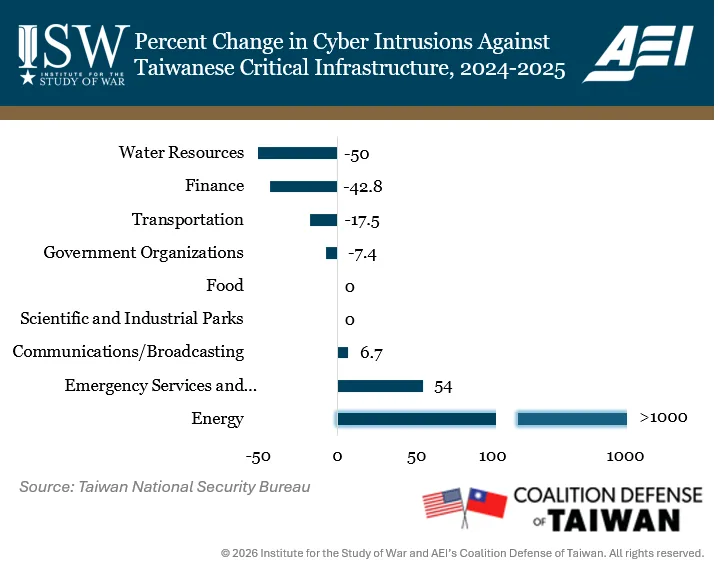
Some critical infrastructure sectors experienced a disproportionate increase in malicious cyber incidents in 2025, including an over 1,000 percent increase against energy facilities and a 54 percent increase against hospitals and emergency services. The PRC’s increasing focus on disrupting energy and emergency services signals its intention to weaken Taiwan’s crisis response and defense resilience. PRC cyber operations against Taiwan’s energy infrastructure would likely aim to degrade its energy distribution and support a blockade against energy imports, destroying Taiwan’s ability to resist invasion.
The US Department of State’s condemnation of the PLA’s Justice Mission 2025 blockade exercise used stronger language on Taiwan than the 2025 US National Security Strategy (NSS). The PRC conducted the blockade exercise from December 29 to 30, 2025, triggering statements of concern and condemnation from many Western countries and US allies.[56] US State Department Deputy Spokesperson Tommy Piggot criticized the exercise for unnecessarily increasing tensions and called on Beijing to cease its military pressure against Taiwan. He said that the United States “supports peace and stability across the Taiwan Strait and opposes unilateral changes to the status quo, including by force or coercion.”[57] This is stronger language than a similar statement in the 2025 NSS, which said that “the United States does not support any unilateral change to the status quo in the Taiwan Strait.”[58] Piggot’s statement echoed previous Trump administration statements prior to the NSS, indicating that the US position on Taiwan has not changed.[59]
China
The PLA Navy (PLAN) is enhancing its fleet survivability through improvements to air defense radars on its recently commissioned vessels. PRC state media released footage of the Type 052D Luyang III Mod-class guided missile destroyer (DDG) Loudi, confirming that the vessel was commissioned with the Southern Theater Command (STC) in late 2025.[60] Footage of the vessel showed that Loudi’s forward mast hosts a Type 368 X-band active electronically scanned array (AESA) radar system that older vessels in the Type 052D class do not have.[61] PRC state media touted Loudi as an example of PLAN modernization, pointing out its new radar system as a major technological advancement.[62]
An AESA radar is an advanced system that can track multiple targets moving in different directions. It is more advanced than the passive electronically scanned array (PESA) system that US Navy DDGs rely on for air and missile defense.[63] The PLAN’s use of AESA radar on its DDGs may improve their ability to provide for a fleet’s defense against anti-ship missiles. An AESA system would also be more effective against swarm attacks either by unmanned aerial vehicles or unmanned surface vessels.[64]
Several Type 052D DDGs participated in the PLA’s Justice Mission 2025 military exercises around Taiwan on December 29-30, suggesting they may form an important component of a PLAN effort to blockade and isolate the island. The AESA radar on Loudi would likely enhance the survivability of a PLAN blockade force against land-based anti-ship missiles launched by Taiwan or against long-range kinetic attacks from US assets by allowing PLAN ships to detect and respond to multiple threats. The PLAN is yet to deploy the Type 368 radar on most of its surface fleet, however. A fleet’s air defense capability also relies on several systems other than radar, including advanced computing and information processing technology, to be effective. The PLAN will likely continue to improve its fleet air defense and produce these improvements at scale to close the gap between the PLAN and the US Navy in the Indo-Pacific.
The PLAN far outpaced the US Navy in commissioning new surface combatants in 2025. The US Navy is currently at risk of allowing the PLAN to contest maritime supremacy in the Indo-Pacific if it fails to substantially increase its procurement of capable surface combatants. The PLAN commissioned up to 16 surface combatants in 2025—one aircraft carrier (CV), one landing helicopter dock (LHD), seven to eight DDGs, and six guided missile frigates (FFGs).[65] The total tonnage of PLAN vessels commissioned in 2025 amounts to 213,000 metric tons, significantly larger than any of the United States’ carrier strike groups.[66] The commissioned vessels have a combined armament of 752 vertical launch system (VLS) cells, slightly less than the VLS armament of eight US DDGs.[67] The US Navy only commissioned one surface combatant in 2025: the littoral combat ship (LCS) USS Pierre.[68] The US Navy also canceled the Constellation-class frigate program in November 2025 due to worries that construction of the vessels would take too long.[69]
The United States currently maintains a significant advantage over the PLAN in terms of active surface combatants. The US Navy operates 11 nuclear-powered aircraft carriers (CVN), nine modern guided missile cruisers (CGs), and 76 modern DDGs as its principal surface combatants.[70] The PLAN, after a particularly fecund 2025, operates three CVs (two of which are outdated), 10 modern CGs, 34 Type 052D DDGs, and 46 modern FFGs.[71] The US carrier fleet outclasses the PLAN by a significant margin, boasting a larger carrying capacity and nuclear power that affords a much greater operating range to the US Navy.[72] The US Arleigh Burke-class DDG likewise outclasses the PLAN’s Type 052D in ship-based firepower.[73]
The pace of PRC shipbuilding suggests that it could achieve approximate parity with the US Navy in the Indo-Pacific in the near future. The PLAN does not need to match the US Navy in every respect to achieve its regional objectives. The US Navy is aiming to procure two new DDGs each year, despite acknowledging that US shipbuilding is currently unable to meet this goal.[74] The PLAN, in contrast, is constructing or planning to construct at least two carriers—one of which may be nuclear powered—four CGs, 10 DDGs, and six FFGS in the near future.[75] Recent rates of PRC shipbuilding suggest that PLAN surface combatants other than the aircraft carriers will take one to two years to reach seaworthiness from beginning construction.[76]The US Navy is attempting to increase its ship procurement rate with its new frigate program intended to produce its first seaworthy vessel by 2028.[77] The US Navy may have to sacrifice the vessel’s firepower to meet this goal, however.[78] The US Navy’s intention to procure 20-25 Trump-class battleships may complicate efforts to increase the rate of US surface vessel procurement because it could strain already limited US shipbuilding capacity.[79]
Northeast Asia
Japan
The PRC Ministry of Commerce (MOFCOM) banned exports of dual-use items with military applications to Japan on January 6 and announced an anti-dumping investigation into Japanese-origin chipmaking materials on January 7. The PRC is likely seeking to coerce Japanese Prime Minister Sanae Takaichi to retract her statements on Taiwan and communicate PRC concerns with Japanese defense spending. MOFCOM stated that this ban was effective immediately and was targeting goods that would enhance Japanese military capabilities.[80] MOFCOM did not provide details on what goods would be defined as dual-use under the new regulations. The PRC export control list for dual-use goods and technologies contains approximately 1,100 items, and it remains unknown what portion of these goods will be included in the export ban.[81]
The PRC list of dual-use goods and technologies includes rare earth materials. The PRC supplies Japan with roughly 60 percent of its rare earth materials. PRC export bans of dual-use goods generally and rare earth materials in particular could seriously impact Japan’s defense modernization and industrial sectors. Japanese think tank Nomura Research Institute estimates that Japan imported an estimated 10.7 billion yen (68.4 billion US dollars) in dual-use items in 2024.[82] It is difficult to assess the effect that this ban will have on the Japanese economy lacking a complete list of banned materials and technologies, however.
MOFCOM announced on January 7 a year-long anti-dumping investigation against Japan over dichlorosilane, a material used primarily for semiconductor manufacturing.[83] Japan supplies approximately 72 percent of PRC dichlorosilane, giving it significant influence over PRC chip manufacturing.[84]The PRC is likely seeking to identify additional methods of coercion to convince Japanese Prime Minister Sanae Takaichi to retract her statements on Taiwan. Takaichi stated on November 7 that a Taiwan contingency may qualify as a “situation threatening Japan’s survival” and thus require the mobilization of the Japanese Self Defense Forces.[85] Takaichi has thus far refused to retract her comments, and there does not appear to be factions within the Japanese government pushing for her to do so. The PRC may be seeking to influence Japanese business leaders to pressure their government by restricting access to rare earths and semiconductors as an alternative method of coercion. The PRC is also likely seeking to harm Japanese military development following the December 26 approval of Japan’s largest ever defense budget.[86] The PRC consistently expresses concerns over Japanese military expansion, accusing it inciting regional instability, and will likely take greater measures to restrict Japanese military development the more it believes Japan will be a combatant in a war over Taiwan. The PRC’s restriction of key materials would limit Japan’s ability to produce advanced weapons systems.
North Korea
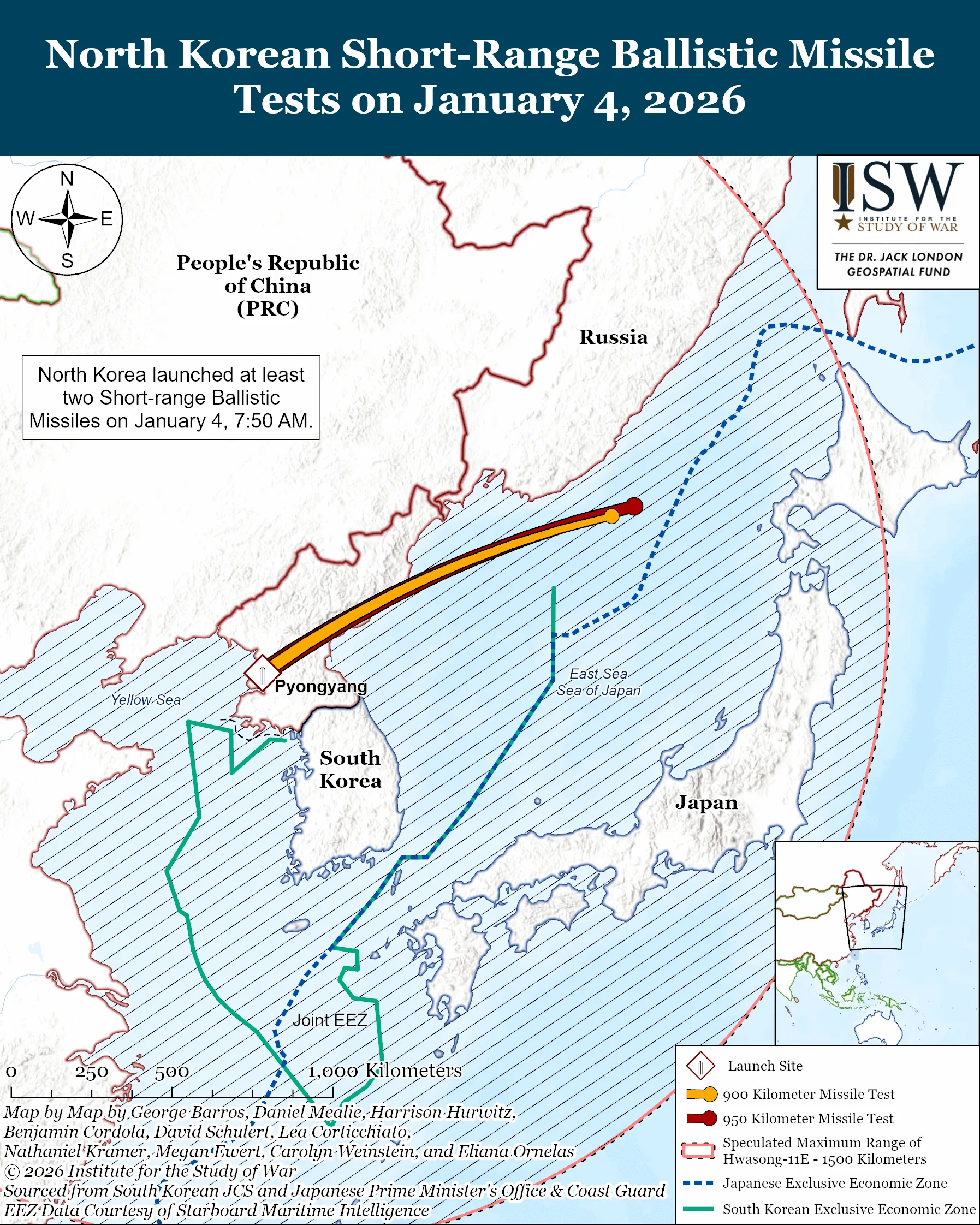
North Korea launched at least two “supersonic” ballistic missiles on January 4.[87] The timing of the launch may signal Pyongyang’s intention to further accelerate military development in the face of recent events, including the United States’ capture of Venezuelan President Nicolas Maduro and the PRC-South Korea Summit.[88] The South Korean Joint Chiefs of Staff and the Japanese Prime Minister’s Office reported that two missiles, speculated as Hwasong 11-E, flew around 900km (559 miles) towards the East Sea/Sea of Japan.[89] South Korean national defense scholars speculated that the launch intended to verify the missiles’ low-altitude gliding flight capability and operational range.[90] The launch was the first since November 7 and the third launch of South Korean President Lee Jae Myung’s term.[91] North Korea has conducted tests of various types of missiles every month since October 2025.[92] Workers’ Party of Korea (WPK) General Secretary Kim Jong Un also inspected tactical guided weapons and ordered an increase in their production on the day before the missile launch.[93] Hwasong-11E, a low-altitude ballistic missile, has a maximum range of 1,500km, which would allow it to strike targets anywhere in the Korean Peninsula and the main islands of Japan.[94] This type of missile also employs anomalous maneuverability similar to cruise missiles, which evade missile defense networks more effectively than conventional missiles.[95]Kim Jong Un’s visit to a missile factory occurred just after the United States’ capture of Venezuelan President Maduro on January 3 and just before President Lee’s visit to Beijing on January 5.[96] Kim Jong Un stated the need to enhance North Korea’s nuclear deterrence and development of missiles to respond to recent unspecified “geopolitical crises” and “complicated international events.”[97] The US capture of Maduro, essentially a “decapitation” operation against an anti-US regime, likely reinforced his belief that highly advanced asymmetric weapons and nuclear weapons are necessary to deter the United States and other advanced military powers. The launch also likely serves as an expression on its discontent regarding the possibility of discussion on denuclearization issues during the Xi-Lee Summit. North Korea may justify this belief on the self-defense through facilitating and regularizing missile test and other military developments. North Korean officials have stated repeatedly that Pyongyang will no longer negotiate with the United States unless it drops its demand for denuclearization. North Korea will likely further strengthen its cooperation with Russia across various sectors, while continuously advocating for a coalition to stand against the “US-led order.”
South Korea
CCP General Secretary Xi Jinping and South Korean President Lee Jae Myung held talks in Beijing on January 5.[98] The PRC leveraged the summit to reinforce messaging promoting multipolarity and the one-China policy. Beijing is unlikely to play a meaningful mediating role in inter-Korean dialogue. Lee and Xi called for joint efforts to promote peace on the Korean Peninsula. Neither side publicly referenced North Korea’s nuclear weapons program in their remarks or readouts.[99] South Korea’s National Security Council Director Wi Sung-lak stated that the two leaders reaffirmed the importance of resuming dialogue with North Korea and that the PRC expressed its intention to play a “constructive” role in supporting peace and stability on the Korean Peninsula.[100] The two governments signed 15 cooperation documents, including two memoranda of understanding, to expand economic cooperation.[101]
Lee’s state visit reflects a policy shift from the previous Yoon Suk-yeol administration and signals an effort to reset diplomatic and trade relations with Beijing. Lee on January 3 said that he “respects one-China” terms of the 1992 diplomatic normalization agreement.[102] The Yoon administration emphasized a values-based foreign policy and publicly opposed “any unilateral change to the status quo by force” in cross-strait affairs, which the PRC criticized.[103] Lee appears to be reversing Yoon’s foreign policy direction, pursuing a balancing strategy rather than aligning wholly with the United States. This strategy likely aims to stabilize South Korea-PRC relations while encouraging Beijing to play an intermediary role in efforts to restore dialogue with Pyongyang. The PRC remained South Korea’s largest trading partner in 2025, prompting Lee to pursue closer bilateral cooperation.[104]
The PRC appears focused on increasing strategic alignment with South Korea. Beijing likely used the summit to reinforce diplomatic recognition of the One-China policy and to expand its political leverage in cross-strait dynamics.[105] Xi invoked shared historical narratives of resistance to Japanese militarism to seek diplomatic support amid deteriorating PRC-Japan relations. Xi’s emphasis on multipolarity and economic globalization was likely a reference to US tariffs and what the PRC calls US “hegemony.” Xi also called to make the “right strategic choices” to reinforce PRC messaging and frame the summit as a coordinated posture favorable to the PRC.
The PRC likely welcomes renewed economic cooperation with South Korea, but deeper economic interdependence could increase PRC influence over South Korea’s decision-making, including its relationships with the United States and Japan. The PRC is unlikely to meaningfully advance inter-Korean dialogue. The PRC has avoided publicly supporting denuclearization since Xi’s September 3 meeting with WPK General Secretary Kim Jong Un, likely in response to Pyongyang’s demand for recognition of its nuclear program as “self-defensive.”[106] The PRC may believe that pressing denuclearization would weaken its leverage over North Korea at a time when Pyongyang’s cooperation with Russia is strengthening.[107]
Europe
The PRC is leveraging its economic power to limit UK support for Taiwan. The Guardian reported on January 2 that the PRC threatened to cancel the UK-China Joint Economic and Trade Commission (JETCO) meeting due to then-Trade Minister Douglas Alexander’s visit to Taiwan in June 2025, which included meetings with Taiwan’s President Lai and Taiwan’s Deputy Minister of Economic Affairs Cynthia Kiang.[108] JETCO is a high-level trade meeting that was ultimately held in September 2025. The prior JETCO was in 2018.[109] The UK government under Prime Minister Keir Starmer has been aiming to increase economic ties with the PRC, in spite of national security concerns.[110] The UK government faced backlash in September 2025 after it dropped the case against two UK nationals accused of spying on behalf of the CCP because the UK had not labeled the PRC a national security threat at the time of the alleged crimes.[111] The UK also announced sanctions against two PRC tech companies for allegedly carrying out cyberattacks against the UK and its allies in December 2025.[112]The PRC has repeatedly used trade to coerce countries to limit diplomatic engagement with Taiwan.[113] The PRC persuaded Honduras to switch recognition from Taiwan to the PRC in 2023 in exchange for a free trade agreement and infrastructure investment.[114] The United Kingdom does not have diplomatic relations with Taiwan but maintains unofficial ties that Beijing seeks to discourage.

[1] https://www.mfa.gov dot cn/web/wjdt_674879/fyrbt_674889/202601/t20260105_11806730.shtml
[2] https://www.mfa.gov dot cn/web/wjdt_674879/fyrbt_674889/202601/t20260106_11807212.shtml
[3] https://www.nytimes.com/2026/01/05/world/americas/un-security-council.html
[4] https://understandingwar.org/research/china-taiwan/china-taiwan-weekly-update-june-27-2025/
[5] https://www.bloomberg.com/news/articles/2026-01-07/us-tells-venezuela-to-cut-ties-with-china-and-russia-abc-says; https://www.reuters.com/business/energy/venezuelas-oil-exports-surpass-900000-bpd-despite-us-pressure-data-shows-2025-12-03/
[6] https://www.mfa.gov dot cn/web/wjdt_674879/fyrbt_674889/202601/t20260105_11806730.shtml; https://www.scmp dot com/news/china/diplomacy/article/3338798/china-says-it-still-committed-ties-venezuela-and-energy-cooperation
[7] https://www.wsj.com/livecoverage/venezuela-strikes/card/trump-suggests-venezuela-oil-exports-to-china-will-grow-mawzhI8LHNh2V4s5douU?gaa_at=eafs&gaa_n=AWEtsqfn8qdszKCr4r1TyjgFmWPZf4k2c5Sh9B697RHeunvbls1Sgeo7Y_zN&gaa_ts=695d4f60&gaa_sig=pIqPew86ODb3HUC5HYl-kZXR-7RuaiUT5qmNhL2hXLCi_wAF6yoMrFPSFWYn7esQLJkRhCUvxi4V6sZKu6it6w%3D%3D
[8] https://abcnews.go.com/Politics/trump-demands-venezuela-kick-china-russia-partner-us/story?id=128963238
[9] https://www.bloomberg.com/news/articles/2026-01-05/china-asks-banks-to-report-exposure-to-venezuela-after-us-raid
[10] https://www.nytimes.com/2026/01/05/business/venezuela-oil-china-deal.html
[11] https://www.chinamil.com dot cn/site1/jsslpdjs/2004-09/14/content_132406.htm
[12] http://english.scio.gov dot cn/pressroom/2025-12/30/content_118253194.html ; http://www.xinhuanet dot com/politics/2019-07/24/c_1124792450.htm ; http://www.gwytb.gov dot cn/m/fyrbt/202410/t20241016_12656828.htm
[13] http://english.scio.gov dot cn/pressroom/2025-12/30/content_118253194.html ; http://www.xinhuanet dot com/politics/2019-07/24/c_1124792450.htm ; http://www.gwytb.gov dot cn/m/fyrbt/202410/t20241016_12656828.htm
[14] http://eng.chinamil.com dot cn/2025xb/O_251451/16435021.html ; https://www.globaltimes dot cn/page/202512/1351762.shtml
[15] https://understandingwar.org/research/china-taiwan/china-taiwan-weekly-update-october-3-2025/ ; https://jamestown.org/taiwan-exposes-more-prc-military-infiltration-cases/
[16] https://www.19fortyfive.com/2026/01/could-chinas-military-try-to-maduro-taiwan/
[17] https://www.taiwannews.com dot tw/news/6276254
[18] https://www.bloomberg.com/news/articles/2026-01-05/taiwan-sees-trump-s-arrest-of-maduro-as-helpful-in-deterring-xi
[19] https://www.newsweek.com/china-made-military-radars-may-have-failed-venezuela-during-us-raid-11308099
[20] https://miastrategicintel.com/strategic-report-current-state-of-venezuelas-air-defense-system/
https://www.eurasiantimes dot com/chinas-anti-stealth-jy-27-radar-flops-in-venezuela/ ; https://www.scmp dot com/news/china/military/article/3338912/venezuela-attack-seen-reminder-china-boost-air-defence-counter-intelligence [21]
[22] https://www.scmp dot com/news/china/military/article/3311054/china-aims-new-jy-27v-radar-stealthy-targets-such-americas-fifth-gen-fighters
[23] https://understandingwar.org/research/china-taiwan/china-taiwan-weekly-update-january-9-2025/
[24] https://udn dot com/news/story/7314/9214144
[25] https://focustaiwan dot tw/politics/202512190020?utm
[26] https://focustaiwan.tw/politics/202512220019
[27] https://udn dot com/news/story/6656/9239909?from=udn-ch1_breaknews-1-0-news
[28] https://understandingwar.org/research/china-taiwan/china-taiwan-weekly-update-october-30/
[29] https://focustaiwan dot tw/politics/202601020015
[30] https://news.tvbs dot com.tw/English/3089410
[31] https://news.tvbs dot com.tw/English/3089410;
https://focustaiwan dot tw/politics/202601020015
[32] https://focustaiwan dot tw/politics/202512180023
[33] https://understandingwar.org/research/china-taiwan/china-taiwan-update-january-2-2026/ ; https://understandingwar.org/research/china-taiwan/china-taiwan-update-december-23-2025/
[34] https://taipeitimes dot com/news/Taiwan/archives/2026/01/02/2003849939
[35] https://focustaiwan dot tw/politics/202601020015
[36] https://taipeitimes dot com/news/Taiwan/archives/2026/01/02/2003849939
[37] https://www.taipeitimes dot com/News/front/archives/2026/01/04/2003850005; https://www.ocac.gov dot tw/OCAC/Eng/Pages/Detail.aspx?nodeid=329&pid=82590861#:~:text=Taipei%2C%20Jan.,circulated%20by%20Chinese%20media%20platforms
[38] https://www.aei.org/articles/china-taiwan-weekly-update-october-31-2025/; https://understandingwar.org/research/china-taiwan/china-taiwan-update-october-31-2025/;
[39] https://www.aspistrategist.org dot au/chinas-taiwanese-separatist-hotline-shows-expanding-lawfare-strategy/;
[40] https://www.aei.org/articles/china-taiwan-weekly-update-october-31-2025/; https://understandingwar.org/research/china-taiwan/china-taiwan-update-october-31-2025/
[41] https://www.chinalawtranslate.com/en/taiwan-independence/
[42] https://www.aei.org/articles/china-taiwan-weekly-update-november-17-2025/; https://understandingwar.org/research/china-taiwan/china-taiwan-update-november-17-2025/
[43] https://en.mofa.gov dot tw/News_Content.aspx?n=1328&sms=273&s=121444; https://www.ocac.gov dot tw/OCAC/Eng/Pages/Detail.aspx?nodeid=329&pid=82590861#:~:text=Taipei%2C%20Jan.,circulated%20by%20Chinese%20media%20platforms; https://www.taiwannews.com dot tw/news/6276185
[44] https://www.taiwannews.com dot tw/news/6276185
[45] https://medium.com/doublethinklab/artificial-multiverse-foreign-information-manipulation-and-interference-in-taiwans-2024-national-f3e22ac95fe7; https://medium.com/doublethinklab/deafening-whispers-f9b1d773f6cd; https://globaltaiwan.org/wp-content/uploads/2023/08/OR_ASTAW0807FINAL.pdf
[46] https://medium.com/doublethinklab/inauthentic-accounts-impersonate-taiwanese-to-attack-political-party-c7d04d5e1e13; https://merics dot org/en/report/savvy-disinformation-offensive-china-takes-aim-taiwan-election
[47] https://www.aei.org/articles/china-taiwan-weekly-update-july-3-2025/; https://understandingwar.org/research/middle-east/china-taiwan-weekly-update-july-3-2025/
[48] http://www.news dot cn/tw/20260107/dd2b149c38b34fda9df58e051752eebe/c.html
[49] http://www.news dot cn/tw/20260107/dd2b149c38b34fda9df58e051752eebe/c.html
[50] http://www.gwytb dot gov.cn/xwdt/xwfb/xwfbh/202105/t20210512_12351715.htm
http://www.gwytb dot gov.cn/xwdt/xwfb/wyly/202410/t20241014_12656119.htm
[51] http://www.news dot cn/tw/20260107/dd2b149c38b34fda9df58e051752eebe/c.html
[52] http://www.news dot cn/20251113/85b5c264354a4106bd0543e29c36c79b/c.html
[53] https://www.nsb dot gov.tw/zh/assets/documents/%E6%96%B0%E8%81%9E%E7%A8%BF/9473ea89-55e8-460d-87c1-65bc51085d80.pdf
[54] https://www.cna dot com.tw/news/aipl/202601060164.aspx
[55] https://www.cna dot com.tw/news/aipl/202601060164.aspx
[56] https://www.mofa.go.jp/press/release/pressite_000001_01973.html?fbclid=IwdGRleAPBpadleHRuA2FlbQIxMQBzcnRjBmFwcF9pZAo2NjI4NTY4Mzc5AAEenJnbgsaguHrBxkcNLeZh3RYzTYEZAFYUdR-GQ3B8PzrKnAHkqUk8IvETucw_aem_uceX2WWZhF8FL4BQRF9y3Q ; https://www.gov.uk/government/news/statement-on-chinas-military-drills-december-2025 ; https://x.com/jaytaryela/status/2006328223039451189?s=20 ; https://www.theguardian.com/australia-news/2025/dec/31/australia-says-deeply-concerning-destabilising-chinese-exercises-near-taiwan-risk-inflaming-regional-tension ; https://www.eeas.europa.eu/eeas/spokesperson-statement-china%E2%80%99s-military-exercise-around-taiwan_en
[57] https://www.state.gov/releases/office-of-the-spokesperson/2026/01/response-to-chinas-military-exercise-near-taiwan
[58] https://www.whitehouse.gov/wp-content/uploads/2025/12/2025-National-Security-Strategy.pdf
[59] https://www.voanews.com/a/us-still-opposes-forced-coercive-changes-to-taiwan-s-status-rubio-says/7990671.html
[60] https://www.news dot cn/milpro/20260104/64247e227e5443538af387e967afdf71/c.html
[61] https://m.weibo dot cn/status/5250325267351218
[62] https://www.globaltimes dot cn/page/202601/1352031.shtml
[63] https://www.china-arms.com/2024/07/china-hypersonic-interception-radar/; https://duotechservices.com/news/whats-the-real-difference-active-vs-passive-phased-array-radar
[64] https://www.northropgrumman.com/what-we-do/mission-solutions/radars/active-electronically-scanned-array-aesa
[65] https://www.youtube.com/watch?v=lyt2rqSDH1M&t=392s
[66] https://www.war.gov/Multimedia/Photos/igphoto/2003337909/
[67] https://www.navy.mil/Resources/Fact-Files/Display-FactFiles/Article/2169871/destroyers-ddg-51/
[68] https://strongernavy.org/u-s-navy-on-track-to-commission-only-2-ships-in-2025-lowest-in-decades-while-silicon-valley-banks-billions-from-china-operations/
[69] https://news.usni.org/2025/11/25/navy-cancels-constellation-class-frigate-program-considering-new-small-surface-combatants
[70] https://www.wdmmw.org/united-states-navy.php
[71] https://x.com/someplaosint/status/2005841097403068782?s=20; https://www.wdmmw.org/peoples-liberation-army-navy-china.php; https://admiraltytrilogy.com/mcmf.php
[72] https://www.naval-technology.com/projects/gerald-r-ford-class/; https://www.iiss.org/online-analysis/military-balance/2025/11/chinas-carrier-capabilities–fujian-adds-a-new-boost/
[73] https://www.navy.mil/Resources/Fact-Files/Display-FactFiles/Article/2169871/destroyers-ddg-51/; https://odin.tradoc.army.mil/WEG/Asset/Type_052D_Class_(Luyang_III-Class)_Chinese_Destroyer
[74] https://news.usni.org/2025/01/02/report-to-congress-on-u-s-navy-destroyer-programs-16
[75] https://admiraltytrilogy.com/mcmf.php
[76] https://www.bbc.com/news/articles/c4gmnpg31xlo; https://admiraltytrilogy.com/mcmf.php
[77] https://www.twz.com/sea/this-will-be-the-navys-new-ffx-frigate
[78] https://www.twz.com/sea/navys-new-frigate-will-not-have-vertical-launch-systems-for-missiles
[79] https://www.goldenfleet.navy.mil/
[80] https://www.mofcom.gov dot cn/zwgk/zcfb/art/2026/art_8990fedae8fa462eb02cc9bae5034e91.html
[81] https://www.reuters.com/world/asia-pacific/china-bans-exports-dual-use-items-military-purposes-japan-2026-01-06/
[82] https://www.bloomberg.com/news/articles/2026-01-06/japan-protests-china-s-new-export-controls-on-dual-use-goods
[83] https://www.mofcom.gov dot cn/syxwfb/art/2026/art_c335c23268d0418381af7a2d28c728f5.html
[84] https://www.scmp dot com/economy/global-economy/article/3339053/china-initiates-anti-dumping-probe-against-japan-over-key-semiconductor-chemical
[85] https://understandingwar.org/research/china-taiwan/china-taiwan-update-november-17-2025/
[86] https://apnews.com/article/japan-defense-spending-china-missile-221b2cb5da0760d6e07f63ac01deba93
[87] https://kcnawatch.org/newstream/1767593445-481908375/%ea%b7%b9%ec%b4%88%ec%9d%8c%ec%86%8d%eb%af%b8%ec%8b%b8%ec%9d%bc%eb%b0%9c%ec%82%ac%ed%9b%88%eb%a0%a8-%ec%a7%84%ed%96%89/
[88] https://www.yna dot co.kr/view/AKR20260104012051504
[89] https://www.nknews.org/2026/01/north-korea-fires-ballistic-missile-into-east-sea-jcs/
[90] https://www.chosun dot com/politics/diplomacy-defense/2026/01/05/R4A3MRRM7BFO5PCP65FV2OG5MU/
[91] https://www.joongang.co dot kr/article/25394903 ; https://www.yna.co dot kr/view/AKR20260104012051504
[92] https://understandingwar.org/research/china-taiwan/china-taiwan-update-january-2-2026/
[93] https://www.yna.co dot kr/view/AKR20260104005600504
[94] https://www.munhwa dot com/article/11558370
[95] https://www.joongang.co dot kr/article/25394995
[96] https://www.yna.co dot kr/view/AKR20260104012051504
[97] https://kcnawatch.org/newstream/1767560997-348064374/hypersonic-missile-launching-drill-conducted-in-dprk/
[98] https://www.yna.co dot kr/view/AKR20260105157600001?section=politics/all&site=topnews01
[99] https://www.segye dot com/newsView/20260106515551?OutUrl=naver
[100] https://www.yna.co dot kr/view/AKR20260105157600001?section=politics/all&site=topnews01
[101] https://www.yna.co dot kr/view/AKR20260105149500003?section=politics/all&site=major_news01 ; https://www.mfa.gov dot cn/web/wjdt_674879/gjldrhd_674881/202601/t20260105_11806708.shtml
[102] https://www.hani dot co.kr/arti/international/china/1237821.html
[103] https://www.khan dot co.kr/article/202304212118001#ENT ; https://news.kbs dot co.kr/news/pc/view/view.do?ncd=7972442
[104] https://www.newstopkorea dot com/news/articleView.html?idxno=28638#:~:text=%EB%8C%80%ED%95%9C%EB%AF%BC%EA%B5%AD%20%EA%B3%B5%EC%8B%9D%20%EC%A0%84%EC%9E%90%EC%A0%95%EB%B6%80%20%EB%88%84%EB%A6%AC%EC%A7%91,%2C%204.3%25%EB%A1%9C%20%EB%92%A4%EB%A5%BC%20%EC%9D%B4%EC%97%88%EC%8A%B5%EB%8B%88%EB%8B%A4.
[105] https://www.taiwannews dot com.tw/news/6275846
[106] https://www.yna.co dot kr/view/AKR20260105158000504?section=nk/news/all
[107] https://www.yna.co dot kr/view/AKR20251002004000072
[108] https://www.theguardian.com/world/2026/jan/02/china-threatened-to-cancel-key-trade-talks-after-uk-ministers-taiwan-visit-in-june
[109] https://www.chinachamber.org.uk/2025%e5%b9%b4%e4%b8%ad%e8%8b%b1%e7%bb%8f%e8%b4%b8%e8%81%94%e5%a7%94%e4%bc%9a%e6%88%90%e5%8a%9f%e4%b8%be%e8%a1%8c/
[110] https://www.ft.com/content/b0589eaf-b45a-4452-808b-bd167fe8d28a
[111] https://www.bbc.com/news/articles/ceq057734w1o
[112] https://understandingwar.org/research/china-taiwan/china-taiwan-update-december-19-2025/
[113] https://www.atlanticcouncil.org/in-depth-research-reports/report/maintaining-taiwans-international-space-to-enhance-deterrence-against-china/
[114] https://www.atlanticcouncil.org/in-depth-research-reports/report/maintaining-taiwans-international-space-to-enhance-deterrence-against-china/;
https://www.pbs.org/newshour/world/honduras-establishes-ties-with-china-after-ending-recognition-of-taiwan

