Toplines
The United States is reportedly hesitating over whether to fulfill its next arms sales to Taiwan out of concern that it could derail US President Donald Trump’s upcoming visit to Beijing. Suspending the sales would risk emboldening the CCP and encouraging it to pursue further concessions from the United States, however. In a phone call on February 16, CCP General Secretary Xi Jinping warned Trump against fulfilling the arms sales and threatened that it could upend the Beijing visit.[1] The arms sales would include 20 billion US dollars’ worth of systems for Taiwan, according to the Financial Times.[2]
Xi’s threats come as he has extracted other Taiwan-related concessions from the United States. Washington reportedly denied Taiwanese President William Lai Ching-te permission to enter the country in July 2025 to avoid damaging the chances of a Trump-Xi summit.[3] ISW-CDOT noted at the time that the denied visit to Lai risked driving the CCP to further leverage diplomatic engagements and trade negotiations to divide the United States from Taiwan.[4]
The arms package reportedly contains key systems that would support the development of Taiwan’s “T-dome” integrated air and missile defense (IAMD) network. The T-Dome is a proposed multi-layered IAMD network meant to neutralize aerial threats to Taiwan with large quantities of mobile air defense systems and advanced sensor and command-and-control (C2) infrastructure.[5] Taipei Times reported on February 14 that the package would likely include Integrated Battle Command Systems (IBCS), Patriot Advanced Capability-3 Missile Segment Enhancement systems (PAC-3 MSE), National Advanced Surface-to-Air Missile Systems (NASAMS), and Lower Tier Air and Missile Defense Sensors (LTAMDS).[6] ICBS are C2 systems that would enable Taiwan to integrate its existing Patriot missile and Tien Kung missile air defense battalions into a single unified system.[7] PAC-3 MSE missile interceptors would fortify Taiwan’s multi-layered air defense munitions with improved velocity, range, and altitude compared to Taiwan’s domestically produced anti-ballistic missiles, enabling Taiwanese forces to defeat a wider range of threats, including hypersonic missiles.[8] NASAMS would further improve air defense coverage by strengthening Taiwan’s ability to intercept cruise missiles, drones, and aircraft.[9] LTAMDS is an IBCS-compatible air and missile defense radar that would enhance Taiwan’s battlespace awareness with omnidirectional and longer-range detection capabilities to provide early warning for incoming aerial threats.[10]
A robust IAMD network is crucial for Taiwan to survive a PRC attack. PLA operational concepts emphasize joint strike campaigns, which include large-scale missile barrages against C2 centers, key military bases, and critical infrastructure to pave the way for an amphibious invasion.[11]
The reported components of the arms package comprise defensive systems, discrediting PRC accusations that Taiwan’s ruling Democratic Progressive Party (DPP) is acting aggressively by procuring offensive capabilities.[12] The Lai administration proposed in November 2025 a record 40-billion-US-dollar special defense budget that, if passed, would provide significant funding for the acquisition of T-dome systems.[13]
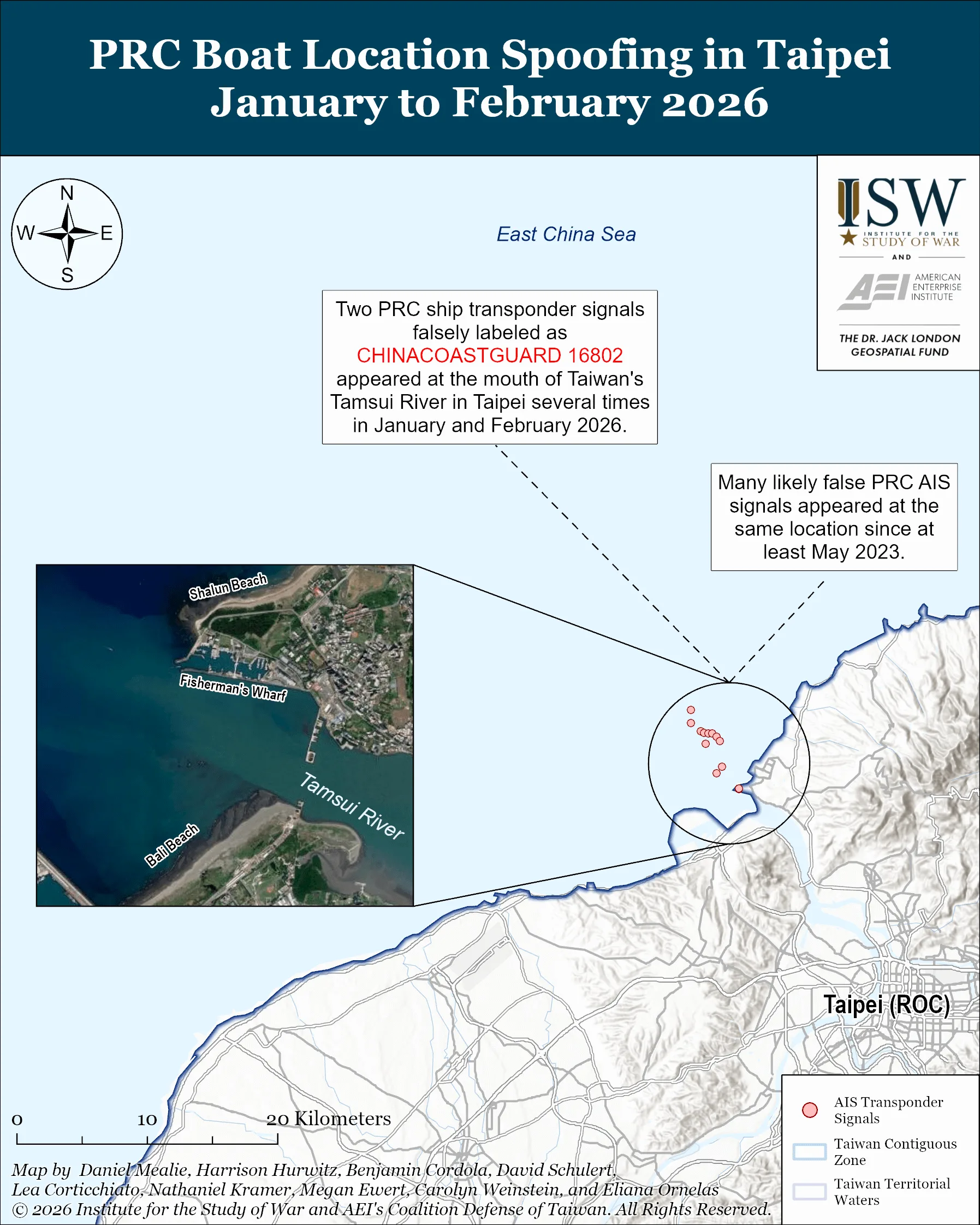
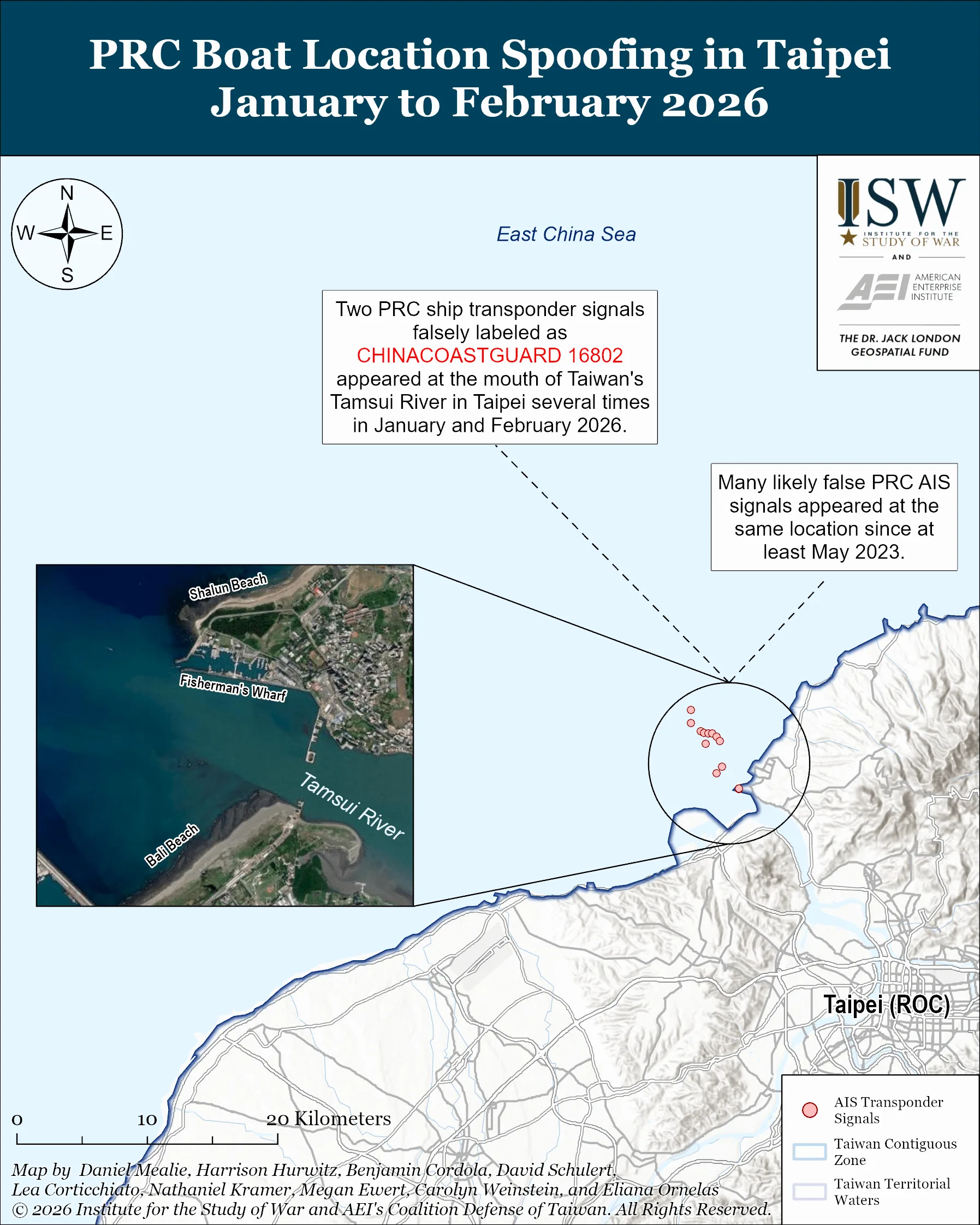
The PRC may be using signal spoofing to make ship-tracking software detect illusory PRC vessels, including a China Coast Guard (CCG) ship, inside a Taiwanese harbor. A PRC boat that has infiltrated New Taipei may be broadcasting the spoofed signals as part of a cognitive warfare effort to degrade Taiwan’s threat awareness. ISW-CDOT found dozens of Automatic Identification System (AIS) signals of PRC vessels that have intermittently appeared and disappeared at the mouth of the Tamsui River in New Taipei, Taiwan from at least May 2023 through February 2026, based on ship-tracking data from Starboard Maritime Intelligence. AIS is a system installed on most ships that broadcasts the ship’s identity, location, and other relevant data. At least two of the PRC signals near the Tamsui harbor had the name “CHINACOASTGUARD 18602,” the name of a real CCG ship. No sources reported a CCG ship entering Taiwan’s internal waters, however, indicating that the signals were fake. Dozens of other AIS signals indicated the presence of PRC fishing or cargo vessels. ISW-CDOT assesses that all of these signals were spoofed and do not represent real PRC vessels near New Taipei, because the signals appeared very briefly before “teleporting” to other locations hundreds of miles away. All of the signals appeared in or near Tamsui Fisherman’s Wharf, a fishing harbor in New Taipei’s Tamsui district, suggesting that a boat docked at that harbor may be broadcasting the signals.
ISW-CDOT previously assessed that the PRC was experimenting with spoofing fake AIS signals around Taiwan to confuse Taiwan’s threat awareness. One such signal impersonated a Russian warship, and another impersonated a PRC Maritime Safety Administration ship.[14] ISW-CDOT assessed that PRC fishing boats, likely affiliated with the Chinese Maritime Militia (CMM), took turns hosting these false signals, causing them to move between locations in the PRC’s maritime periphery much faster than would be possible for real boats. The signals near Tamsui follow the same pattern of “teleporting” around the map. The signals sometimes change their names: the fake “Russian Warship” signal that appeared in August and September 2025 is now broadcasting the generic name “123.” Starboard data shows the two fake “CCG 18602” signals have appeared periodically near Tamsui since at least 2023, but they likely used different names at the time.
ISW-CDOT assesses with low confidence that the PRC may have smuggled an AIS transponder into Tamsui’s Fisherman’s Wharf, possibly aboard a fishing boat that has remained docked there for years to support a PRC cognitive warfare campaign or other malign activities. The wharf is located at the mouth of the river that flows through Taipei and New Taipei and is also between Shalun and Bali Beaches, two “Red Beaches” that the Taiwanese military identified as viable landing sites for a PRC amphibious invasion.[15] It is conceivable that a small PRC boat infiltrated the harbor undetected or smuggled an AIS transponder onto a lawfully registered Taiwanese boat that can dock at the harbor long-term. A PRC national sailed a speedboat into the Tamsui River in June 2024 and was only detected and detained after he collided with boats at a ferry terminal.[16]
Key Takeaways
- US arms sales to Taiwan: The United States is reportedly hesitating over whether to fulfill its next arms sales to Taiwan out of concern that it could derail US President Donald Trump’s upcoming visit to Beijing. Suspending the sales would risk emboldening the CCP and encouraging it to pursue further concessions from the United States.
- PRC activity around Taiwan: The PRC may be using signal spoofing to make ship-tracking software detect illusory PRC vessels, including a CCG ship, inside a Taiwanese harbor. A PRC boat that has infiltrated New Taipei may be broadcasting the spoofed signals as part of a cognitive warfare effort to degrade Taiwanese threat awareness.
Cross-Strait Relations
Taiwan
Taiwanese Legislative Speaker Han Kuo-yu said on February 16 that the DPP special defense budget will be first on the Legislative Yuan’s (LY) agenda after the Lunar New Year holiday.[17] The Taiwanese government’s Overseas Community Affairs Council circulated an article stating that the announcement was in response to a letter from 37 US Congress members sent on February 12 calling for Taiwan “to step up” in the face of PRC aggression.[18] The bipartisan group of US lawmakers addressed the letter to Han Kuo-yu, opposition Kuomintang (KMT) Chairwoman Cheng Li-wun, opposition Taiwan People’s Party (TPP) Chairman Han Kuo-chang, and DPP Caucus Whip Ker Chien-ming. The letter stated that the US Congress members fear that Taiwanese military advancements will be insufficient without “significant increases in Taiwan’s defense spending at levels reflected in President Lai’s proposed special budget.”[19] The Lai administration proposed a 1.25 trillion New Taiwan Dollar (39.5 billion US dollar) special defense budget for the next eight years in November 2025, but the opposition-controlled LY has repeatedly blocked it from review. The TPP proposed its own special defense budget with only one-third the total funding of the DPP’s on January 30, however the LY will prioritize reviewing the DPP budget.[20]
China
PRC Foreign Affairs Minister Wang Yi used the Munich Security Conference to continue portraying the PRC as a responsible and stable leader of the international community. Wang attended the annual conference from February 13-15 and gave a speech at the “China Session” on February 14. Wang decried “unilateralism” throughout 2025 likely a veiled reference to the United States.[21] Wang also highlighted CCP General Secretary Xi Jinping’s Global Governance Initiative (GGI), a PRC-led framework for reforming global institutions that Xi debuted in September 2025.[22] Wang said that the UN system should be “revitalized” but is currently not functioning because “some countries amplify differences and disagreements, pursue their own interests first, and are keen on bloc confrontation” — another likely reference to the United States. The PRC often uses the term “bloc confrontation” to refer to US coalition-building against the PRC. Wang also called for peace in Gaza, Ukraine, Iran, and Venezuela, including calling for eliminating the “root causes” of the Ukraine war, a term that the PRC and Russia use to refer to NATO expansion.[23] The PRC adopts Russian rhetorical framing of the war in Ukraine to blame NATO, rather than Russia, for the war.
Wang’s speech repeated common PRC narratives in support of multilateralism and the international system, but was notably less focused on the PRC’s leading role in the world compared to his speeches at previous Munich Security Conferences.[24] Wang may be taking advantage of rifts in US relations with Europe to implicitly present the PRC as a reliable partner aligned with European values. An unnamed PRC delegate said that the strained US-European relationship was a recurring theme of the conference and resulted in notably less criticism of the PRC, compared to previous years.[25] Wang advocated for greater European participation in Ukraine peace talks, observing that Europe seemed to be “sidelined” in United States-Russia negotiations in 2025.[26]
Wang met on the sidelines of the conference with US Secretary of State Marco Rubio and other top Western officials. Official readouts did not specify what Wang and Rubio discussed, except for US President Donald Trump’s planned visit to the PRC in April.[27]
The PRC denied US allegations that it conducted a low-yield nuclear test in June 2020. The US Department of Defense (DOD) has reported that the PRC is rapidly expanding its nuclear arsenal and focusing on developing counterstrike capabilities. Senior US State Department Official Thomas DiNanno stated on February 2 that the PRC conducted clandestine nuclear tests with low explosive power at the Lop Nor testing site in June 2020.[28] The United States has voiced concerns over secret PRC nuclear tests for years, although the PRC has denied all previous accusations. Assistant Secretary for the Bureau of Arms Control and Nonproliferation at the US Department of State Christopher Yeaw provided additional evidence supporting the US claim on February 17. PRC Washington Embassy spokesperson Liu Pengyu dismissed the US allegations on February 18.[29] Liu said that the United States was “fabricating excuses” to resume its own nuclear testing.[30] The United States accused the PRC of violating the Comprehensive Nuclear Test Ban Treaty, a 1996 UN treaty to ban nuclear weapons test explosions for civilian and military purposes.[31] The United States and PRC are both signatories but have refused to ratify the treaty. Both states maintain that they will abide by the treaty’s provisions, however.
The US DOD reported that PRC stockpiles of nuclear warheads have continually increased over the past several years, with the PRC remaining on track to have over 1,000 warheads by 2030.[32] The DOD reported that the PRC is likely heavily focusing on developing early warning counterstrike capabilities, which enable a counterstrike launch before the enemy’s first strike can detonate. The PRC has long maintained its No First Use of nuclear weapons policy but is likely still developing nuclear weapons as a deterrent to the United States and its allies.
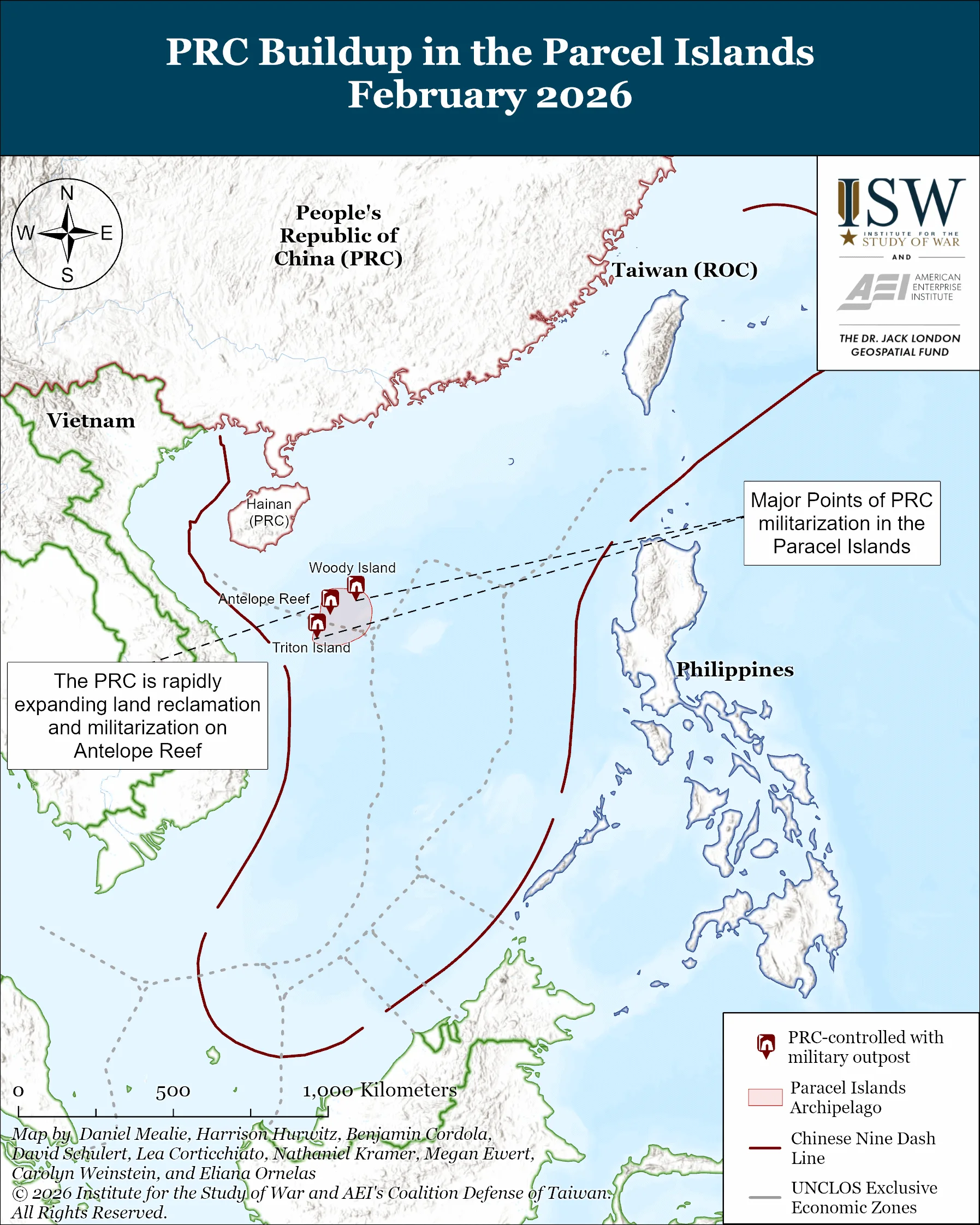
The United Kingdom-based Open Source Center reported on February 13 that the PRC is accelerating its land reclamation activities in Antelope Reef. PRC efforts in Antelope Reef are likely part of broader efforts to militarize the Paracel Islands and project PRC power in the South China Sea. The report stated that PRC construction in Antelope Reef began in December 2025, with dredgers creating an estimated 15 square kilometers of new land on the reef.[33] The PRC has since established a concrete plant, pre-fabricated shelters, and pipelines to house the workforce and support further construction on Antelope Reef. The PRC is likely to continue this construction along the reef to enhance the PRC’s military presence in the Paracel Islands. The Paracel Islands are a disputed archipelago in the South China Sea claimed by the PRC, Vietnam, and Taiwan. The PRC has controlled the entire archipelago since a 1974 battle with Vietnam. The PRC has constructed an estimated 20 outposts throughout the Paracel Islands, some of which contain military equipment and infrastructure.[34]
PRC land reclamation in the Paracel Islands allows the PRC to strengthen its territorial claims in the South China Sea, as the United Nations Convention on the Law of the Sea (UNCLOS) affords inhabitable islands different rights than uninhabited rocks. The Paracel Islands are also of significant strategic importance to the PRC.[35] The Paracel Islands are approximately 200 nautical miles south-east of Hainan, the southernmost province of the PRC. The Paracels thus serve as a useful forward operating base that allows the PRC to project power into the South China Sea. PRC surveillance systems, like those on Triton Island and Woody Island, can monitor surface and sub-surface naval activity in the region.
Northeast Asia
Japan
Japan arrested a PRC fishing boat captain for attempting to evade inspection within Japan’s exclusive economic zone (EEZ). The PRC may use maritime EEZ incursions as a form of harassment against Japan amid an ongoing diplomatic spat. Japan released the captain after detaining him for 30 hours following the capture of his ship near the Goto Islands in the East China Sea.[36] PRC Ministry of Foreign Affairs (MFA) spokesperson Lin Jian confirmed during a February 13 press conference that the PRC was working to return the fishermen.[37]
The PRC has engaged in a months-long diplomatic spat with Japan since Japanese Prime Minister Sanae Takaichi’s November 2025 statement concerning Japan’s potential involvement in a Taiwan contingency.[38] The PRC may use ostensibly civilian fishing activity within the EEZs of neighboring states, including Japan, as a low-cost means of harassment.[39] PRC fishing vessels conducted synchronized movements near Japan in December 2025 and January 2026, possibly to intimidate Japan following Takaichi’s comments.[40]
North Korea
North Korea hosted a Lunar New Year gathering for PRC Ambassador Wang Yajun and other officials from the PRC Embassy in Pyongyang at the Wonsan-Kalma Coastal Tourist Area on February 15.[41] North Korea’s Director of the Wonsan-Kalma Coastal Tourist Area Administration Kim Yong-deok told the PRC officials that the site serves to promote tourism in North Korea and that Pyongyang looks forward to exchanges and cooperation with “relevant Chinese departments.”[42] Wang said that the site would attract more domestic and international tourists, “including those from China.”[43] Wang also expressed hopes that the resort area would contribute to promoting bilateral cooperation in tourism.[44] This marks the first visit by the PRC officials to the Wonsan-Kalma Tourist Area, a 2.5-mile-long beach resort opened in July 2025.[45]
North Korea closed its borders from 2019 to 2024 due to the COVID-19 pandemic. North Korea allowed Russian tourists in 2024 and began receiving visitors from the PRC, Australia, France, Germany and the United Kingdom in February 2025, but the regime suspended non-Russian tourism after 14 days for unspecified reasons.[46] PRC tourism has not yet resumed, however. PRC tourism to North Korea reached its peak in 2018 with around 200,000 visitors.[47] Seoul-based media outlet NK News estimated that North Korea generated around 175 million US dollars in revenue through PRC tourism.[48]
North Korea’s decision to host PRC Embassy officials at its foreign tourism zone may indicate North Korea’s intentions to resume and attract PRC tourists. North Korea also reportedly featured the Wonsan-Kalma Tourist Area in a 2026 calendar issued for PRC tourists in December 2025, months after halting foreign entry in February 2025, signaling that the suspension may be temporary.[49] Potential tourism resumption for PRC nationals would provide North Korea with additional sources of revenue in foreign currency without being subject to international sanctions enforcement. North Korea has notably increased the trip cost from around 500 US dollars in 2020 to between 1,350 US dollars and 1,800 US dollars in 2025. North Korea may earn beyond 2019 estimates of 175 million US dollars if the PRC tourism recovers to a pre-pandemic level.[50]
Southeast Asia
Philippines
The United States announced on February 16 that it would expand deployments of advanced missile systems to the Philippines and enhance bilateral military cooperation. The PRC will likely perceive additional deployments as a threat to its interests in the first island chain. The United States and the Philippines held the 12th Philippines-United States Bilateral Strategic Dialogue (BSD) on February 16, during which both reaffirmed their commitments to the 1951 United States-Philippines Mutual Defense Treaty (MDT) and reiterated that MDT extends to any armed attack against either country’s armed forces, including the coast guard, anywhere in the Pacific, including the South China Sea.[51] The United States and the Philippines made a series of commitments to enhance bilateral military cooperation during the BSD, including the United States’ promise to increase deployments of advanced missiles and unmanned systems to the Philippines.
The United States deployed the Typhon missile system, a mid-range capability system capable of launching Tomahawk cruise missiles approximately 1,000 miles to the Philippines in 2024.[52] The United States and the Philippines decided to move the Typhon launchers to Luzon, in the northern Philippines, in January 2025, which would allow them to hit PRC territory.[53] The United States transferred the Navy-Marine Expeditionary Ship Interdiction System (NMESIS) to the northern Philippines Batanes Islands during combined exercises in April 2025.[54] The Batanes Islands are located between Taiwan and Luzon in the maritime chokepoints known as the Bashi Channel and Luzon Strait. NMESIS has an approximate range of 115 miles, covering the entirety of the Bashi Channel. ISW-CDOT assessed that the PRC likely perceives the placement of NMESIS on the Batanes as a threat to the effectiveness of its A2/AD, a key component of PRC military strategy.[55] The United States has not yet announced which advanced missile capabilities it will deploy to the Philippines, but the PRC is likely to view any deployment as provocative and harmful to its objectives within the first island chain.
Philippine authorities arrested a Mongolian national on February 12 on suspicion of concealing his ties to the PLA and conducting espionage for the PRC in the Philippines’ Zambales province.[56] Philippine national security and immigration authorities allege that Boldbaatar Bold-Erdene illegally hid his previous service in the PLA and his jet fighter pilot’s license from the PLA Air Force (PLAAF) Aviation University when applying for an entry visa as a flight student in Zambales.[57] Boldbaatar reportedly graduated from Mongolia’s National Defense University, and photos from Mongolia’s sports ministry and the Philippine Bureau of Immigration appear to show a younger Boldbaatar in a Mongolian Armed Forces dress uniform and camouflage fatigues, respectively.[58] It is unclear how Boldbaatar was able to enter the PLA as a non-PRC national. The PLAAF Aviation University hosts foreign air force personnel for exchange and training programs.[59] Boldbaatar may have earned his PLA jet fighter pilot’s license through one of these programs while serving in the Mongolian Armed Forces.
The authorities also accused Boldbaatar of taking aerial photographs of Zambales’s Iba Airport — reportedly used as a training ground by the Philippine Air Force —and nearby areas.[60] Iba Airport is located along the closest mainland Philippine coastline to Scarborough Shoal, a disputed maritime feature claimed by the Philippines and the PRC and occupied by the PRC since 2012.[61] The PRC regularly deploys PLA Navy and CCG ships to harass and block Philippine fishing boats and resupply vessels from sailing in or near the shoal.[62] PRC espionage operations targeting military facilities and infrastructure in the Philippines likely aim to bolster the PLA’s ability to paralyze Philippine military capabilities in a potential conflict.
Latin America
Peru ousted President José Jerí following undisclosed meetings with PRC businessmen. The PRC holds major economic interests in Peru, but Peru could be taking steps to reduce PRC influence.[63] Peru’s Congress voted to impeach Jerí on February 17.[64] Jerí’s impeachment signals that Peru may be taking steps to reduce PRC influence. The PRC is a major trading partner of Peru, which hosts numerous PRC infrastructure projects, including Chancay Port. Chancay is Latin America’s deepest port, part of the PRC’s Belt and Road Initiative (BRI), and is majority-owned by PRC state-owned enterprise COSCO.[65] The US State Department criticized Peru’s economic involvement with the PRC after a Peruvian court overruled local efforts to oversee the port.[66] The State Department’s Bureau of Western Hemisphere Affairs expressed concern that “Peru could be powerless to oversee Chancay, one of its largest ports, which is under the jurisdiction of predatory Chinese owners.”[67] The PRC has similarly sought to secure critical minerals via mining operations in Peru.[68] Jerí’s impeachment follows efforts by other Latin American countries to reduce PRC influence, including Panama’s withdrawal from BRI and decision to cancel a CK Hutchison subsidiary’s contract over two Panama Canal ports.
Africa
The PRC officially handed over control of a satellite ground station to Namibia on February 13. The PRC’s overseas satellite infrastructure projects expand the PLA’s global space-based intelligence, surveillance, and reconnaissance (ISR) and communications capabilities through its Military-Civil Fusion strategy. PRC state media outlet Xinhua stated that the PRC provided financial and technical aid to construct the Satellite Ground Data Receiving Station (SGDRS) at Namibia’s Telecom Earth Station site.[69] PRC technicians will continue to provide technical support to the station’s Namibian staff.[70] The PRC has constructed several satellite ground stations across Africa, including an earlier station in Namibia built in 2001 and operated by the PLA Aerospace Force’s Base 26 satellite tracking, telemetry, and command (TT&C) unit, as well as sites in Nigeria, Ethiopia, and Egypt.[71] The PRC frames these satellite infrastructure projects as aid to host nations, but reportedly retains access to data and imagery collected through these stations.[72] The PRC has also established or signed access agreements for similar stations in Pakistan, Venezuela, and several other South American and Southeast Asian nations.[73] Overseas satellite ground infrastructure supports the PLA’s military capabilities by allowing it to better track US and allied satellites, as well as expanding the space-based ISR coverage available to the PRC.[74] PRC publications call for the PLA to take advantage of civilian satellite technology advances through the Military-Civil Fusion strategy.[75] A recent PRC espionage operation also targeted France’s Starlink ground station in an attempt to intercept satellite communications.[76]

[1] https://www.ft.com/content/06e27fb5-bc9e-4b3d-ac20-7b54757e044e
[2] https://www.ft.com/content/06e27fb5-bc9e-4b3d-ac20-7b54757e044e
[3] https://www.bloomberg.com/news/articles/2025-07-29/taiwan-president-calls-off-us-transit-as-trump-seeks-xi-summit
[4] https://understandingwar.org/research/china-taiwan/china-taiwan-weekly-update-august-1-2025/
[5] https://www.reuters.com/world/china/taiwan-build-multi-layered-t-dome-defence-system-counter-china-threat-2025-10-10/
[6] https://www.taipeitimes dot com/News/front/archives/2026/02/14/2003852299
[7] https://www.taipeitimes dot com/News/taiwan/archives/2026/02/08/2003851974
[8] https://www.armyrecognition.com/news/army-news/2026/u-s-plans-major-patriot-pac-3-mse-sale-to-taiwan-to-counter-chinas-ballistic-missile-threat
[9] https://www.rtx.com/raytheon/what-we-do/integrated-air-and-missile-defense/nasams
[10] https://www.rtx.com/news/news-center/2025/04/21/rtxs-lower-tier-air-and-missile-defense-sensor-positioned-for-production
[11] https://api.army.mil/e2/c/downloads/2025/05/08/1888a601/tradoc-g2-how-china-fights-in-lsco-apr-25-public.pdf
[12] http://www.mod dot gov.cn/gfbw/jmsd/16429533.html
[13] https://www.cna dot com.tw/news/aipl/202601190177.aspx
[14] https://understandingwar.org/research/china-taiwan/china-taiwan-weekly-update-october-3-2025
[15] https://def.ltn.com dot tw/article/breakingnews/4370972
[16] https://www.voanews.com/a/taiwan-arrests-chinese-man-who-took-speedboat-into-taipei-harbor-/7650459.html
[17] https://www.focustaiwan dot tw/politics/202602160010
[18] https://www.ocac.gov dot tw/OCAC/Pages/Detail.aspx?nodeid=329&pid=83736480https://www.taiwannews dot com.tw/news/6302637
[19] https://www.foreign.senate.gov/press/rep/release/risch-ricketts-coons-kim-and-bera-lead-bipartisan-bicameral-letter-calling-on-taiwan-to-meet-the-moment-boost-defense-spending-to-deter-communist-china; https://www.msn.com/en-gb/news/world/us-lawmakers-step-up-pressure-on-taiwan-parliament-to-approve-defence-spending/ar-AA1WgZw6
[20] https://understandingwar.org/research/china-taiwan/china-taiwan-update-february-6-2026/
[21] https://www.fmprc.gov dot n/wjbzhd/202602/t20260214_11860087.shtml
[22] https://understandingwar.org/research/china-taiwan/china-taiwan-weekly-update-september-8-2025/
[23] https://www.scmp dot com/news/china/diplomacy/article/3343639/transatlantic-divorce-plays-out-munich-china-enjoys-silence
[24] https://www.mfa.gov dot cn/mfa_eng/wjbzhd/202402/t20240218_11246512.html ; https://www.fmprc.gov dot cn/mfa_eng/wjbzhd/202502/t20250215_11555665.html
[25] https://www.scmp dot com/news/china/diplomacy/article/3343639/transatlantic-divorce-plays-out-munich-china-enjoys-silence
[26] https://www.fmprc.gov dot cn/wjbzhd/202602/t20260214_11860162.shtml
[27] https://www.fmprc.gov dot cn/wjbzhd/202602/t20260214_11859492.shtml ; https://www.state.gov/releases/office-of-the-spokesperson/2026/02/secretary-rubios-meeting-with-director-of-the-office-of-the-ccp-central-foreign-affairs-commission-and-chinas-foreign-minister-wang-yi
[28] https://www.wsj.com/world/china/u-s-accuses-china-of-secretly-conducting-nuclear-tests-fd728b6e?mod=article_inline
[29] https://www.wsj.com/politics/national-security/u-s-hardens-allegation-that-china-conducted-a-secret-nuclear-test-644a918a?gaa_at=eafs&gaa_n=AWEtsqcCBxg1YQ9tIE0-KOdaDjgbtujGnK6ABmZaFPQ8xwy0It7XfGUy0NoE578lr_4%3D&gaa_ts=699613e4&gaa_sig=w6xP9WhagNR91lHEdBdSNWVyNS8E0ceH3LKRi-C6lF3wr3sFh6lUSkCfUp6n4c-w5psIPgBsbwdFZG5C1CN0ww%3D%3D
[30] https://www.reuters.com/world/china/us-reveals-new-details-alleged-chinese-nuclear-test-2026-02-17/
[31] https://www.washingtonpost.com/national-security/2026/02/17/china-nuclear-test-trump/
[32] https://media.defense.gov/2025/Dec/23/2003849070/-1/-1/1/ANNUAL-REPORT-TO-CONGRESS-MILITARY-AND-SECURITY-DEVELOPMENTS-INVOLVING-THE-PEOPLES-REPUBLIC-OF-CHINA-2025.PDF
[33] https://stories.opensourcecentre.org/coral-to-concrete/
[34] https://amti.csis.org/island-tracker/china/
[35] https://www.lowyinstitute.org/the-interpreter/south-china-sea-paracels-spotlight#:~:text=While%20the%20South%20China%20Sea,rather%20less%20so%20to%20Washington.
[36] https://www.nytimes.com/2026/02/14/world/asia/japan-china-boat-captain-release.html
[37] https://www.mfa.gov dot cn/web/fyrbt_673021/202602/t20260213_11858655.shtml
[38] https://www.asahi.com/ajw/articles/16182808
[39] https://www.newsweek.com/palau-says-china-news-trespassing-1985157; https://understandingwar.org/research/china-taiwan/china-taiwan-update-january-23-2026/
[40] https://understandingwar.org/research/china-taiwan/china-taiwan-update-january-23-2026/
[41] https://www.yna.co dot kr/view/AKR20260215005800504?section=nk/news/all
[42] https://www.nknews dot org/2026/02/chinese-envoy-visits-north-koreas-wonsan-kalma-resort-raises-hopes-for-tourism/#:~:text=Kim%20Jong%20Un%20officially%20opened,to%20tourists%20from%20other%20countries.
[43] https://www.nknews dot org/2026/02/chinese-envoy-visits-north-koreas-wonsan-kalma-resort-raises-hopes-for-tourism/#:~:text=Kim%20Jong%20Un%20officially%20opened,to%20tourists%20from%20other%20countries.
[44] https://mp.weixin.qq dot com/s/rZSKdqUUlQDjxBGFBVMm7w
[45] https://www.38north.org/2025/07/wonsan-kalma-beach-resort-hosts-a-high-level-visit/
[46] https://www.sixthtone dot com/news/1016723; https://www.bbc.com/news/articles/c707d1ez0kno
[47] https://www.upi dot com/Top_News/World-News/2019/09/09/North-Korea-Tourist-visits-in-2018-reached-200000/2311568039535/#:~:text=11:07%20AM-,Sept.,travelers%20to%20South%20Korea%20annually.
[48] https://www.nknews dot org/2019/10/as-chinese-tourism-to-north-korea-soars-local-operators-feel-the-strain/
[49] https://www.scmp dot com/news/asia/east-asia/article/3335934/north-korea-beckons-chinese-tourists-beach-resort-2026-calendar?module=perpetual_scroll_0&pgtype=article
[50] https://www.nknews dot org/2019/10/as-chinese-tourism-to-north-korea-soars-local-operators-feel-the-strain/; https://www.bbc.com/news/articles/c707d1ez0kno; https://www.sixthtone dot com/news/1016723
[51] https://www.state.gov/releases/2026/02/joint-statement-on-the-philippines-united-states-bilateral-strategic-dialogue/
[52] https://www.congress.gov/crs-product/IF12135
[53] https://www.navalnews.com/naval-news/2025/04/u-s-deploys-anti-ship-missiles-near-taiwan-in-the-luzon-strait/
[54] https://www.imef.marines.mil/Media-Room/Press-Releases/Announcement/Article/4168249/us-marine-corps-joint-force-deploy-nmesis-to-batanes-for-exercise-balikatan-2025/
[55] https://understandingwar.org/research/china-taiwan/china-taiwan-weekly-update-april-25-2025/
[56] https://immigration.gov.ph/bi-arrests-mongolian-man-for-suspected-espionage-linked-activities-in-zambales/ https://immigration.gov dot ph/bi-arrests-mongolian-man-for-suspected-espionage-linked-activities-in-zambales/; https://www.pna.gov dot ph/articles/1269178; https://www.pna.gov dot ph/articles/1269268
[57] https://www.abs-cbn dot com/news/regions/2026/2/17/bi-arrests-mongolian-national-for-alleged-espionage-linked-activities-in-zambales-1728; https://www.manilatimes dot net/2026/02/17/news/govt-backs-arrest-of-mongolian-who-concealed-chinese-military-background/2279236
[58] https://www.philstar dot com/headlines/2026/02/15/2508192/mongolian-nabbed-over-spy-allegations; https://sport.gov dot mn/competitions/i/501/; https://immigration.gov dot ph/bi-arrests-mongolian-man-for-suspected-espionage-linked-activities-in-zambales/
[59] https://www.airuniversity.af.edu/Portals/10/CASI/documents/Research/Other-Topics/2020-06-11%20PLA%20Academic_Institutions.pdf; https://web.archive.org/web/20201108203943/http://www.81.cn/jwgz/2017-06/13/content_7637639.htm
[60] https://immigration.gov dot ph/bi-arrests-mongolian-man-for-suspected-espionage-linked-activities-in-zambales/; https://usa.inquirer dot net/169583/iba-field-becomes-regional-airport-paf-training-site-in-zambales
[61] https://www.aei.org/articles/china-taiwan-weekly-update-july-3-2024/; https://understandingwar.org/research/china-taiwan/china-taiwan-weekly-update-july-3-2024/;
[62] https://www.aei.org/articles/china-taiwan-weekly-update-july-3-2024/; https://understandingwar.org/research/china-taiwan/china-taiwan-weekly-update-july-3-2024/; https://www.aei.org/articles/china-taiwan-weekly-update-april-18-2025/;
https://understandingwar.org/research/china-taiwan/china-taiwan-weekly-update-april-18-2025/; https://www.aei.org/articles/china-taiwan-weekly-update-october-24-2025/; https://understandingwar.org/research/china-taiwan/china-taiwan-weekly-update-october-24-2025/;
[63] https://www.aiddata.org/blog/chancay-port-opens-as-chinas-gateway-to-south-america
[64] https://www.nytimes.com/2026/02/17/world/americas/peru-president-jose-jeri-impeachment.html
[65] https://apnews.com/article/peru-china-us-chancay-port-cosco-shipping-74aa6feb42b9788685483829dc9cf6bf
[66] https://apnews.com/article/peru-china-us-chancay-port-cosco-shipping-74aa6feb42b9788685483829dc9cf6bf
[67] https://x.com/WHAAsstSecty/status/2021617772854460897; https://apnews.com/article/peru-china-us-chancay-port-cosco-shipping-74aa6feb42b9788685483829dc9cf6bf
[68] https://www.aiddata.org/blog/chasing-copper-and-cobalt-chinas-mining-operations-in-peru-and-the-drc
[69] https://english.news dot cn/20260213/ac98481f75d04d62940dd4f79d74b953/c.html; https://www.reuters.com/business/media-telecom/china-hands-over-satellite-ground-station-namibia-state-media-reports-2026-02-13/
[70] https://english.news dot cn/20260213/ac98481f75d04d62940dd4f79d74b953/c.html; https://www.reuters.com/business/media-telecom/china-hands-over-satellite-ground-station-namibia-state-media-reports-2026-02-13/
[71] https://www.airuniversity.af.edu/Portals/10/CASI/documents/Research/CASI%20Articles/2022-08-08%20China’s%20Space%20Program%20Through%20The%20Lens%20of%20Irregular%20Warfare%20Theory.pdf; https://jamestown.org/pla-military-aerospace-force-on-the-frontier-of-innovation-and-competition/; https://www.reuters.com/investigations/china-builds-space-alliances-africa-trump-cuts-foreign-aid-2025-02-11/; https://features.csis.org/hiddenreach/china-space-diplomacy-global-south/; https://www.washingtonpost.com/world/interactive/2023/china-space-program-south-america-defense/
[72] https://www.reuters.com/investigations/china-builds-space-alliances-africa-trump-cuts-foreign-aid-2025-02-11/; https://www.reuters.com/business/media-telecom/china-hands-over-satellite-ground-station-namibia-state-media-reports-2026-02-13/; https://features.csis.org/hiddenreach/china-space-diplomacy-global-south/
[73] https://features.csis.org/hiddenreach/china-space-diplomacy-global-south/; https://www.uscc.gov/research/china-venezuela-fact-sheet-short-primer-relationship; https://www.washingtonpost.com/world/interactive/2023/china-space-program-south-america-defense/
[74] https://features.csis.org/hiddenreach/china-space-diplomacy-global-south/; https://www.reuters.com/investigations/china-builds-space-alliances-africa-trump-cuts-foreign-aid-2025-02-11/
[75] https://www.scmp dot com/news/china/diplomacy/article/3343762/why-china-being-urged-integrate-commercial-space-tech-military-systems
[76] https://www.aei.org/articles/china-taiwan-update-february-13-2026/; https://understandingwar.org/research/china-taiwan/china-taiwan-update-february-13-2026/