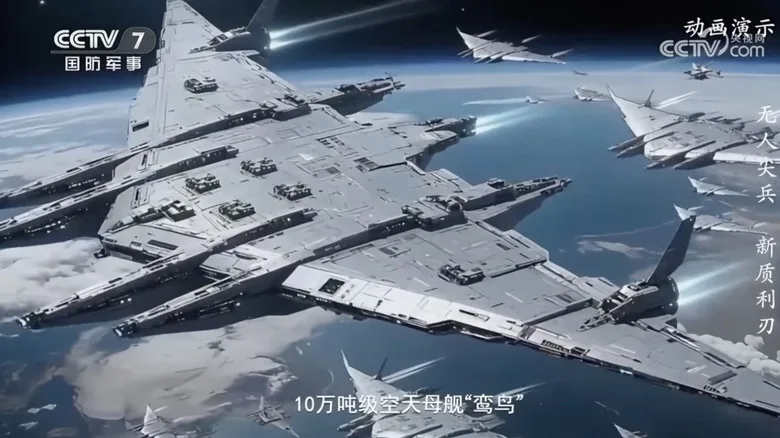
Chinese state broadcaster CCTV has shown what might be the wildest concept video to come out of Beijing in years. It’s basically a rendered clip of a whole fleet of massive triangular grey motherships hovering at the edge of the Earth’s atmosphere, firing weapons into orbit and deploying futuristic fighter jets. Now, we’ve seen plenty of artists dream up what military gear might look like decades from now, but a state broadcaster actively pitching a ship straight out of a Star Wars movie is a different story. But perhaps the most surprising bit is the claim that this carrier might become operational in the next 20-30 years.
The carrier is called Luanniao, which is a mythological creature in Chinese folklore. Meanwhile, those jets are called Xuannu after a Chinese goddess of war. These jets are described as highly manoeuvrable stealth aircraft capable of operating outside the atmosphere. Excerpts from the broadcast have been making the rounds online, including a YouTube recording with optional English subtitles.
Read more: 13 Countries That Make Their Own Fighter Jets
An oddly descriptive clip

A swarm of Luanniao motherships – CCTV/YouTube
CCTV has also provided some numbers behind the Luanniao. The craft would measure 242 metres long and 684 metres wide, with a maximum takeoff weight of 120,000 tons. For some context, the USS Gerald R. Ford — the largest aircraft carrier currently in service for the US Navy — is about 337 metres long, 78 metres wide, and weighs roughly 100,000 tons fully loaded. Now, it may sound like the Gerald dwarfs the Luanniao because of the lengthier build, but the latter is far more colossal in terms of area because of its significantly wider wingspan. That’s apparent from the fact that it’s designed to carry up to 88 of those Xuannu unmanned fighters.
It’s worth noting that the Luanniao is the flagship piece of the Nantianmen Project, which translates to “South Heavenly Gate.” It was first proposed in 2017 by AVIC, the Aviation Industry Corporation of China, and it encompasses a whole suite of next-generation aerospace weapons.
But while most of the crafts seen in the clip are firmly in the sci-fi territory for now, there’s one slightly more tangible part as well: The Baidi, a sixth-generation fighter that had a life-sized mockup revealed at the 2024 Zhuhai Airshow. Another element is the Zihuo, a vertical takeoff and landing fighter equipped with an AI system for autonomous decision-making. Models of these have been popping up at Chinese defence exhibitions over the past couple of years. This has led some analysts to believe development has moved beyond the earliest phases. Moreover, it doesn’t help that China already has a separate, tangible flying aircraft carrier undergoing testing – though it’s designed to launch drones rather than full-sized aircraft.
Not everyone’s convinced

The Luanniao mothership flying alongside Xuannu jets – CCTV/YouTube
Building sixth-generation fighter jets is one thing, especially since prototypes of those like the J-36, with all of its unusual features, and the J-50 have already been spotted. But a flying mothership the size of an ocean supertanker is a wholly different story. So it’s unsurprising to see defense experts approach the news with a healthy dose of salt.
Peter Layton, a defence expert and visiting fellow at Australia’s Griffith Asia Institute, told The Telegraph that if the Luanniao were ever completed, it would “outclass pretty much everyone.” He pointed out that something like this would fly above surface-to-air missiles, other fighter aircraft, and most defensive systems entirely. But more importantly, he also said the technology needed to make a 120,000-ton aircraft hover at the edge of Earth’s atmosphere simply doesn’t exist yet.
Then there’s the more blunt take from German diplomat and space analyst Heinrich Kreft. In an interview with DW, he called the project “humbug” and “psychological warfare.” But he also warned against dismissing it outright, noting that China is actively working “on all conceivable future projects and weapons systems” and may be further ahead in fields like laser technology than anyone else.
Finally, we have The National Interest, which, in an article from September 2025, framed the whole thing as part of a “wider propaganda push” designed to make the West nervous. The report asserts that it could even be a potential bait to trick the US into overspending.
All in all, the consensus seems to be that the technology needed to make any of this work doesn’t exist yet, and that this is probably more of a flex. But as multiple experts have pointed out, writing off China’s ambitions has consistently been a bad call.
Want the latest in tech and auto trends? Subscribe to our free newsletter for the latest headlines, expert guides, and how-to tips, one email at a time. You can also add us as a preferred search source on Google.
Read the original article on SlashGear.