_0.png?itok=9dpkKjKF)
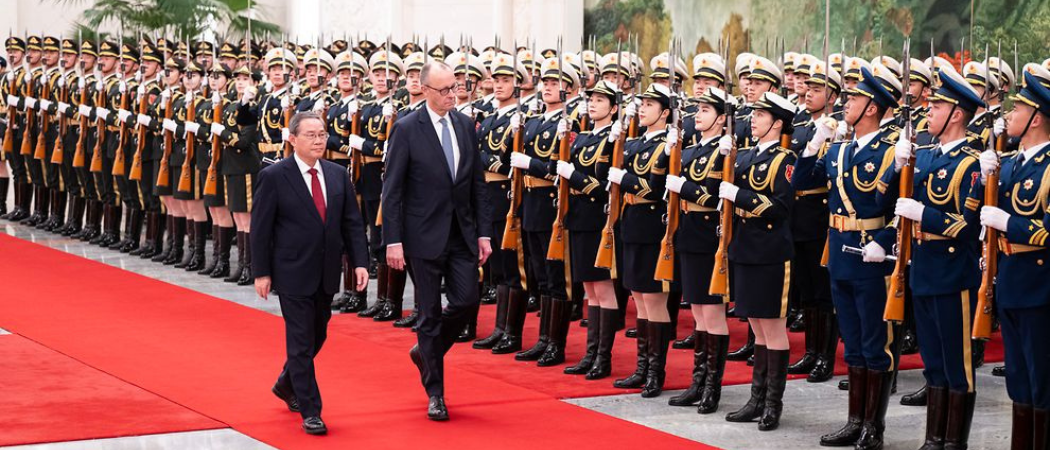
Chinese science diplomats are making the case in Brussels and elsewhere that Europe should swing back to Beijing after US President Donald Trump’s threat last month to forcibly seize the Danish territory of Greenland.Although Trump climbed down, for now, at a charged Davos summit in Switzerland at the end of January, the previously unthinkable idea that the US could turn its military on European allies stunned the continent, accelerating conversations about de-risking relations with the US, including in science and technology. This has spurred a fresh debate over Europe’s science and technology strategy, with some signs the broader transatlantic rift could lead to a rapprochement with China. Earlier this month, a delegation of German universities visited Hong Kong and Shenzhen to scope out new collaborations. And in January, the Technical University of Munich signed an expanded cooperation deal with Tsinghau University in Beijing. This week, German Chancellor Friedrich Merz is visiting China for the first time, including the tech hub of Hangzhou to see German and Chinese technology firms. The Chinese side, meanwhile, is pushing for a “two-way flow of talent, knowledge and technology”. In November last year, the UK science minister visited Beijing to discuss collaborating, although sensitive research areas are still off the table. “There seems to be some sort of reproachment with China among European actors,” said Anna Lisa Ahlers, head of a Berlin-based Max Planck Institute research group studying China in the global system of science. Jeff Stoff, a US-based research security analyst who has worked on German scientific links with Chinese military institutions, also reports seeing anecdotal evidence of Canada and Germany reaching out more to China in response to the rift with the US.Discussions in Germany about whether to re-engage with China started when Trump threatened US university funding after taking office, said Antonia Hmaidi, an expert on Chinese technology at the Mercator Institute for China Studies in Berlin. “There were some discussions around, what is the risk of not cooperating [with China]?” she said.But this year, the Chinese side has ramped up its lobbying of German universities and companies, she said. “We’ve seen a more concerted effort, to my mind, to reach out and to position themselves as the sane option.”De-riskingA pivot back to Beijing would come after the EU and some of its member states spent years “de-risking” from China after criticism that European universities naively embarked on joint research projects that could aid the Chinese military or surveillance state, and disproportionately let knowledge flow to the Chinese side. Last November, the EU ejected Chinese universities from half of its €93.5 billion Horizon Europe research programme. This followed a rule change in 2023 that kicked China out of close-to-market innovation projects. Collaboration is now largely restricted to environmental and agricultural projects. Beijing and Brussels remain at loggerheads over a mooted new roadmap that would structure their science and technology cooperation. The EU still has concerns European companies don’t get an even playing field in China when it comes to areas such as intellectual property (IP) and public procurement. Lack of IP protectionDespite the Greenland threats, there’s no sign that Brussels will relax its rules on Chinese cooperation in Horizon Europe. And a number of voices warn against swinging back towards China, just because of a rift with the US. Europe should “not bend over backwards to please the Chinese and close one eye over the lack of protection of IP rules simply because our friends on the other side of the pond are no longer our friends,” said Robert-Jan Smits, former head of the research and innovation directorate-general at the European Commission.In the Netherlands, where research cooperation with China has come under intense scrutiny, the appointment of Chinese researchers “has almost come to a halt,” he said. Horrifyingly dangerousThe Ukraine war is also a major sticking point, with multiplereports that China is surreptitiously helping Moscow’s invasion by exporting dual-use technology to Russia. “While the EU rethinks its priorities due to uncertainties with the Trump administration’s foreign policies, the notion that EU nations would consider China a more reliable partner than the US is horrifyingly dangerous,” said Stoff, who previously worked in the US intelligence community. “Has the EU already forgotten that China is probably the only reason why Russia is still able to prosecute its war in Ukraine?”Related articlesExplained: China has been kicked out of most of Horizon EuropeEU plans to ban Chinese universities from half of Horizon EuropeBans, flagships, and a green pivot: the state of EU-China research relationsAccording to Hmaidi, however, the rift with the US could be a chance for Europe to re-establish links with China “on a new footing” where there is a “two-way flow of IP.” But it would be “terrible” for Europe to revert to its previous arrangement with China, in which IP flow was one-sided and Beijing was “able to cherry pick and choose whichever partners would be useful for them,” she said. Other partnersRather than scurrying between the US and China, observers such as Smits want the EU to focus on links with scientific middle powers, such as India, Japan, Canada and South Korea. The Commission has already opened up parts of Horizon Europe to countries across the globe, and last month inked a range of cooperation deals with India. “There is a lot of frustration at the reliance on the US and China,” said one research security advisor at a large European research university, who wished to remain anonymous. “I think the EU will continue to be proactive in building links with South America, India, Japan, Korea etc, including in Horizon [Europe]. This is one part of the strategy to hedge against China/US.” During a visit by French President Emmanuel Macron to India earlier this month, Paris-Saclay University announced a series of deals with Indian institutions. The French defence firm Safran also announced a joint computer science and artificial intelligence bachelors programme with the Birla Institute of Technology and Science, based in Rajasthan.US military partnershipsThe Greenland crisis has also opened the question of whether Europe should curtail research partnerships with the US military. The US army, air force and navy all have research offices based at an Imperial College London innovation hub, for example.Earlier this month, Hugh Brady, Imperial’s president, said the university would not withdraw from such partnerships. “Nato still exists,” he said during a panel at Science|Business’s annual conference in Brussels. However, Imperial would “diversify” its partnerships and “build resilience and scale into our own system,” Brady went on. Behind the scenes, at least one EU government is stepping up scrutiny of defence-related research partnerships with the US following the Greenland threat, one research leader told Science|Business. However, Chinese universities are still systematically riskier partners than their US counterparts, argued LJ Eads, a former US air force intelligence analyst who runs Data Abyss, a company offering to track research projects with Chinese defence-related institutions. “China embeds technology and talent transfer mechanisms directly into institutional cooperation frameworks,” he said. “All Chinese universities operate under explicit Party oversight structures.” While the Greenland crisis may make the US seem less of a reliable partner, “it does not alter the structural characteristics of China’s research system.” he said. The European Commission and the Chinese Mission to the EU did not respond to requests for comment.
Visited 1 times, 1 visit(s) today

