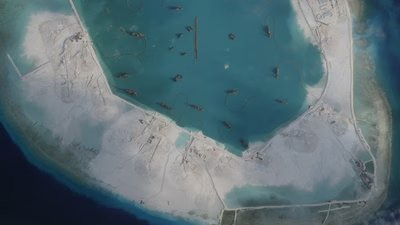
After a hiatus of nearly a decade, China is jump-starting its island-building campaign in the South China Sea—and turning a once-obscure reef into what could be its largest military base in the disputed waters.

The construction at Antelope Reef could give Beijing another runway, more missile facilities and additional surveillance installations, analysts say, and serve as a backup to its existing military footprint in the region. And because it is relatively close to the Chinese mainland, it also offers Beijing a chance to increase civilian infrastructure, bolstering its argument that the area is part of China.
The status of the South China Sea has long been disputed between China and countries in the region. Beijing’s island-building campaign has strengthened its hold on the waterway and given it control of a thoroughfare that would be vital in any conflict over Taiwan, the self-governing island that Beijing claims. The U.S., meanwhile, has supported other countries such as the Philippines in pushing back against the Chinese claims.
The work at Antelope Reef, which according to satellite imagery includes jetties, a helipad, gray-roofed structures and a new coastline that looks suitable to be a runway, caught some analysts by surprise. Antelope Reef is in the Paracel Islands, an archipelago in the northern part of the South China Sea that is firmly controlled by China, though Vietnam and Taiwan also have claims there.
Recent flashpoints have been around Scarborough Shoal in the east and in the more-disputed Spratly Islands further south. Vietnam has embarked on an island-building campaign of its own in the Spratlys, and has been rapidly catching up to China in creating new land.
“This is the first time in a long time that they have reopened this basket of being able to build islands extremely large and extremely quickly,” Harrison Prétat, deputy director at the Asia Maritime Transparency Initiative at the Center for Strategic and International Studies in Washington, said of the work at Antelope Reef.
“This could be a response to show Vietnam and maybe show others that China’s not going to be outdone, and they’re not going to sit by while someone else builds up their own outposts,” Prétat added, though he noted other factors are probably also at play.
A CSIS analysis of satellite imagery determined that the area of reclaimed land at Antelope Reef was roughly 1,490 acres so far, already about the same size as Mischief Reef in the Spratlys, which is China’s largest outpost and measures some 1,504 acres. China’s largest island in the Paracels, Woody Island, which hosts an air and naval base and a town that administers the region, measures 890 acres, according to CSIS.
Vietnam’s foreign ministry has protested the work at Antelope Reef, saying any foreign activities in the Paracels without Vietnamese permission are illegal.
Chinese officials have called the Paracels their inherent territory. “Necessary construction on our own territory is aimed at improving living and working conditions on the islands and growing the local economy,” a Chinese foreign ministry spokesman said.
There has been no international ruling on which country has sovereignty over the Paracels. A 2016 ruling from a tribunal at the Permanent Court of Arbitration in The Hague, however, effectively invalidated the basis for China’s historic maritime claims to most of the South China Sea, its so-called nine-dash line.
The work at Antelope may not be a strategic game-changer because China already has a steady grip on the Paracels. But it could still pose a problem for the U.S. and allies if there is a conflict over Taiwan.
A dredged lagoon at Antelope Reef could host navy vessels, including submarines, and perhaps even China’s new aircraft carriers and coastguard ships, said Collin Koh, a senior fellow at the S. Rajaratnam School of International Studies in Singapore. If fighting erupts over Taiwan, military bases in the Paracels will be more useful to China than outposts in the Spratlys, which are farther south from the mainland and could be cut off, he said.
“If we are talking about a scenario where China might be preparing for potential, real high-intensity operations, then the Paracels buildup makes sense,” he said.
The U.S. has long opposed China’s construction of artificial islands in the South China Sea. It is “something I think all of us that care about international laws should be concerned about,” Adm. Daryl Caudle, the Navy’s chief of naval operations, told reporters during a recent visit to Australia. “It doesn’t follow the rules of the sea.”
Although work at Antelope Reef appears to have started before the Trump administration’s military action in Venezuela and Iran, analysts said Beijing will likely benefit from Washington’s attention being elsewhere. A recent threat assessment from the U.S. intelligence community also dialed back the view that China could invade Taiwan by next year.
“Beijing probably saw that the administration’s focus is not particularly on the South China Sea,” Prétat said. “It’s kind of up in the air—how hawkish are they on China, or how hawkish is the president on China?”
Write to Mike Cherney at mike.cherney@wsj.com