This article is part of a series sharing the stories of startups developing innovative solutions to environmental challenges and how they are pushing their business forward even as the Trump Administration champions fossil fuels and slashes funding for green projects. Read all the stories here.
What’s a hurd? A key clue to what this startup company does, for one.
It’s the inner core of the hemp plant that remains after the fibers, seeds and flowers have been removed, what’s left after the traditionally valuable parts are put to various uses. That’s still 70% to 90% of the plant and that’s where Taylor Heisley-Cook and David Mun come in.
They are making clothes from agricultural waste — or more precisely their company takes that biomass and turns it into a new and sustainable material for fabric.
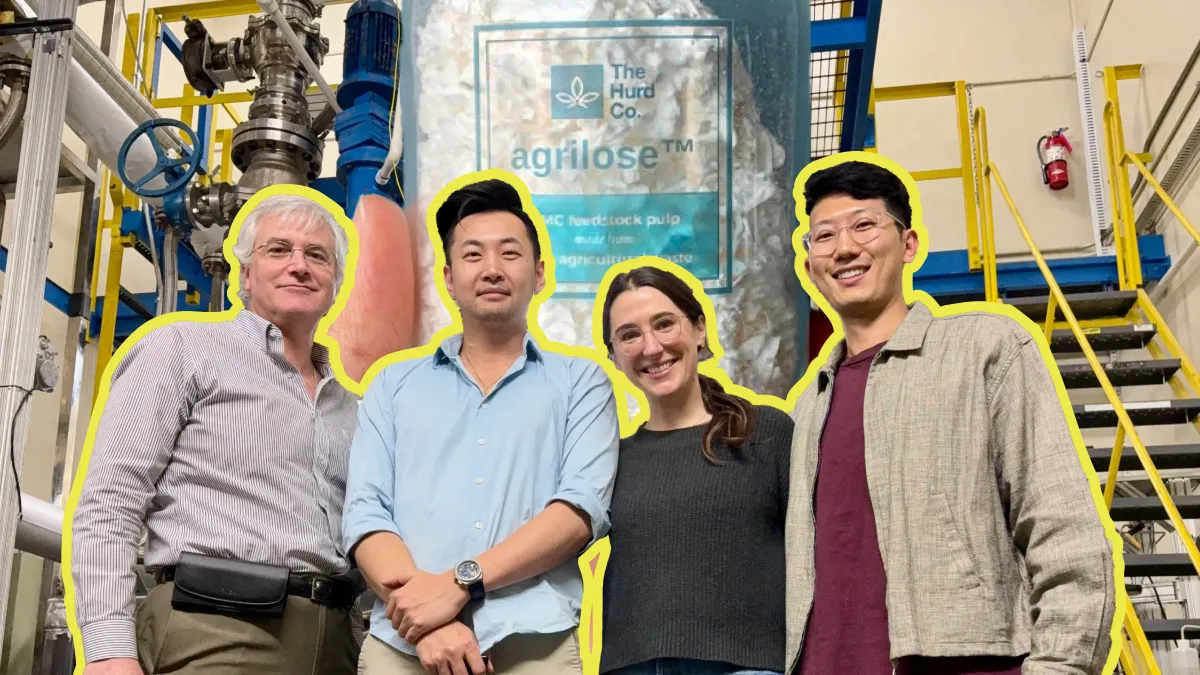
The Hurd Co. began as a thesis project at the University of California, Santa Barbara, where Heisley-Cook and Mun met at the Bren School of Environmental Science and Management, and today they have built a pilot facility with a capacity to produce 10 kilograms of pulp each day. That’s enough to make sample garments.
“So that’s where we got our start,” Heisely-Cook said. “That’s where we got our name.”
Heisley-Cook has long been a self-described “fabric nerd,” learning to sew as a six-year-old from her grandmother and making her own clothes. She grew up in Los Angeles but her family is from a farm in Ohio and so she was familiar with agricultural waste. Even so she was surprised at just how much there was.
There’s a much bigger opportunity for impact if we’re able to produce clothing that everybody can afford.
Taylor Heisley-Cook
The business of changing fashion
To move away from fast fashion and environmentally unsuitable fabrics, the industry needs a sustainable source. Fibers such as viscose, rayon, lyocell and modal are derived from wood pulp, then undergo a chemical process to create fabric and so fall into a class called man-made cellulosic fabric. The Hurd Co. is substituting the agriculture waste for trees to create a man-made cellulosic pulp it calls agrilose.
“So it’s the same quality cellulose,” Heisley-Cook said “Manufacturers can use it the same way. And we are able to offer it at the same price — once we are actually in the production phase.”
The Hurd Co. is working with four brands, which Heisley-Cook declined to name, that will produce sample garments. The fabrics are soft and they drape and are used to make clothes that flow, dresses and skirts for example.
Heisley-Cook and Mun first made sure that they could produce their cellulose, then shifted to creating their supply chain, identifying their waste suppliers, signing contracts with their partner brands and building the pilot facility.
Still in its early stages, the company raised a round of funds from friends and relatives, its angel round, and now is in its seed round and received grants from the U.S. Department of Energy and the California Almond Board.
The company also participated in the Berkeley SkyDeck, a business accelerator at the University of California, Berkeley, that helps students, alumni and faculty get their scientific and technical discoveries to market. Twenty startups — typically ones almost ready for their first round of funding from top Silicon Valley venture capital funds — are chosen every six months to receive $200,000 from the related Berkeley SkyDeck Fund.
Federal funding has been crucial to the work at universities, “the bedrock of so many great innovations that have come out of Berkeley and other universities,” said Darren Cooke, the UC Berkeley’s interim chief innovation and entrepreneurship officer. But research universities have been facing rocky times and so UC Berkeley has been investigating other forms of funding.
This year, it is launching a venture capital fund within the University of California. Called the Berkeley Chancellor’s Fund, and capitalized through philanthropic donations, it will provide investments for university-affiliated startups.
As far as the Hurd Co., Heisley-Cook said people cannot make sustainable choices unless they can afford sustainable options. It is planning to keep its prices in line with the pulp currently based on trees.