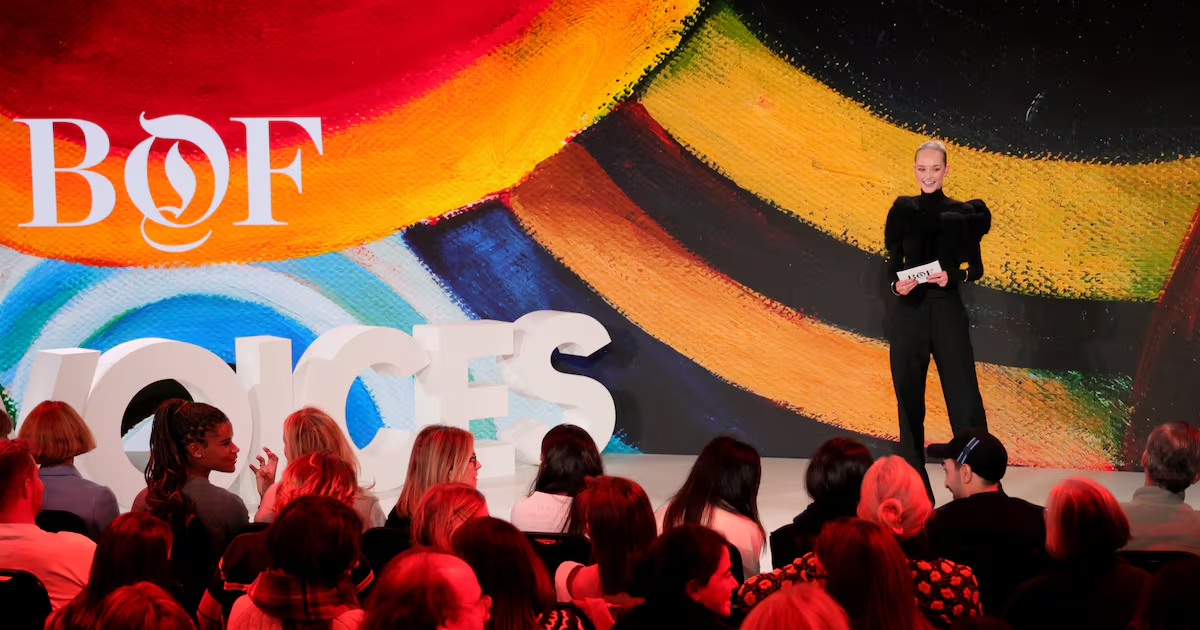
OXFORDSHIRE, United Kingdom — At Soho Farmhouse, the amphitheatre for BoF VOICES 2025 glowed red as British-American musician Anoushka Shankar filled the room with the calming texture of a traditional Indian sitar.
“Stolen Moments” was the song — a creative work born from a difficult period in Shankar’s life: a divorced single mother of two, prepping for a tour, managing a tough afternoon with her children. She took them to the garden, nestling the ill one in her arm and as the other played on a nearby trampoline and the sun broke through the trees as she practiced the sitar.
“The moment really crystallised for me … something to hold on to,” the Grammy-award winner told VOICES attendees. “Over the next [few] days, I found myself coming back to that … I realised it was possible, if I was truly present, not caught up in my head or in worries or thoughts, I could really fully experience these moments of joy,”
Lessons like those — including another about a mantra she learned from Alcoholics Anonymous referencing addiction “that we ‘could’ be restored return to sanity” — have inspired a stream of new works for Shankar, whose session discussed overcoming creative numbness post-pandemic and personal struggles, including addiction, sexual abuse and health issues.
“I always thought that word “could” was the most important word and the most interesting word, because … it doesn’t say we will definitely guarantee you sanity,” Shankar said.
Rather, she said, it’s “just enough that we believe something could change.” That sentiment also underscored a central theme of the fifth and final session of VOICES 2025: the power of hope. That amidst rampant geopolitical tension, multiple ongoing wars, economic pressure, and the rollback of diversity and climate initiatives across both private companies and the public sector, there remains an opportunity to return to progress.
Reframing Pain
The last few years have brought no shortage of pain points for people working in fashion and living in the broader world — and much like the solutions brands are chasing, whether around AI, tariffs or waning consumer sentiment, panelists during Session 5 argued that the answer is less about controlling the uncontrollable and more about reframing it.
Jean Campbell, the British fashion model and host of the podcast “I’m Fine,” told VOICES attendees she has struggled with chronic pain since age 12, undergoing five surgeries, spending two months in a wheelchair, six months on crutches and three years learning to walk again.
The process, she said, led to unhealthy, numbing habits — chemical dependency and habitual “disassociating” — because she didn’t know how to manage the physical and psychological symptoms of pain. Connecting with other people, something she resisted for years, ultimately inspired her to launch “I’m Fine” in 2024.
Her “a-ha” moment centred on the idea of choice — even when the pain wasn’t.
“My prognosis was a fact, but my interpretation of it was not and my beliefs could be changed,” she said. “Pain can be an education … but also something that can lead to our relationships with ourselves, the people that we know, the people that we’re yet to meet, and also our relationship with the world.”
Next, Anthony “Staz” Stazicker, who co-founded the British high-performance outerwear brand ThruDark alongside Louis Tinsley, both retired Special Forces military veterans, recounted losing his mother at age 11 and learning early that life isn’t fair.
“[It] completely tore me apart,” he said, but it also “set fire inside my soul.”
He found purpose in the Special Forces and developed a fascination with the utilitarian garments — camouflage and other technical pieces — they wore. That curiosity inspired the creation of the brand, built around high-performance gear for extreme conditions. The two make it a point to put their garments to the test, the latest and perhaps most extreme came in May, Stazicker and Tinsley put those principles to the test with a speed ascent of Mount Everest.
“I wanted to prove that my mindset could withstand the ultimate test,” Stazicker said. “Standing on top of the summit wasn’t a victory lap, it was the culmination of everything — my upbringing, the loss, the setbacks, the military lessons, the failures, the resilience, teamwork, camaraderie. Everest reaffirms that adversity is not a barrier, it’s a blueprint.”
Reframing doesn’t just apply to health crises or high-stakes military missions, session five speakers noted. It also applies to the very practical, everyday realities facing many fashion professionals in an age defined by AI disruption and macroeconomic uncertainty: layoffs.
Laura Brown, the former editor-in-chief of InStyle, who was laid off in 2022, and WSJ. Magazine editor-in-chief Kristina O’Neill, who was fired from her role the following year, took the stage with moderator and journalist Monita Rajpal to discuss how they turned their perceived misfortune into a book: “All the Cool Girls Get Fired: How to Let Go of Being Let Go and Come Back on Top”, released in October. On stage, they emphasised the importance of separating self-worth from job titles and tackling the practical realities of termination, from healthcare to legal advice.
The book also examines the early-career firings of high-profile women, including Oprah Winfrey, Jamie Lee Curtis and Katie Couric — women who went on to reach “new stratospheres” far beyond those initial roles, as Brown described it. The lesson, particularly in industries like fashion where identity is often deeply tied to one’s job, is that being fired can create the space to redefine one’s worth on one’s own terms and unlock opportunities that a day-to-day role can obscure. As O’Neill put it, sometimes it becomes “the best thing that ever happened to me.”
“When you are fired and you embark on a conversation or a journey about what you want to happen next, the world is your oyster,” O’Neill said. “You’re able to make choices that — when your head is down and you’re working so hard — you don’t have time to recalibrate when you’re responding [to the day to day].”
Miracles Still Happen
Rohan Silva, founder and chief executive of Second Home & Libreria Bookshop, told VOICES attendees how he and his wife, Katie Silva, spent years navigating infertility before having their first child in 2018. A long effort to have a second baby ended in heartbreak in 2022, when their daughter Zola, born at 31 weeks, died shortly after birth.
When they tried again in 2024 through a surrogate, they ended up with two children: one carried by the surrogate they had enlisted, and another by Katie, who unexpectedly became pregnant soon after.
Doctors told the Silvas the phenomenon had a name, “California twins.”
For Silva, it was the outcome of something “we never even dreamed.”
“Miracles happen and you can be positive at the end of a lot of pain,” he said.
Awar Odhiang, the Canadian model born in a refugee camp in Ethiopia before her family resettled in Calgary, was discovered while folding a sweater in the clothing store where she worked. Her career went global in 2019, and today she walks more than 60 shows per season. Her closeout of Matthieu Blazy’s first Chanel show at Paris Fashion Week in October became a viral sensation, her joyful, swirling walk capturing global attention.
Her runway résumé spans Louis Vuitton, Gucci, Versace, Moschino and Dolce & Gabbana, underscoring her international reach and magnetic presence.
But it’s a far leap from her early ambitions — studying medicine — and a world she once saw as “different from my reality, different from my dreams.” The fact that she broke through has pushed Odhiang to advocate for systemic change for other Black models from the diaspora, as she continues to find herself an “only” in many fashion rooms.
“Consistency is key and really showing up for everybody,” she said. “And taking lived experiences seriously — brands really need to stop asking the same people to share the same stories without really changing the system … we can move towards a better future for every single person.”
BoF VOICES 2025 is made possible in part by our partners McKinsey & Company, Amazon Fashion, Pixel Moda, Value Retail, Certilogo, Swap Commerce, Soho House, Wheely and Getty Images.