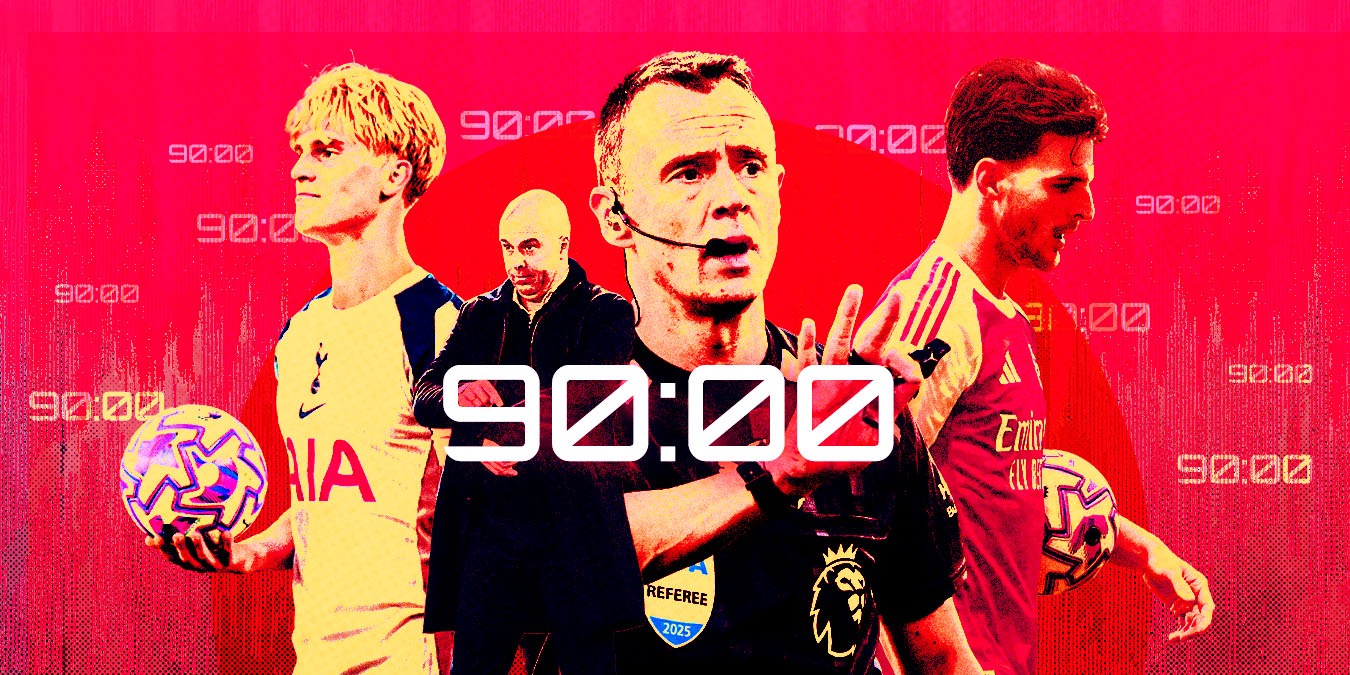
With set-pieces and
throw-ins increasing this season, are we seeing less of the ball in
play in the Premier
League? We dig into the data to find out.
The start of every football match brings a little flutter in the
stomach, especially if it involves your team, wondering what could
occur over the next 90+ minutes.
Will the star players perform well? Will the referee have a good
game by giving your team every decision? And will the football gods
shine down just the right amount of fortune?
A slightly more pertinent question to ask this season, though,
is how much football will we actually see?
If you’re familiar with our work here at Opta Analyst,
you might remember
our article from a couple of seasons ago on ball-in-play time,
when we revealed that Premier League fans weren’t seeing quite as
much open-play football in games as previous years.
We’re not saying that our data nosiness directly led to key
changes such as more stoppage time being added in games, but we’re
also not not saying that was the case. After all, there
was a notable rise in ball-in-play time in the Premier League over
the following two campaigns, more than we’d ever seen before (on
record). Average ball-in-play time per game went up from 54 minutes
and 49 seconds in 2022-23, to 58 minutes and 11 seconds in
2023-24.
It’s still early in the 2025-26 season, but the pendulum may be
swinging back the other way.
We recently wrote about how the early weeks of the new campaign
have seen a greater focus on set-pieces, especially long
throws, and that led us to consider the impact on ball-in-play
time.
But seven matchdays in, just how much of a difference has there
been?
How Much
Is the Ball in Play in 2025-26?
We have seen an average ball-in-play time of 55 minutes exactly
per game this season after 70 matches, almost two full minutes
fewer than last season (56 mins, 59 secs) and over three minutes
fewer than 2023-24 (58 mins, 11 secs).
You might think it just means added time isn’t as long as it was
the last two seasons, but at the moment the overall length of games
including stoppage time (100 mins, 35 secs) is second only to the
2023-24 campaign (101 mins, 36 secs) in Premier League history on
record (since 2006-07). Games are lasting on average 51 seconds
longer than last season (99 mins, 44 secs), even though, as
mentioned, the ball is in play for almost two minutes fewer.
That means, on average, each game this season has no ball in
play for a total of two minutes and 50 seconds longer than last
season, roughly the time it would take to listen to You’re the
One That I Want by John Travolta and Olivia Newton-John.
In total, games are averaging 45 minutes and 35 seconds of
delays/pauses during play this season (up from 42 minutes and 45
seconds last season), or roughly one episode of Countdown.
We could all be struggling to solve a conundrum instead of watching
someone saunter over slowly to take a corner in stoppage time.
For clarity, our definition of a ‘delay’ is the time between the
ball going out of play and play resuming across corners, free
kicks, throw-ins, goal kicks, kick-offs, penalties and drop
balls.
In terms of overall ball-in-play time across full seasons since
2010-11, it has only been lower than 55 minutes twice, clocking an
average of 54 minutes and 45 seconds in 2021-22 and just four
seconds longer in 2022-23.
However, as you may have already realised given those two
seasons pre-date the lengthy stoppage time we have seen since the
start of 2023-24, this season is comparatively low for BIP time
when looking at it as a percentage. The ball has been in play for
just 54.7% of games on average in the Premier League this season;
the lowest it’s been over the past 10 full seasons is 55.7%, which
was in 2022-23.
Looking at specific teams, Everton
have had the shortest overall total time on the pitch this season
(690 mins, 6 secs), yet their ball-in-play time is over 19 minutes
longer than Newcastle
United, despite the Magpies’ total time on pitch being over 21
minutes longer than David Moyes’ men.
Despite being recently promoted and considered underdogs in most
of their games, Leeds
United are averaging the longest ball-in-play time in the
Premier League this season at 56 minutes and 48 seconds (57.5% of
total match minutes). It either means Daniel Farke is happy for his
side to get on with it, or the opposition are generally doing their
utmost to keep the ball in play.

Newcastle have seen the ball in play during their games for the
lowest proportion at 52.3% (53 mins, 9 secs on average), closely
followed by Chelsea
(52.6%) and Manchester
United (52.7%). Again, though, this could have just as much to
do with the approach of their opponents than those teams always
seeking to take time out of a game.
Having said that, one match in particular will be dragging
Newcastle’s numbers down.
The
Longest Shortest Game
Newcastle’s five-goal thriller against Liverpool on Matchday 2
is the game with the lowest ball-in-play time this season, which is
quite something when you consider it lasted 109 minutes and 24
seconds in total, the third longest of any Premier League match in
2025-26.
One likely reason is the number of fouls awarded in the game,
with 31 given by referee Simon Hooper on the night, the
joint-second most in a Premier League match this term. The total
delay for taking free-kicks in the game was an astonishing 27
minutes and seven seconds, around seven and a half minutes longer
than any other Premier League game this season.
Newcastle averaged 67 seconds per free-kick, at least 10 seconds
longer than any other team has averaged in a single game in the
Premier League after seven matchdays in 2025-26.
That likely factored into there being 13 minutes and 43 seconds
of stoppage time played in the second half, the most in a Premier
League game this season. Despite that, the ball was in play for
just 45 minutes and 55 seconds (42%) at St. James’ Park. That means
for 63 minutes and 29 seconds of that game, nothing was happening.
In hindsight, it’s quite astonishing that there were five goals,
including Rio
Ngumoha’s dramatic late winner for Liverpool.
Not far behind was Chelsea’s 3-1 home defeat to Brighton
just a couple of weeks ago, when the ball was only in play for 46
minutes and 44 seconds out of a total match time of 105 minutes and
14 seconds (44.4%).

At the other end of the scale, the game with the best value has
been
Wolves vs Leeds on MD5, with the ball in play for 62 minutes
and 13 seconds out of a total match time of 98 minutes and six
seconds (63.4%).
Who Are
the Slowest at Set-Pieces?
Despite being fifth for greatest proportion of match minutes
with the ball in play, it is Sunderland
who are spending the most time taking corners on average, with
almost 50 seconds per corner. Many would have probably expected
Arsenal to
be top of that list; the Gunners led the way for corner delays last
season, at a similar average of just under 44 seconds. This season,
they’re second, taking 45 seconds on average to take each
corner.

However, Mikel Arteta’s side have won more corners than any
other team in the Premier League this season (53), and so are
comfortably ahead when it comes to total time taken to restart from
them. Overall, Arsenal have used up 40 minutes and six seconds
taking corners in just seven games this season, at least 11 minutes
and 12 seconds more than any other team.
All three goals in the recent game between Newcastle and Arsenal
were scored from corners, which wasn’t all that surprising
considering 19 corners were awarded between the two teams, the
joint most in a Premier League match this season (along with
Tottenham
vs Wolves). In total, 12 minutes and 14 seconds of that game at St.
James’ Park was taken up by delays for taking corners, the most in
a Premier League match this season.
The quickest on average for taking corners are Wolves, closely
followed by Manchester
City, both averaging less than 30 seconds to take each
corner.
For those curious, there is not yet any correlation between time
taken over corners and effectiveness from them. Arsenal take the
second longest time and have scored the most goals from corners
this season (6), but Chelsea have scored the second most (5)
despite taking the third shortest time to take corners. Sunderland
and Wolves at either end of the spectrum have scored one each. Man
City (29.1 secs) are yet to score from a corner, but so are
Liverpool (40.6 secs).
Compared to last season, teams are generally spending more time
in taking corners, goal-kicks and throw-ins. For the latter, it is
understandable considering how many more long throws we’re seeing.
It’s actually fairly surprising throw-ins are only taking just over
two seconds longer on average, up to 17.7 seconds this season from
15.6 seconds in 2024-25.
Goal-kicks are also taking two seconds longer (30.3 seconds, up
from 28.3 seconds) on average, but corners have seen the most
noticeable jump, up to 36.9 seconds from 33.6 seconds last season.
With each one taking 3.3 seconds longer on average, if we end up
seeing the same number of corners in the Premier League as last
season (3,890), we will have spent more than three and a half hours
extra waiting for them in total across the campaign.
While you might assume time for those delays is added on at the
end of games, the IFAB rules as written on The FA’s website do not
specify time lost for taking set-pieces as a factor when it comes
to time added on. It does mention “any other cause, including any
significant delay to a restart”, which probably suggests time will
be added on if officials believe timewasting is occurring rather
than just standard delays for taking set-pieces, though that is
somewhat unclear.
On a similar note, it is interesting to see the allowances for
teams taking long throws. We are seeing significantly more long
throws sent into the opposition’s box this season (3.7 per game, up
from 1.5 last season), but as mentioned, on average, throw-ins are
taking around two seconds longer to execute.
Brentford
are taking almost four seconds longer than any other team in the
Premier League on average to take a throw-in. This will largely be
because so many of them are long – the Bees have taken 34 long
throws into the opposition’s box, more than any other team – so
they generally take more time to line everything up. Wolves are
taking almost half the time on average, just 12.7 seconds per
throw-in, the quickest in the division.

As with corners, Sunderland are taking the longest on average to
take goal-kicks (36.7 secs), but more interestingly, Nottingham
Forest are the quickest. They’ve needed just 26.2 seconds per
goal-kick, contrary to last season when their average of 34.1
seconds was the longest in the Premier League.

Free-kicks can be a tricky one to read, as it will largely
depend on where they are won. Deep inside your own half and chances
are you’ll take it quickly, but within 10-20 yards of the
opposition’s box and you’re far more likely to be taking your time
lining up a cross or shot. For what it’s worth, Crystal
Palace (41.6 secs) and Brentford (41.0 secs) spend the longest
average time taking free-kicks, while Fulham
(25.8 secs), Brighton (26.8 secs) and Liverpool (26.9 secs) take
them quickest.
Not So
Busy Bees
Taking all delays into account, it is Brentford are spending the
most time getting the ball back into play, taking 33.5 seconds on
average to do so. They are closely followed by promoted pair
Burnley
(32.7 secs) and Sunderland (32.3 secs), but also not far behind are
Arsenal and Man Utd (both 31 secs).
Wolves are the fastest at getting the game going again (24.1
secs), and given they are bottom of the Premier League with just
two points after seven games, perhaps they should consider slowing
down a bit.
Man City (25.6 secs), Nottingham Forest (26.4 secs) and
Liverpool (26.8 secs) are also eager to get the ball back into
play. Again, that is a big change from Forest, who were the slowest
in the league overall last season at restarting play (32.2
secs).

It should be said that the average for ball-in-play time has
been going up in recent weeks, with a significant rise in the last
round of games, so perhaps soon it will be back to where it has
more typically been in the last few years. After the first four
matchdays of 2025-26, the average ball-in-play time was just 54
minutes and 21 seconds, so it has gone up by almost 40 seconds in
the last three matchdays. The 10 games on MD7 averaged ball-in-play
time of over 57 minutes (57:05).
So, there you have it. As things stand, we are getting some of
the longest football matches we have ever seen in the Premier
League this season, but we’re not necessarily seeing more football,
unless you enjoy the sight of a player with the ball under their
arm waiting for teammates to flood the box.
We’re not here to judge.

Enjoy this? Subscribe
to our football
newsletter to receive exclusive weekly content. You should
also follow our social accounts over on X, Instagram, TikTok and Facebook.