Market Overview
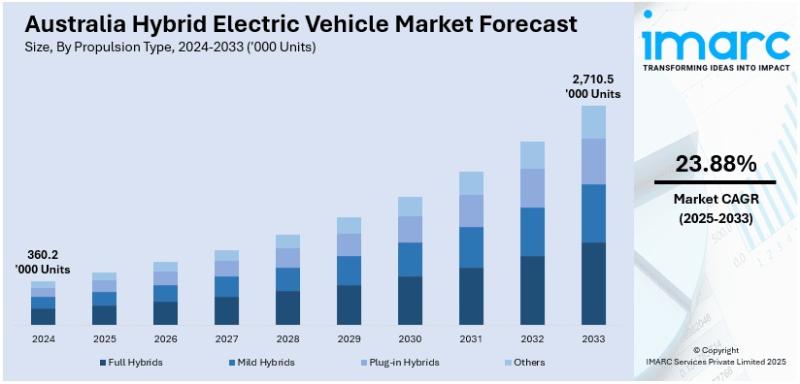
The Australia hybrid electric vehicle market reached a size of 360.2 thousand units in 2024 and is forecasted to grow to 2,710.5 thousand units by 2033. The market is driven by government incentives, rising fuel prices, increasing environmental awareness, and advancements in battery technology. Consumer preference for fuel-efficient vehicles alongside expanding charging infrastructure supports the country’s transition towards sustainable transportation. The forecast period is from 2025 to 2033, with a CAGR of 23.88%.
For more information, visit the Australia Hybrid Electric Vehicle Market
https://www.imarcgroup.com/australia-hybrid-electric-vehicle-market
How AI is Reshaping the Future of Australia Hybrid Electric Vehicle Market
• AI-powered data analytics enhance government policy formulation and subsidy allocation, promoting wider adoption of hybrid electric vehicles in Australia.
• AI-driven optimization of battery technology and powertrain efficiency contributes to improved vehicle performance and affordability in the Australian HEV market.
• Collaboration between National Australia Bank (NAB), EV distributors, and charging infrastructure providers leverages AI for personalized incentives and fleet management benefits.
• AI algorithms support route planning and energy management for hybrid vehicles, particularly boosting efficiency for long-distance driving across Australia’s vast regions.
• Introduction of AI-assisted customer education programs and virtual test drives by dealerships facilitate better consumer understanding and trust in hybrid technologies.
• AI-enabled market intelligence aids automakers in launching models like Skoda’s plug-in and mild hybrids tailored for Australian consumers’ preferences.
Grab a sample PDF of this report: https://www.imarcgroup.com/australia-hybrid-electric-vehicle-market/requestsample
Australia Hybrid Electric Vehicle Market Growth Factors
Government-related policies and incentives also play a role in the adoption of HEVs in Australia. The Australian government promotes the adoption of HEVs through rebates for the purchase of HEVs, tax incentives, reduced registration fees, and road tax exemptions in several states. Regulation on car emissions and fuel consumption targets have encouraged manufacturers to offer more HEV models in the Australian marketplace. The National Australia Bank (NAB) and EV retailers and charging providers are collaborating by offering charging credits, deals and discounts for electric vehicles and plug-in hybrids in an effort to promote the adoption of EVs by businesses and individuals.
An important aspect of the market for HEVs in Australia is the increasing awareness among Australian consumers of the environmental issues higher-emissions vehicles create and their desire for lower emissions vehicles. HEVs are also highly regarded by both consumers and governments for their contribution to greenhouse gas (GHG) emissions reduction and for being supportive of renewable energy. In line with the trend to further invest in green technology, the Australian automotive industry is increasing its HEV lineup, including off-road vehicles and utility vehicles, to meet the needs of both green-minded and rural consumers
Infrastructure development to support clean mobility including the introduction of green vehicle lanes and hybrid parking bays in major urban areas has been one factor supporting the growth of the Australian HEV market. Investment in infrastructure such as future-proofed highway rest stops with charging stations for hybrids has also been undertaken to improve the attractiveness of hybrid vehicles in a country with wide-ranging sparse areas. Additionally, Australia’s high fuel price sensitivity, tendency of their consumers to drive longer distances and the rising popularity of HEVs are helping stimulate the HEV industry.
Australia Hybrid Electric Vehicle Market Segmentation
Propulsion Type Insights:
• Full Hybrids
• Mild Hybrids
• Plug-in Hybrids
• Others
Configuration Type Insights:
• Series HEV
• Parallel HEV
• Combination HEV
Vehicle Type Insights:
• Passenger Cars
• Commercial Vehicles
• Two-Wheelers
• Others
Power Source Insights:
• Stored Electricity
• On Board Electric Generator
Regional Insights:
• Australia Capital Territory & New South Wales
• Victoria & Tasmania
• Queensland
• Northern Territory & Southern Australia
• Western Australia
Key Players
• National Australia Bank (NAB)
• GWM
• Skoda
• BYD
Recent Developement & News
• March 2025: Skoda announced plans to launch plug-in hybrid and mild hybrid vehicles in Australia by the end of the year. Models like Kodiaq and Superb will feature PHEVs with up to 135km electric range, while the Octavia will adopt mild-hybrid technology, supporting increased hybrid adoption.
• June 2025: AFIA disclosed surging demand for low-emission vehicles, reporting financing for electric and hybrid vehicles exceeding $6.17 Billion, marking a 50% annual increase. This financing supported acquisition of 104,835 electric and hybrid cars, reflecting a strong market shift.
• October 2025: The BYD Shark 6, a new plug-in hybrid utility vehicle, received nearly 1,000 pre-orders shortly after launch. Offering an approx. 80km electric range before petrol use, this model intensifies competition in Australia’s traditionally diesel-heavy utility vehicle segment.
If you require any specific information that is not covered currently within the scope of the report, we will provide the same as a part of the customization.
https://www.imarcgroup.com/request?type=report&id=32089&flag=F
Contact Us
IMARC Group,
134 N 4th St. Brooklyn, NY 11249, USA,
Email: sales@imarcgroup.com,
Tel No: (D) +91 120 433 0800,
United States: +1-201971-6302
About Us
IMARC Group is a global management consulting firm that helps the world’s most ambitious changemakers to create a lasting impact. The company provide a comprehensive suite of market entry and expansion services. IMARC offerings include thorough market assessment, feasibility studies, company incorporation assistance, factory setup support, regulatory approvals and licensing navigation, branding, marketing and sales strategies, competitive landscape and benchmarking analyses, pricing and cost research, and procurement research.
This release was published on openPR.