Eruptions of charged particles from the sun are moving toward Earth and could create vivid displays of the northern lights, or aurora borealis, across large parts of the northern United States this week.
A burst of solar material known as a coronal mass ejection (CME) was detected by NOAA satellites departing the sun on Monday. CMEs are massive clouds of magnetized plasma that can set off geomagnetic storms when they interact with Earth’s magnetic field.
NOAA’s Space Weather Prediction Center (SWPC) forecasts that the incoming CME could reach Earth around midday Tuesday, prompting a Strong (G3) Geomagnetic Storm Watch, a level 3 out of 5 on the agency’s space weather scale.
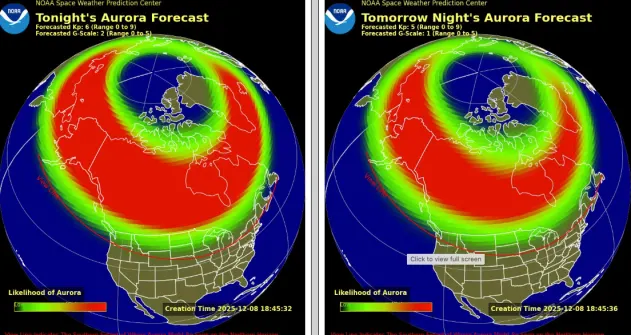
If a strong geomagnetic storm develops, the aurora forecast suggests the northern lights could be visible across the northern tier of the country and may even reach as far south as the Midwest as well as Oregon, depending on storm strength and cloud cover.

The aurora forecast for Dec. 8 and 9, 2025. (Image: NOAA SWPC)
The northern lights typically appear near Earth’s poles, but intense solar storms can push auroras much farther south. When this happens, skywatchers may spot sweeping waves of green, red and purple light moving across the night sky.
Space weather events like this week’s solar eruption can also impact technology, potentially affecting the power grid, satellites, GPS navigation and radio communications.
The current CME is linked to an M8.1 solar flare that erupted from an active region of the sun on Dec. 6, according to the SWPC. A nearby sunspot region also produced a powerful X1.1 solar flare on Monday, causing about an hour-long radio blackout on the sunlit side of Earth.

A cloud forecast for 1 a.m. EST Tuesday.
For those hoping to see the aurora, NOAA notes that the best viewing conditions occur under dark, clear skies away from city lights. While cloud cover is forecast to dominate the northern half of the U.S., many of those clouds are high-level, with most of the northern Plains, Ohio Valley, Pennsylvania and New England having a chance to see the northern lights, at least partially, through the clouds.