When senior American officials, led by Vice President JD Vance, touch down in Islamabad on Saturday for peace talks with Iran, they will carry with them a request that goes beyond nuclear stockpiles and a blocked strait. One with at least six Americans right at the centre of it.

Donald Trump’s administration intends to push for the release of these US citizens languishing in Iranian custody, The Washington Post has reported.
JD Vance, Trump’s special envoy Steve Witkoff, and the presidential son-in-law, Jared Kushner, are expected to raise the issue when talks open in Pakistan’s capital. People briefed on the plans told the Post that this demand could be deprioritised if broader negotiations — over Iran’s closure of the Strait of Hormuz and its uranium stockpile, plus its niclear ambitions if any — prove difficult from the outset.
The White House spokesperson declined to comment on the issue of US citizens: “These are ongoing discussions and the United States will not negotiate through the press.”

The US State Department pointed towards Iran and noted a “long and shameful history of unjustly detaining US nationals”. “Out of respect for their safety and security, we have nothing further to share,” it added in a statement, the Post report said.
At least six Americans are believed to be held, though the identities of all of them have not been made public.
Here is what is known about those at the centre of the potential release deal:
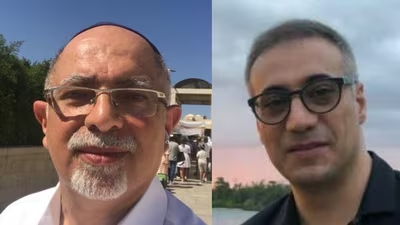
Two of the US citizens being detained, Kamran Hekmati, 61, and Reza Valizadeh, 49, were in Evin Prison, a notorious complex in Tehran that holds thousands of prisoners, including many held on political charges, the Post noted.
Valizadeh, the journalist with US govt-funded channel
Reza Valizadeh is serving a 10-year sentence. He worked as a reporter for Radio Farda, the Persian-language service of Radio Free Europe/Radio Liberty, which is a US government-funded broadcaster. He became a US citizen in 2022.
In September 2024, he returned to Tehran to visit his elderly parents, believing, according to his family, that Iranian authorities had assured him it was safe to do so. His brother now believes those assurances were a trap, possibly involving a former colleague with ties to the military wing of the Iranian regime, the Islamic Revolutionary Guard Corps or IRGC.

Valizadeh was arrested by the IRGC and sentenced in December 2024 to 10 years in prison on charges of “collaborating with a hostile government”. His appeal was rejected in January 2025.
The US State Department formally designated him “wrongfully detained” in May 2025. An exhaustive list was not immediately available.
He suffers from asthma, which has worsened due to overcrowded conditions, poor air quality and exposure to smoke in prison, the Post said. He has alegedly been denied medical care.
After Israeli airstrikes hit parts of Evin Prison during last year’s 12-day Israel-Iran war, Valizadeh was reportedly transferred to another facility.
Jewish man with alleged Mossad link
Kamran Hekmati is a Jewish Iranian-American who emigrated to the United States after the 1979 Iranian Revolution, and built a life in Great Neck, New York, running a jewellery business in Manhattan.
In July 2025, he travelled to Iran to visit family. When he tried to leave through Tehran’s airport, authorities confiscated his passport. He was arrested two months later.
The charge against him is related to an Iranian law that prohibits its citizens from visiting Israel. Hekmati has argued he’d done so 13 years earlier, to attend his son’s bar mitzvah. He was then charged a second time in December, accused of having met with agents of Israeli spies from the Mossad abroad.
“Kamran is recovering from bladder cancer and requires regular medical care and screenings to detect any resurgence. He is not receiving that care at Evin Prison,” says US-based rights group Foley Foundation, run by the kin and friends of James W Foley, an American journalist kidnapped in 2012 while reporting in Syria and murdered by the ISIS group in 2014.

Advocates have also raised concern that his Jewish faith and alleged connections with Israel make him vulnerable to additional mistreatment. Secretary of State Marco Rubio formally designated him wrongfully detained in March 2026.
A ‘forgotten’ Green Card holder
Of those in Iranian custody, Shahab Dalili’s case may or may not be part of the deal. He has been in Evin Prison since 2016, after travelling to Tehran for his father’s funeral and never coming home. He was sentenced to 10 years on charges of aiding and abetting the United States government.
Dalili is not a US citizen, but a legal permanent resident, a Green Card holder. His wife and children are American citizens.

That distinction has, over the years, placed him in a bureaucratic no-man’s land. The US government has never formally designated him “wrongfully detained”, a status that could lead to additional diplomatic efforts. He has been left out of every prisoner swap the US has negotiated with Iran.
When five Americans were released in a landmark September 2023 deal — under which the US unfroze $6 billion in Iranian funds — Dalili was not among them. His son Darian, upon hearing the news, emailed US State Department officials: “You are leaving my father to die.” Advocacy group Hostage Aid Worldwide, as recently as this week, described him as a “forgotten American national”.
History of release deals
The 2023 prisoner exchange was not the first time Washington and Tehran have traded detainees.
The Trump administration, in its first term, secured the release of several Americans from Iranian custody.
Iran, in turn, has a long-documented history of arresting dual nationals on vague or politically motivated charges to use as leverage in negotiations with Western governments — a practice advocates call “hostage diplomacy”.
A French connection
Rights advocates are hopeful ahead of this weekend’s talks, pointing to Iran’s recent decision to release two French citizens convicted on espionage charges.
Kieran Ramsey of Global Reach, a nonprofit working on several of these cases, described such a release as a “simple and no-loss way” for Iran to offer an off-ramp from the current conflict.