Q: Greetings and Salutations, Ask Us Guy:
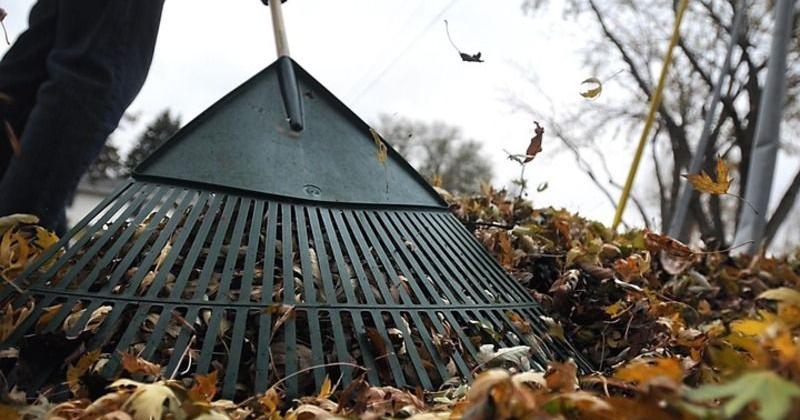
As I raked the seemingly endless amount of leaves dropping from our trees for the second time this fall, it occurred to me that removing this nutrient-rich yard waste might have unintended consequences. Are we, as professional homeowners, inadvertently depriving our trees of needed nutrients by raking the leaves to the curb? Don’t get me wrong, I thoroughly enjoy this mindless task, and the inevitable beer or two that follows upon completion, but I’m really just concerned about the health of our trees ‘-)
Thanks for your input!
A: Any input from Ask Us Guy — who mainly took journalism and history classes at the University of Minnesota — wouldn’t be too useful, so he turned to Jon Trappe from the U of M’s Extension Service.
Trappe specializes in turf and urban greenspace issues and said the reluctant raker has a point from an ecological standpoint. If the fate of the underlying grass was not of any concern, the best course is to let nature do its thing, permit the leaves to settle undisturbed on the ground and allow them to decompose over time.
“In general, we recommend people mulch or recycle the tree leaves as they mow as much as possible,” Trappe said. “The reason is you’re basically returning the nutrients to the soil that the trees have pulled from it.”
The broader ecosystem, including ground-nesting bees and other insects, evolved over millions of years in a forest setting where a layer of leaves was part of the annual cycle. Lawns, rakes and homeowners dreaming of a golf-course-quality expanse of turf played no part in that evolution.
“There’s something satisfying in having a nice manicured lawn, but there’s a lot more benefit in trying to keep the leaves as much as possible,” Trappe said.
The “as much as possible” caveat is an important one, however, for anyone who wants to have a healthy lawn the following year. Somewhere around 70-80% of the leaves that drop in a typical yard can be chopped up with a mulching mower and left on the lawn without doing damage. Beyond that, and maybe even sooner for yards with large trees that generate a thick blanket of leaves, it’s time to rake and remove.
“If you see more tree leaves than grass, it’s time to bag them up,” Trappe said.
Jon Trappe
Too many leaves left over the winter brings snow mold and other fungal issues that will kill grass.
And as much as the homeowner submitting this week’s question might prefer to go straight to the “beer or two” phase of fall yardwork, he can’t legitimately make the case that he’s just trying to save the trees by feeding them “this nutrient-rich yard waste.” The nutrient benefit that comes from decaying leaves is relatively small.
“It’s pretty marginal,” Trappe said. “The bigger thing is all the lawn clippings throughout the year.”
People who rake and remove grass after mowing are the ones who are really starving the soil, removing the equivalent of about 1 pound of nitrogen for every 1,000 square feet of grass. Returning those nutrients to the soil by mulching grass and leaving it in place provides between half and two-thirds of the nitrogen the soil needs.
So how does Trappe handle raking on his personal property? He pretty much follows his own advice, trying to let nature do its thing with as little interference as possible. Despite the extra material on his lawn that comes from numerous red pines and maples and a very large oak, he mulches in the leaves and needles throughout the fall but does one raking and bagging at the very end of autumn.
With that approach, a lot of the leaves he chopped up earlier stay in place. Those little pieces pass between the rake’s tines as the rake grabs the late-falling whole leaves. (He also gives his grass just one round of applied fertilizer each year. And he worries about treating the weeds, including a fair amount of creeping Charlie, only every other year.)
Trappe’s only other suggestion for property owners is to remember to think of the totality of environmental impacts of their lawn-care decisions. For instance, hauling leaves and yard waste to a distant site contributes additional pollution that comes with transportation. So any excess leaves that must be raked should be used whenever possible as groundcover on gardens and flower beds. Even if the ground cover needs to be taken to the yard waste composting site next spring, the volume being hauled will be substantially less because of decomposition that occurs between now and when the gardens come back to life in April.
Contact Ask Us at The Free Press, 418 S. Second St., Mankato, MN 56001. Call Mark Fischenich at 344-6321 or email your question to mfischenich@mankatofreepress.com; put Ask Us in the subject line.