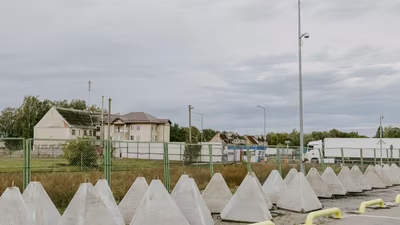
MARIJAMPOLE, Lithuania—European governments are preparing for war with Russia. A newly released wargame suggests they aren’t ready.

A Russian incursion, or outright invasion, into countries of the North Atlantic Treaty Organization and the European Union has become more likely because of Europe’s tensions with President Trump over Greenland, Ukraine, trade and other matters, many European security and political leaders say.
They point out that Russia has switched to a war economy, focusing national resources on a rearmament program and military recruitment that goes well beyond the needs of the campaign in Ukraine.
The key question is: How soon? The earlier belief in Berlin and other capitals was that Russia wouldn’t be able to threaten NATO until 2029 or so. There is now a growing consensus that such a crisis could come much sooner—before Europe, which is expanding its own investment in defense, is in a position to fight back.
“Our assessment is that Russia will be able to move large amounts of troops within one year,” the Netherlands Defense Minister Ruben Brekelmans said in an interview. “We see that they are already increasing their strategic inventories, and are expanding their presence and assets along the NATO borders.”
President Vladimir Putin wants to resurrect the glories of the Russian Empire, making countries that were once part of it, such as the Baltic nations of Lithuania, Latvia and Estonia, obvious targets. All of them have been members of the EU and NATO for two decades.
“Anxiety is very visible in my country, but at the same time, we are preparing to defend ourselves,” said Deividas Matulionis, Lithuania’s national security adviser. While Lithuania expects the U.S. and other NATO allies to assist in case of a Russian incursion, he added, the country’s own troops shouldn’t be underestimated: “They will be fighting, definitely, even before the reinforcements come.”
NATO military planners also worry about potential Russian designs on Swedish, Finnish and Danish islands in the Baltic Sea, parts of Poland, and the Norwegian and Finnish far north, as well as a campaign of strikes on European strategic infrastructure as far west as the Dutch port of Rotterdam.
The exercise simulating a Russian incursion into Lithuania, organized in December by Germany’s Die Welt newspaper together with the German Wargaming Center of the Helmut-Schmidt University of the German Armed Forces, became an object of heated conversation within Europe’s security establishment even before the newspaper published its results on Thursday. The exercise involved 16 former senior German and NATO officials, lawmakers and prominent security experts role-playing a scenario set in October 2026.
In the exercise, Russia used the pretext of a humanitarian crisis in the Russian exclave of Kaliningrad to seize the Lithuanian city of Marijampole, a key crossroads in the narrow gap between Russia and Belarus. Russian portrayals of the invasion as a humanitarian mission were sufficient for the U.S. to decline invoking NATO’s Article 5 that calls for allied assistance. Germany proved indecisive, and Poland, while mobilizing, didn’t send troops across the border into Lithuania. The German brigade already deployed to Lithuania failed to intervene, in part because Russia used drones to lay mines on roads leading out of its base.
“Deterrence depends not only on capabilities, but on what the enemy believes about our will, and in the wargame my ‘Russian colleagues’ and I knew: Germany will hesitate. And this was enough to win,” said Franz-Stefan Gady, a Vienna-based military analyst who played the Russian chief of general staff.
A town of some 35,000 people, Marijampole is home to one of Europe’s most strategic highway intersections. Running southwest is the Via Baltica superhighway to Poland, clogged with trucks from all over the EU and Ukraine. Running west is the transit road between Belarus and Kaliningrad that Lithuania must, under a treaty, maintain open to Russian traffic. This week, it was busy with Russian trucks, mostly stripped of markings on their containers, that, just before the border, drove past a tower with the Ukrainian and Lithuanian flags and the motto “Together to Victory.”
In the wargame, absent American leadership, Russia managed within a couple of days to destroy the credibility of NATO and establish domination over the Baltics, by deploying an initial force of only some 15,000 troops.
“The Russians achieved most of their goals without moving many of their own units,” said Bartłomiej Kot, a Polish security analyst who played the Polish prime minister in the exercise. “What this showed to me is that once we are confronted by the escalatory narrative from the Russian side, we have it embedded in our thinking that we are the ones who should be de-escalating.”
In real life, Lithuania and other allies would have had enough intelligence warnings to avoid this scenario, said Rear Adm. Giedrius Premeneckas, Lithuania’s chief of defense staff. Even without allies, Lithuania’s own armed forces—17,000 in peacetime and 58,000 after an immediate mobilization—would have been able to deal with a limited threat to Marijampole, he said. Russia itself would have to consider the high stakes involved, he added: “It would be a dilemma for Russia to sustain Kaliningrad, and if Russia starts something, it must be said very clearly by NATO that if you do, you will lose Kaliningrad.”
The commander of German land forces, Lt. Gen. Christian Freuding, said on a visit to Lithuania on Wednesday that, while NATO intelligence still assesses that Russia wouldn’t be able to act against members of the alliance until 2029, Germany and its allies “are ready for the fight tonight, whatever it takes.” He added that he wouldn’t speculate on how much time Europe has left.
The debate over the immediacy of the Russian threat determines the nature of European military planning. Skeptics point out the slow pace of Russian advances in Ukraine, where Putin has been bogged down in a costly war of attrition, losing more than a million men. “Putin has failed in virtually everything he set out to do,” Finnish President Alexander Stubb said in an interview. “He hasn’t even attempted to come to NATO because he is not succeeding in Ukraine. So don’t overestimate Russian capacity.”
While Russia recruits some 35,000 fresh troops a month, it loses about 30,000 on Ukrainian battlefields monthly, slowing its capacity for a buildup, said Lithuania’s Premeneckas.
“We are very thankful to the Ukrainians who, every day, with their blood and their losses are giving us time to prepare better,” he said. “We are using this time wisely because we know that, if there is a deal in Ukraine, Russia will accelerate its war machine. We don’t have the luxury to let Russia feel that we are weak.”
Even without an agreement on Ukraine that the Trump administration is pushing, some European officials and security analysts say, the Russian military could instantly free up as many as 200,000 battle-hardened troops just by switching from offensive operations to holding the line. That is more troops than Putin used for the initial full-scale invasion of Ukraine in 2022.
“Putin is opportunistic, and if he sees an opportunity, he will toy with it, test the reactions, and when he has more capabilities, try to expand the results,” said Nico Lange, a former senior German defense official and a senior fellow with the Munich Security Conference who participated in Die Welt’s exercise. “It can happen right now. If the goal is to show that NATO’s Article 5 doesn’t work, to split the Europeans, what you need is the will, and not the extraordinarily large military capabilities. Why should Putin wait for the Europeans to be ready?”
Russian officials insist that the Kremlin has no designs on EU or NATO members’ territory. Russia also insisted four years ago that it had no intention to invade Ukraine.
The Trump administration’s new national defense strategy, released in January, says that Russia “will remain a persistent but manageable threat” to NATO’s eastern members. It adds, however, that Russia “is in no position to make a bid for European hegemony” because European allies dwarf it in terms of population, economy, and thus latent military power.
This is why Russia wouldn’t attempt to wage against NATO the kind of attrition warfare it is practicing in Ukraine, but not a reason why it would be deterred altogether. “Protracted war would be detrimental for Russia because we would outproduce and out-mobilize them,” said Lt. Col. Amund Osflaten, who teaches land warfare and doctrine at the Norwegian Defense University College. “So, if they are going to do something, they would want to do something early, where they get into advantageous positions that they can easily defend later.”
That is exactly what happened in Die Welt’s scenario. Alexander Gabuev, the director of the Carnegie Russia Eurasia Center in Berlin who played Putin in the exercise, pointed out that the smokescreen of “humanitarian” intervention was crucial to enable Russian conquest. “It was very helpful to keep beating the drum that we need the humanitarian corridor because the evil Lithuanians are preventing us from supplying the poor and hungry people of Kaliningrad.”
Such hybrid tactics, especially at a time when many in the Trump administration openly embrace Putin’s narrative, pose an increasing threat to NATO’s decision-making, European officials say.
“There is a gray area, and as Russia is taking additional steps, the gray zone is becoming darker,” warned Brekelmans, the Dutch defense minister. “At the end, it is up to the NATO ally affected, and the 31 other NATO allies, to decide whether the Article 5 line has been crossed. Russia knows, of course, that this is not a hard science—and we know that it will try to further push that.”
Write to Yaroslav Trofimov at yaroslav.trofimov@wsj.com

