Nadine YousifSenior Canada reporter

 EPA
EPAIn the year since US President Donald Trump was inaugurated for his second term, he has brought with him significant global shifts.
Like many countries, Canada – America’s closest neighbour to the north – has felt the impact and seen a change in the long-standing relationship with its close security ally and trading partner.
Trump has imposed tariffs on several key Canadian sectors and has warned of more to come. He has also referred to Canada as “the 51st state” — a jab that has been met with a mix of anxiety and an uncharactaristically fierce display of patriotism.
He has had an effect not just on how Canadians shop and travel, but on the country’s domestic politics and world view.
Here are five ways Trump has had an impact on Canada.
A shift in how Canadians see the US
While the relationship between the two countries has had its ups and downs, many Canadians shop, travel and even work in the US, and have family ties to the country.
But the past 12 months has seen a change in Canadians’ overall attitudes towards the US, if not towards Americans themselves.
Polling conducted by the Pew Research Center last spring indicated that 64% of Canadians held a negative view of the US in 2025 — the highest ever recorded in more than two decades of polling by Pew.
This is a reversal from how they felt before the second Trump administration, when the majority said they held a favourable view of their neighbour.
The survey suggested an even larger percentage of Canadians, around 77%, lack confidence in Trump as a president. Nine-in-10 respondents described him as “arrogant”, and three-quarters said they believe he is “dangerous”.
A separate Angus Reid poll from October suggests that nearly half of Canadians (46%) want their government to approach the US as an “enemy or potential threat”.
This is higher than for India (24%) or China (34%). Canadian Prime Minister Mark Carney has sought to improve the relationship with both of those countries after years of tensions related, among other issues, to allegations of foreign interference.
A more recent Leger poll conducted earlier this month indicates that one in three Canadians believe the US could take “direct action” to control Canada in the future. The poll was in response to the US seizure this month of former Venezuelan leader Nicolás Maduro and Trump’s renewed comments on taking control of Greenland.
Fewer trips south
The US has long been the number one travel destination for Canadians — an unsurprising statistic given the proximity of two countries.
While it remains a top destination, the number of Canadians making trips south has dropped by more than 25%, according to the latest data by Statistics Canada.
That decline has been noticed by the American tourism industry, which forecast a loss of $5.7bn (£4.3bn) in tourism spending in 2025 compared to the previous year.
Some jurisdictions, like California, have even run advertisements to try to entice Canadians back.
But many have opted to vacation at home, with the domestic tourism sector reporting a record-breaking C$59bn ($42bn) in revenues from May to August, up 6% from the same period last year, according to Destination Canada, a national tourism organisation.
Others have gone to Mexico, with national data showing a 12% surge in Canadians visiting Mexican cities in the last year.
Buying more local products
The boycott has extended to store shelves, with more Canadians now choosing local products in the face of US tariffs.
Nowhere is this more significant than in liquor stores, where American alcohol was pulled from shelves by most provinces in retaliation against Trump’s levies.
Overall exports of US spirits fell 9% in the last quarter of 2025 compared to the same period last year, according to the Distilled Spirits Council of the United States.
In Canada, the value of US liquor imports dropped from $63.1bn in late 2024 to just over $9.5bn in late 2025.
Canadians are also buying more Mexican-made cars, with vehicle imports from Mexico surpassing American imports for the very first time as of July, according to data from Statistics Canada.
There’s even a push to “Buy Canadian” at the federal government level, with Carney prioritising procurement from domestic suppliers, a move tailored to help specific sectors hard-hit by Trump’s tariffs on products like steel and lumber.
That includes in defence procurement, with Canada seeking to shift away from US suppliers as it significantly ramps up defence spending to meet its Nato commitments.
An up-ended federal election
Before Trump’s second term, Canada’s governing Liberal Party appeared headed towards a potentially historic collapse in the upcoming federal election.
Polls at the time consistently showed the opposition Conservatives leading by a wide margin with party leader Pierre Poilievre, whose focus on affordability was resonating with voters, likely to be the next prime minister.
Then the political script in Canada flipped.
Former Prime Minister Justin Trudeau resigned in January – an exit hastened in part to his finance minister publicly quitting in protest over his handling of Trump.
That made way for Carney, a former central banker with political ambitions, to run for the party’s leadership.
Carney leaned heavily on his economic experience as he campaigned as the man who could stand up to Trump, and voters, anxious about Canada’s sovereignty and economy in face of the new US administration, flocked back to the Liberals.
In late April’s election, Carney achieved what was unthinkable just a few months prior: another return to power for the Liberals, with voters giving the party a few seats shy of a majority government.
The Conservatives, meanwhile, lost their fourth consecutive election and Poilievre faces a leadership review later this month.
The latest polling indicates that Carney’s Liberals are a few points ahead of the Conservatives, though the gap between them has narrowed.
 Reuters
Making new friends and allies
With the Canada-US trade relationship increasingly unpredictable, Canada is seeking to bolster ties elsewhere, in some cases mending strained ties.
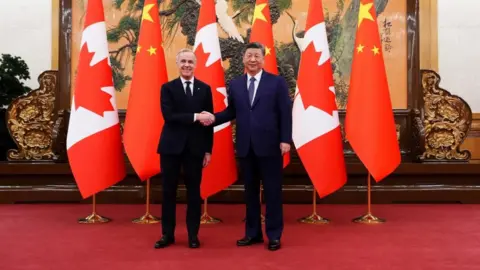
This shift is perhaps most notable with Carney’s visit to China this week — the first by a Canadian prime minister since 2017.
On Friday, Carney announced a deal that would reduce tariffs between the two countries and increase access to each other’s markets.
In Beijing, he struck a pragmatic tone, saying that Canada is forming a “strategic partnership” with the Asian power that will bring economic benefits to both countries.
It was a remarkable shift in tone by Carney, who on the campaign trail called China Canada’s the biggest security threat.
Asked by reporters about his concerns over national security and human rights, the prime minister responded with: “We take the world as it is, not as we wish it to be.”
Carney is also expected to embark on a trade mission to India in the next few weeks. The trip would be a further thawing of Canada-India relations, which have been icy since Trudeau openly accused Indian agents of being behind the extra-judicial killing of a Sikh separatist on Canadian soil.
In the past year, Carney has also made trips to the United Arab Emirates and Qatar, as well as a number of European countries, in search for new trade relationships.
What questions do you have about Trump’s first year since returning as President? Click here or use the form below.