“Trump is pragmatic, and he sees China rising in hard power and also in soft power. By concentrating on the Americas rather than doing a pivot to Asia and spreading too thin on every front, by retreating while being on good terms with China, the Americans can still maybe maintain their dominance of global affairs for 20 or 30 years,” said Wang Huiyao, founder and president of the Center for China and Globalization think tank in Beijing.
The turning point, the consensus in China’s foreign-policy establishment holds, came after a confrontation over trade tariffs, rare earths and export restrictions ended with a temporary truce struck by Trump and Chinese leader Xi Jinping in South Korea in October.
This climbdown from what one U.S. official described as “an economic equivalent of nuclear war”—barriers that would have deprived China, and the U.S., of vital materials and components—has ushered in a new era in Sino-American relations, many Chinese analysts believe: By striking back hard, China has demonstrated its might, earning peer status for the first time and forcing America to retreat.
“The U.S.-China relationship has experienced structural change,” said Wang Yong, director of the Center for American Studies at Peking University. “The American side has realized the power of China, and has learned to be realistic in dealing with China, showing more respect.”
This celebratory mood may be premature, China’s more cautious strategists say, pointing to the slowdown in the country’s economic growth and the tensions bubbling under the surface of its tightly controlled society. Despite the rise of MAGA isolationism under Trump, some of them say, the fundamental nature of the U.S.-China rivalry remains intact even in the current thaw.
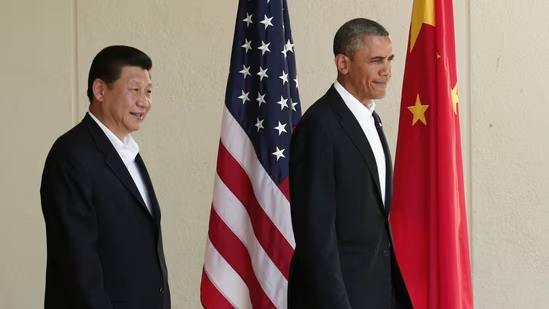
In South Korea, Trump surprised China’s leadership by speaking of a “G-2” condominium with China in world affairs—language that Xi floated at the Sunnylands summit in 2013, just to be rebuffed by President Obama, who viewed it as an abandonment of American allies and of Washington’s global role.

Trump’s endorsement of the G-2 concept signals a recognition of China’s new status, said Wang Dong, executive director of the Institute for Global Cooperation and Understanding at Peking University.
If MAGA prevails and the Trump administration follows through by formally renouncing the idea of strategic competition with China in the new national defense strategy, such a pivot would mark the most fundamental shift in American strategic thinking since the end of the Cold War, if not even the end of World War II, he added.
“MAGA ideology is about saying farewell to the liberal internationalism, dismantling the liberal order, withdrawing from overcommitment all around the world, putting forces back into the Western Hemisphere—that’s the new operating concept. And it’s going to be the new normal for years to come,” Wang said.
China couldn’t be happier if that happens, of course. In this new environment, where Trump appears more interested in selling American soybeans than in protecting Taiwan, the takeover of the island democracy by Beijing becomes a much more achievable goal, perhaps without a fight, many Chinese officials believe.
Spooked by the destruction of Russia’s war on Ukraine, some Taiwanese are already turning toward Beijing. Cheng Li-wun, the newly elected leader of the island’s Kuomintang party, which holds a plurality in the Taiwanese parliament, has taken a more pro-Beijing line than her predecessor, citing the example of Ukraine as the reason for seeking closer ties to the mainland.
She even described Russian President Vladimir Putin as a democrat who had been dragged into war by NATO’s expansion. A Kuomintang victory in the island’s next presidential elections, slated for 2028, could make peaceful absorption by China more likely in following years, especially if the Taiwanese conclude they can’t count on America to defend them.

Xi has ordered his military to be ready for a military takeover of Taiwan by 2027, according to U.S. intelligence estimates. Beijing believes that “China’s reunification with the island is not a question of ‘yes’ or ‘no,’ but an unstoppable reality and a question of how and when,” said Beijing-based political commentator Shen Shiwei, founder of the China Briefing newsletter. While China prefers to achieve that goal peacefully, he added, it requires foreign nations to stop interfering.
During his phone conversation with Trump on Nov. 24, Xi stated that “Taiwan’s return to China is an integral part of the postwar international order” that was created when China and the U.S. jointly defeated Japan in 1945, a worldview that puts Washington, Beijing—and Moscow—on the same side. There was no mention of the island in Trump’s statement on Truth Social, which noted: “Our relationship with China is extremely strong!”
A perception that Taiwan no longer matters as much to relations with Washington, diplomats say, explains why Beijing has reacted so forcefully to Japanese Prime Minister Sanae Takaichi’s suggestion that Tokyo may use its military in case of a Chinese invasion of the island. China has imposed a slew of economic and diplomatic sanctions on Japan, demanding a retraction, and state media started questioning Japanese sovereignty over Okinaw and described it as ancient Chinese land. In recent weeks, China also stepped up its territorial claim on India, barring transit to Indian passport holders from Arunachal Pradesh, a territory that Beijing considers part of China.
The belligerence partially stems from China’s own problems, such as slowing economic growth, a real-estate bubble, flagging domestic consumption and rising unemployment, especially among the young. “In China, there is mounting domestic pressure, and some people want to resort to nationalism, to hawkishness, to seek an outcome that deals with that pressure,” said Shen Dingli, a Shanghai-based international relations scholar.
China’s new confidence comes amid disarray in the democratic world. Trump’s embrace of Russia has frustrated European allies, and his new opening to Beijing spurred fresh alarm in Japan, Taiwan, the Philippines and South Korea. Asked in a Fox interview about a social-media post by a Chinese diplomat suggesting that Japan’s Takaichi should be beheaded, Trump said on Nov. 10 that “a lot of our allies aren’t our friends…Our allies took advantage of us on trade more than China did.”
Coercive American policies toward other nations, especially on trade, open new economic and political opportunities for China around the world, said Wu Xinbo, dean of the Institute of International Studies at Fudan University in Shanghai.

China’s own rapid development plays a role, too: “In the past technologies flowed to the global South from the West, but now more and more comes from China, especially in the clean energy area. This facilitates China’s trade and investment ties,” Wu said. “Then, political influence follows, of course.”
This new sense of confidence means that many Chinese who used to look up to the West as the source of inspiration and ideas increasingly feel they have little to learn—and more to teach.
“China for 18 centuries was leading the world, and only in the last two centuries was left behind Europe and the West. It’s normal that with the great rejuvenation, it’s leading again,” said Wang Yiwei, director of the Institute of International Affairs at Renmin University. “We have so many people who work so hard, while the Europeans, they enjoy too much freedom, with their vacances. The young Europeans are playing postmodern art, while the Chinese young people work hard in the laboratory.”
The success of DeepSeek, China’s own AI model that uses much less computational power than American rivals—a result, in part, of restrictions on importing top-grade chips—is portrayed by China’s establishment as a validation of the Chinese Communist Party’s rule. So is the emergence of blue skies in Beijing and other major cities, where pollution has been dramatically reduced, in part thanks to the adoption of electric vehicles and tough emission standards.
“Beijing used to be known as the capital of smog. And now I myself am a bit surprised when I smell diesel exhaust in a city in America or Europe, because you no longer smell that on the roadside in China,” said Ma Jun, director of the Institute of Public and Environmental Affairs in Beijing. “I hope it can serve as a compelling example to the world.”
Write to Yaroslav Trofimov at yaroslav.trofimov@wsj.com