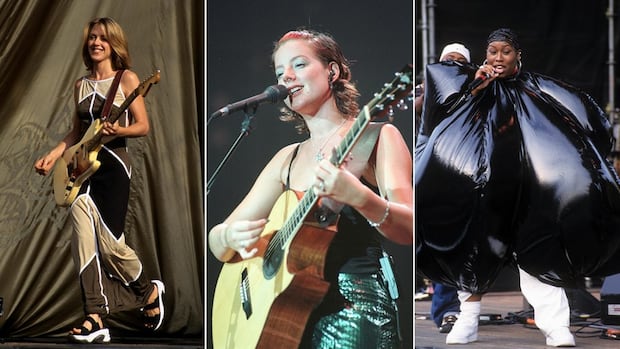
Lilith Fair wasn’t just a landmark in music history — it was a masterclass in late ’90s and early 2000s style. Originally running from 1997 to 1999, and briefly revived in 2010, Sarah McLachlan’s feminist-powered festival grew into a cultural phenomenon — explored in the new CBC documentary Lilith Fair: Building A Mystery, premiering Sept. 17 on CBC and CBC Gem — it became a showcase for some of the most iconic female artists of the era.
Whether it was Jewel’s coffeehouse chic, Missy Elliott’s fantastical inflatable stage costume, or Erykah Badu’s iconic headwraps, Lilith Fair doubled as an unexpected fashion runway. The festival captured a distinctly feminist take on ’90s style — from grunge and bohemian looks to hip-hop glamour.
Sarah McLachlan (1997)
Metallics were everywhere in the run-up to Y2K, channeling a mix of techno-futurism and candy-wrapper shine. But unlike Britney or Cher’s full-on reflective looks, McLachlan kept hers restrained, pairing the shimmer with neutral accessories and a plain top.

Margo Timmins (1998)
Timmins, frontwoman of Cowboy Junkies, embodied the ’90s grunge revival in a vintage-inspired floral tea dress. Paired with boots and layers, the look blended bohemian romance with a rebellious streak, echoing the countercultural energy of the time.

Erykah Badu (1998)
With the release of Baduizm in 1997, Badu helped usher in the neo-soul movement. Her look was iconic, blending Black and African style with spirituality and Afrofuturism. Her signature headwraps signaled a reclamation of Black identity.

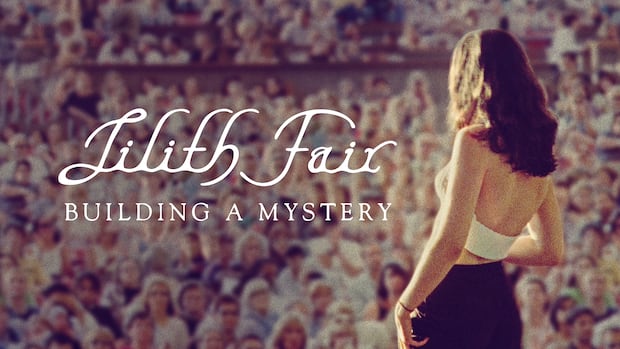
The untold story of the groundbreaking all-women music festival, started by singer-songwriter Sarah McLachlan in the late 1990s.
Liz Phair (1998)
By the time she joined Lilith Fair, Phair — the indie-rock feminist behind Exile in Guyville — had nothing to prove. In a geometric, colour-blocked maxi dress and chunky, sporty sandals, she projected a polished, athletic minimalism that felt effortless and defiant of traditional femininity.

Jewel (1997)
The spaghetti-strap dress was a hallmark of late-’90s fashion — minimalist, sleek and body-skimming. What crystallized this Lilith Fair moment, though, was her folk-woven guitar strap and cutaway guitar, telling the story of a bohemian singer-songwriter stepping into the mainstream.

Paula Cole (1997)
Lilith Fair began as a tour with McLachlan and Cole, as a response to radio stations that refused to play two female artists back to back. Cole leaned into her bohemian style that first year with an embroidered blue peasant blouse, minimal makeup and a deliberately visible bra.

Sarah McLachlan (1998)
Two words: crushed velvet. Romantic and ethereal, it was hugely in vogue in the late ’90s — and McLachlan stood out as the headliner in jewel-tones blue and violet. Those colours, often associated with femininity and mysticism, matched the mood of her music at the time.

Missy Elliott (1998)
When Elliott dropped the music video for her debut solo single, The Rain (Supa Dupa Fly), the world met a future hip-hop legend — in a giant inflatable suit. A year later at Lilith Fair, she reprised the look that’s a perfect emblem of her singular creative vision and sense of fun.

Mary J. Blige (2010)
When Mary J. Blige joined the 2010 Lilith Fair revival, she brought a glamorous, monochromatic edge to the stage. Her signature blond crop and accessories — giant gold hoops, stacked bracelets and oversized sunglasses — reflected her confidence and diva persona as she stood at the forefront of hip-hop and R&B.

Erykah Badu (2010)
Back on the road for the 2010 revival, Badu carried her singular style onstage. She paired a sweatshirt featuring a Pacific Northwest Indigenous formline design with an oversized hat, golden arm cuffs and earrings — a look that paid tribute to cultural heritage while staying unmistakably her own.