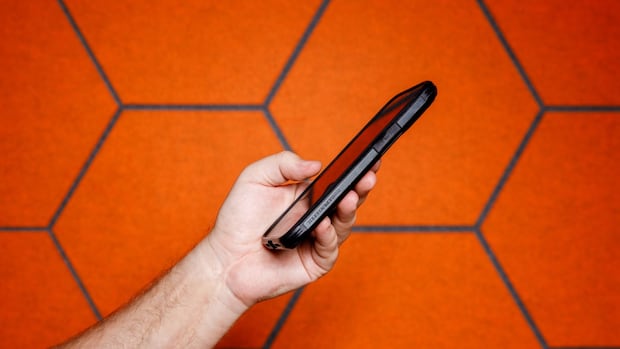
Stuck in a pattern of cycling between games on her iPad and scrolling through her phone, writer Nichole Perkins says that too much screen time had filled her head with static and drained her creativity.
She’d tried the built-in tools on her phone, but they were too easy to ignore. A post on Instagram seemed to offer a solution: a new productivity app that claimed to combat doomscrolling.
Perkins is one of hundreds of thousands of people who downloaded Focus Friend last month. The app surpassed ChatGPT to briefly claim the top spot on Apple’s App Store in the U.S. In the app, you set a timer to allow a cute, cartoon bean to knit some socks. If you disturb it before the timer goes off, the bean will drop its stitches.
It’s the latest example of focus-based apps and products seeing a surge in recent years. But experts say that it’s going to take more than an app of the month to stop our phones from ruling our lives, and that societal shifts in how we relate to technology will go further in actually fixing our broken attention spans.
“Our attention, our wellbeing, our stress, all of those things are at stake,” Gloria Mark, a professor at the University of California Irvine who studies how humans interact with tech, told CBC News.
Overreliance on apps runs the risk of simply replacing one bad habit with another, she said. Gamification can work, but “you have to be careful that that doesn’t take over your mind,” she said.
The phone problem
If you can’t get through a task without picking up your phone, you’re not alone. One study from 2021 found that participants checked their phones every five minutes on average. A 2024 survey of U.S. parents found that nearly half said they spent too much time on their phones.
Constantly checking our phones isn’t just taking a toll on our ability to get through a task undistracted — it’s piling on stress.
“We don’t have a chance to rest,” said Mark, who is the author of Attention Span and runs a newsletter called The Future of Attention. “I’ve been interviewing people and people say they can’t even just have a mindful moment. They have to fill their minds continually with something.”
But unplugging isn’t easy either, says Mark. Transit passes, GPS mapping and even some restaurant menus now require phones. “It’s just woven into our lives,” she said.

‘The most important commodity’
Enter the productivity app: a concept that has been around since the late 2010s, but which has grown in prominence the more tightly we cling to our phones.
“Our attention is actually maybe the most important commodity out there,” said Daniel Smilek, a professor of cognitive neuroscience at the University of Waterloo in Ontario, who studies how people sustain their attention over time.
The principles behind apps like Focus Friend can work, Smilek said. Attention is closely linked to our reward and motivation systems. In the case of Focus Friend, the app works if the reward of letting their digital friend accomplish more knitting is more valuable to users than interrupting it to use the phone would be.
Perkins, who is a writer and podcaster based in Nashville, Tenn., said she was able to write more than 5,000 words in a day while using Focus Friend. Often, she lets Beaniapolis — the name she gave her bean friend — knit while she sits outside to get some sun.
“I’ll reach for my phone, see Beaniapolis is knitting away, and I think, ‘I can’t disturb him.'”
Focus Friend app creator and YouTuber Hank Green said in a TikTok that one of the things he uses the app for is watching TV without being distracted by his phone. Commenters chimed in with their own uses: for sleep, cleaning or even playing with their kids.
On the flip side, apps like Dumb Phone and Minimalist Phone seek to downplay the addictive element of smartphones by replacing the home screen with a black background and colourful icons with stark white text.
“The text does require a bit of extra effort for the brain to recognize which app it is,” Martin Moravek, founder and developer of Minimalist Phone, told CBC News. “It gives you a few more moments to kind of realize if you really want to open it or not.”
It adds enough friction to make some users feel the effort isn’t worth the reward, Smilek said, another way to “control that more automatic habitual element.”

Although the majority of the apps are free to download, they all have a paid option with more features.
You can also buy an $83 Brick, which requires users to tap their phone against a square “key” to lock themselves out of specific apps. Users can only “un-brick” their apps once they tap their phone to the key again.
And the marketplace is crowded: Kaushar Mahetaji admitted she had downloaded and deleted around 20 productivity apps before she found one that she wanted to use for more than a couple weeks.
Mahetaji, a PhD student at the University of Toronto who is studying social media platforms, said the app One Sec works for her because it asks you if you really want to open an app, and why, every time you click on one. She said some friends will download similar apps for a specific purpose, like studying for a test, and then delete them after.
“Even if these apps don’t work for you, at least you’ve thought about what you want out of your technology,” she said.
They may be able to help some individuals interrupt their bad phone habits, but tech solutions are a band-aid if that’s where it ends, experts say. Instead, Smilek says we should be trying to actively fortify our attention on our tasks and goals by recognizing the value in them, not just trying to block attention from the devices.
‘Right to disconnect’
To help us achieve our goals without having to waste our energy battling the magnetic pull of our phone screens, societal change may be needed, Mark said.
Movements to ban cellphones in schools are a step in the right direction, she says, as is legislation to help us turn off our phones.
France passed a law in 2016 enshrining the “right to disconnect,” which stipulated that employers can’t require their employees to be available through messages or phone calls outside of regular working hours. A number of countries have since passed similar laws, such as Belgium, Spain, Portugal and Australia.

When Canadian kids spend time on social media, do they feel like they’re doomscrolling or hopescrolling? We asked kids in Toronto, Ontario.
Since 2022, Ontario has required employers with 25 or more employees to have a written policy regarding employees’ right to disconnect from work. The federal government also unveiled a proposed amendment to the Canada Labour Code in the 2024 federal budget to add “right to disconnect” policies, although no date has been set for such a change.
These policies can help to reclaim our attention spans by taking away one of the reasons we’re compelled to keep our phones on us 24/7, Mark said.
Mark said she would like to see these laws “pass everywhere,” along with bans on employee monitoring, which she says encourage workers to vigilantly check their phone to look busy. Regulation of tech companies could also control addictive features like infinite scrolling and algorithms.
“The smartphone is neutral. It’s neither good nor bad. It’s how we use it,” Mark said. “We have to figure out how we can use our phones for the things that truly serve a need for us, without becoming reliant on those things that don’t truly serve a need for us.”