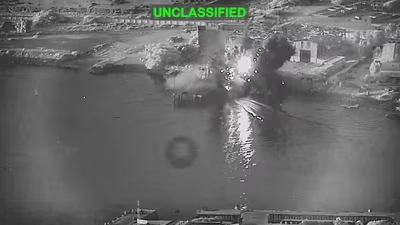
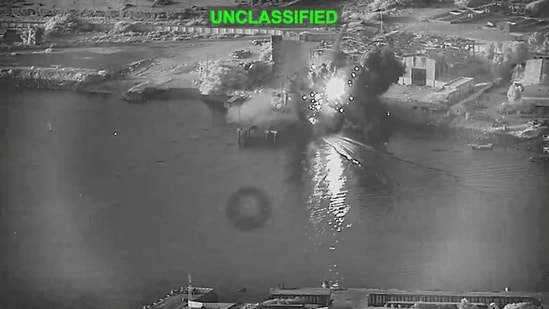
Mr Trump has previously threatened to “obliterate” Iran’s bridges, power plants and water facilities. He now seems to be acting on those threats. America has attacked roads, tunnels, bridges and rail links to Bandar Abbas, a southern port that handles a large share of Iran’s trade, cutting it off from the rest of the country. It has also attacked a desalination plant at Bonji in the southern province of Hormozghan, which is reported to have interrupted water supplies to 10,000 people in 20 villages, according to Iranian state media. (Iran, in response, attacked power and water plants in Kuwait, causing fires in several facilities.)
The White House has denied bombing civilian sites, saying it had hit “exclusively…military targets, including military logistics infrastructure”. On July 21st General Dan Caine, chairman of the joint chiefs of staff, said he was unaware of the strike on Bonji. Strikes on purely civilian infrastructure could amount to war crimes, though Mr Trump’s Pentagon has repeatedly downplayed the importance of the Geneva conventions and international law.
A second target set would include Iran’s nuclear sites, which were attacked by America and Israel last year and again in February. American strikes are thought to have done serious damage to Iranian enrichment facilities—caverns where centrifuges enrich uranium to higher levels, closer to the purity necessary for a bomb—at Natanz and Fordow. The latter was struck by bunker-buster bombs last summer. But another facility at Natanz, Kuh-e Kolang Gaz La, also known as Pickaxe Mountain, appears to be untouched.
On July 22nd Mr Trump repeated his threat to bomb the mountain. On July 13th he had said that although America had seen no “activity” there, he intended to “take out” the facility regardless: “Tell the Iranians to be ready.” The site is probably under construction and not yet operational, according to the Institute for Science and International Security, a think-tank, though Iran has moved thousands of centrifuges there, reports the Wall Street Journal.
Mr Trump could order attacks on the facility’s power lines, ventilation shafts and entrance tunnels, or use bunker-busters to hit its underground chambers directly. But the facility is so deep that James Acton of the Carnegie Endowment, another think-tank, doubts America’s weapons could collapse its tunnels or damage their contents. “Deep underground facilities, such as Pickaxe Mountain,” he observes, “are essentially invulnerable to non-nuclear weapons.” Nor would destroying centrifuges do anything to force Iran to keep Hormuz open.
The third and most drastic option would be a ground offensive of the sort that Mr Trump considered and rejected earlier this year. Attacks on transport links in southern Iran have sparked rumours that America is preparing for such an eventuality by preventing Iranian reinforcements. A ground assault could target Kharg island, a crucial oil-export terminal, the Persian Gulf coastline or the area around the Strait of Hormuz itself. America still has two aircraft-carrier strike groups in the Middle East, along with sizeable amphibious forces.
In reality, a ground war remains unlikely. An American occupation of Kharg island could choke off Iranian oil exports, but America’s navy is doing much the same from a safer distance with its blockade (and American forces on Kharg would be vulnerable). Occupying Iran’s Gulf coastline would do little to stanch the flow of projectiles that can be fired from further inland. A ground offensive against Iran’s nuclear sites to recover or destroy its stockpile of highly-enriched uranium would still amount to the largest and most complex raid in military history, with a significant chance of disaster.
As Mr Trump mulls his options, Iran gets a vote. It has already struck back hard, injuring nearly 100 American troops in July alone. The geographic scope of the war is widening. For the first time in three months, Iran has hit Saudi Arabia. It has also targeted Aqaba on the Red Sea in southern Jordan. Traffic through Hormuz has slowed to a crawl. On July 25th Saudi Arabia struck targets in Yemen, retaliating against attacks on two Saudi tankers in the Red Sea by the Houthis, an Iran-backed rebel group there. On July 23rd the price of Brent crude reached $100 a barrel for the first time since May, following the Houthis’ attacks and announcement of a blockade on Saudi shipping through the passage, dipping back to $97 a day later. At home, support for Mr Trump’s war, which has cost nearly $38bn to date, stands near record lows; the midterm elections are in just over three months.
Arab diplomats hope to persuade Mr Trump that in light of his weak hand, a ten-day ceasefire is the better course. But there is little reason to think Iran would re-open Hormuz or give up its nuclear programme. “The likeliest outcome is…a new normal,” argues Ilan Goldenberg, a former American official who now works at J Street, a doveish pro-Israel advocacy group. That would involve recurring clashes, periodic air strikes on Iran’s nuclear programme, Iranian control of Hormuz and an enduring American presence in the Middle East. Says Mr Goldenberg: “I’ve worked on Iran for nearly 20 years. Our options are never great, but I’ve never seen things this bad. For the first time in my career, I’m at a loss.”