With the plans for local government reorganisation finally announced, how will the biggest council carve-up in more than 50 years affect the county?
The abolition of the ‘two-tier’ council system – which has run much of England since 1974 – has been on the cards since 2024, when the Labour government announced its plans.


For almost two years, Kent and Medway’s 14 local authorities have been tasked with helping write the blueprint for their own abolition.
This week, the government has finally announced its preferences, just as Prime Minister Sir Keir Starmer serves his final days in office before being replaced by Andy Burnham.
But what difference will the new system actually make to day-to-day life in Kent?
What the new councils will look like
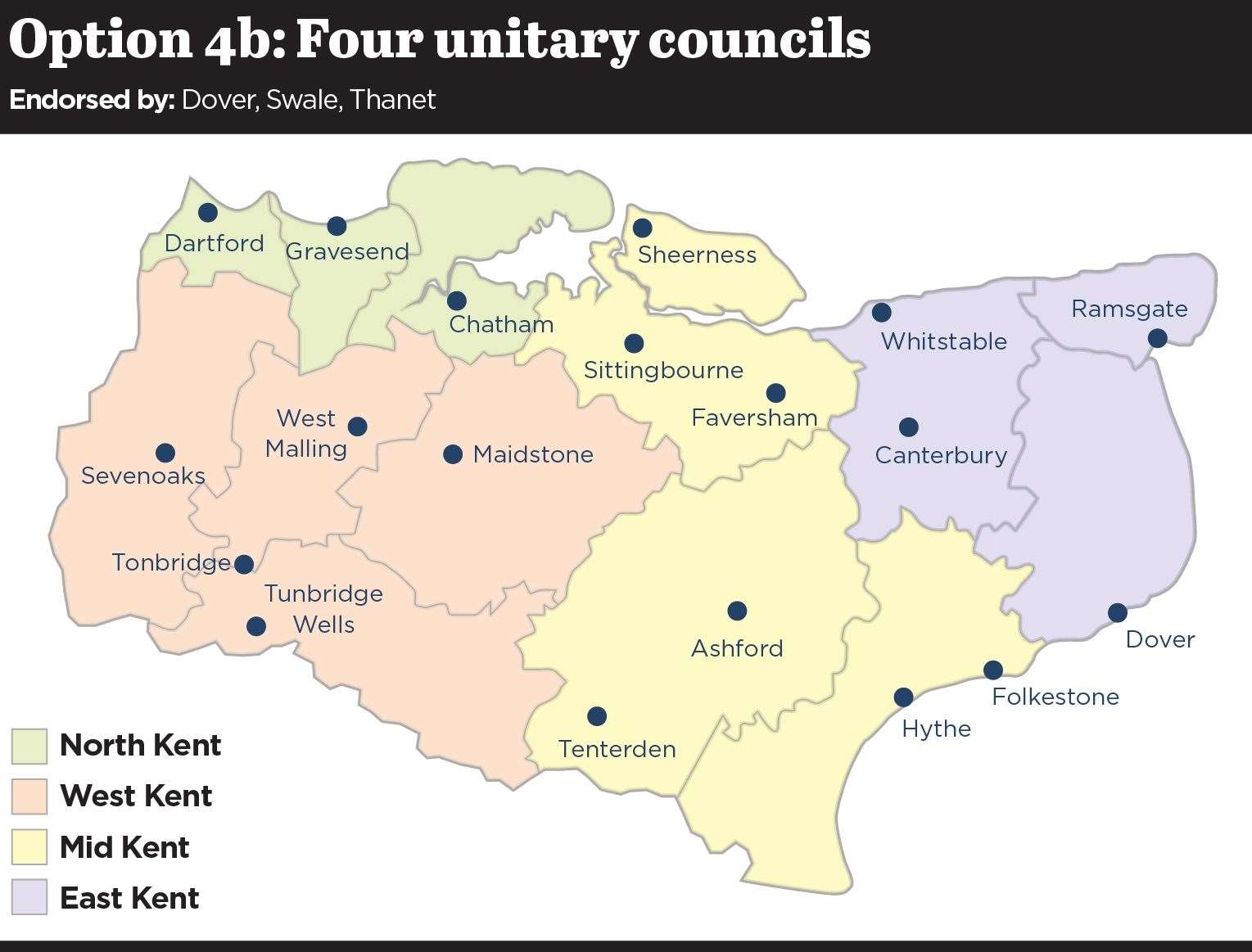
Local government minister Steve Reed has chosen for Kent the option often referred to as ‘4b’.

This will split the county into four unitary authorities.
Education, planning, highways, collecting bins and running tips; currently, these are all divided between district and county councils – but in the new unitaries, these powers will be concentrated.
Using the geographies of the existing districts, the new unitary councils are:
East Kent – Canterbury, Thanet and Dover
Mid Kent – Folkestone & Hythe, Ashford and Swale
North Kent – Medway, Gravesham and Dartford
West Kent – Maidstone, Tonbridge & Malling, Tunbridge Wells and Sevenoaks
This specific layout was the one endorsed by Dover, Swale and Thanet councils.

Rejected options include proposals for three councils, five councils and even for one singular massive council – the option preferred by Kent County Council’s (KCC) Reform leadership.
Services
As it stands, the splitting of powers between districts/boroughs and the county causes much consternation at the lower level.
Approval of housing developments falls to districts and boroughs, but houses require roads – which are the responsibility of the county council.
Covering such a massive area, KCC’s highways officers are often called upon to attend local planning committee meetings where roads are a matter of contention, but seldom attend.

Districts and boroughs are responsible for organising bin collections – a system which has recently been reformed and standardised.
The county council, however, runs tips. In the new system, these large new councils will be responsible for both your bins and recycling centres.
As for roads, they will be in charge of fixing potholes, too.
How will it affect me?
The stated aim of the reorganisation is to “streamline” local services with a view towards further devolution in the service of economic growth.

The basic theory is what economists call “agglomeration effects”, that there can be productivity and cost benefits from organising services on a larger scale.
Indeed, local councils already seek these efficiencies by pooling together some services. Dover, Thanet and Canterbury operate PartnershipOne which pools their council tax services. Ashford, Maidstone and Swale jointly outsource their bin collections.
Under the new system, bin collections and the like will be organised by the large unitary councils, covering a massive area.
In theory, with responsibility for highways and housing and planning unified in one authority, decisions on housing developments and transport will work better together.
But this also means that planning committees will be making decisions covering a huge area. Will people in Folkestone or Hythe be enthused by Sheppey councillors voting in favour of new housing 50 miles away on the south coast?

Such tensions are real enough already with our existing council geographies.
The politics
In terms of political representation, the massive size of the new council may become evident to residents quite quickly.
Folkestone, Ashford and Swale may be the clearest case. The leaders of the opposition, for example, could be from Sittingbourne and Sheppey area, whereas the administration parties could be from Folkestone or Ashford, or vice versa.
English local government geography already creates areas which have vastly different places within them – usually larger towns surrounded by smaller villages.
With these even larger authorities, this will be amplified.
The new East Kent will contain Canterbury – the cosmopolitan university city – as well as Thanet and Dover, which are less diverse, economically worse-off and much more likely political territory for the likes of Reform UK.
More devolution?
The government’s announcement on local government reorganisation says it will “unlock the path towards devolution and economic growth”.
In practice, devolution is likely to mean the new unitary authorities pooling powers together in a new upper level, possibly including an elected mayor.

Under the incoming new Prime Minister, Andy Burnham, a noted fan of devolution who benefitted handsomely from it as the directly elected mayor of Greater Manchester, it is quite likely this process will go further, with more powers.
In future years, Kent’s new councils may find themselves with more revenue-raising powers independent of the national government, and theoretically less beholden to Westminster on financial matters.
What now?
Elections to the four new Kent councils will take place in 2027, and they will exist as ‘shadow authorities’ alongside the current councils to learn how to take the reins.
By April 1, 2028, the new councils will take over fully, and the abolition of the councils which have run Kent for 50 years will be complete.
In the meantime, the 14 councils will be hard at work planning how various systems, including payroll, will be changed under the new system – which will likely involve at least some job losses.