The following is a guest editorial courtesy of Arina Sharagina, Marketing Manager at broker technology solutions provider Brokeree Solutions.
The global copy trading platform market reached around USD 4.27 billion in 2024, with the Asia Pacific emerging as a high-growth market for this technology. Research estimates that this region will grow at a compounded annual rate of 21.5% through 2033.
Keeping those numbers in mind, Brokeree tried digging deeper into what’s happening in the Southeast Asian region and ran a Google Trends search interest analysis, a study the team conducts regularly to see how search interest in copy trading has shifted across markets over the last few years.
What the Search Data Shows
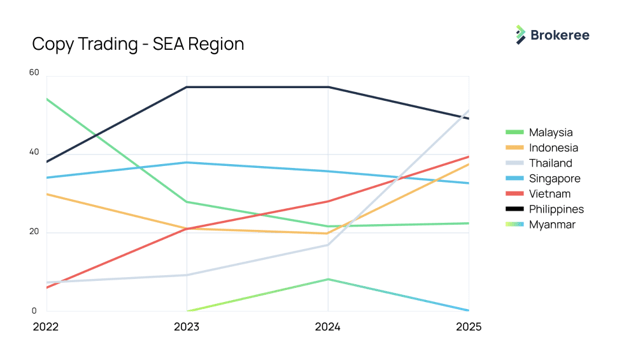
Recent data across seven Southeast Asian countries, drawn from Google Trends search interest data between 2022 and 2025, point to broad-based attention rather than a single-country spike.
One caveat worth noting upfront: the search data captures only English-language queries, which means interest expressed in Thai, Vietnamese, Bahasa Indonesia, and other regional languages is not reflected here.
Search interest in copy trading nearly tripled in Thailand between 2022 and 2025, moving from a low base to one of the highest interest scores in the region. Vietnam followed a similar trajectory, growing from minimal interest to a level on par with established markets. Indonesia climbed steadily. The Philippines, already one of the highest-interest markets in APAC, held that position throughout. Only Malaysia and Singapore stayed roughly flat, though both remain meaningful markets in absolute terms.
What stands out is not the performance of any individual market but the breadth. Multiple Southeast Asian markets are now generating meaningful search demand simultaneously, rather than the regional total resting on one or two countries.
Search results reflect interest rather than account openings or trading volume. In our experience, though, it tends to map closely to what brokers in a region begin asking about. More brokers across the Asia Pacific want to know how to launch copy trading services. Retail traders are searching for them directly. And, in some cases, introducing brokers and affiliates are asking for it as well.
“The growth we’re seeing across Southeast Asia is consistent with what our team is hearing from brokers throughout the region,” said Tatiana Pilipenko, Regional Head of Business Development (APAC, UK & Americas) at Brokeree Solutions. “Copy trading has moved beyond being a supplementary feature. For many brokers, it is becoming a core acquisition and retention tool. As retail participation expands and traders look for more structured ways to engage with financial markets, brokers are increasingly evaluating how copy trading fits into their broader product and regional growth strategy.”
Three Forces Behind the Numbers
The first is retail participation. In several APAC markets, particularly the emerging ones, investing has moved beyond a small, experienced audience. When new participants enter financial markets, they tend to look for structured ways to participate. Copy trading offers that structure without requiring immediate expertise.
The second is the demographic composition of the region’s retail base. APAC’s new entrants skew younger, and millennials and Gen Z bring expectations shaped by the consumer apps they already use. The financial journey often starts and stays on a smartphone, which makes mobile-first copy trading a natural entry point rather than a secondary channel.
The third is the expectation of multi-asset access. Traders in APAC markets are rarely looking at forex in isolation. Indices, commodities, equities, and crypto are part of the same conversation, often within the same account. Copy trading that doesn’t span those asset classes looks dated to followers who expect signal providers to operate across them, with crypto being a particularly visible part of that expectation in this region.
Where Brokers are Focusing in 2026
The growing demand for multi-asset trading is changing how brokers think about platform infrastructure and product strategy. Treating forex and crypto as separate offerings is becoming harder to justify when followers expect signal providers to trade across both.
Therefore, brokers are moving toward multi-asset environments to create new opportunities for copy trading. But supporting multi-asset copy trading without the right platform is more demanding operationally. Brokers need to think about how to onboard signal providers, present performance clearly, configure risk, and build the right narrative around the product. If those elements don’t align, brokers may see fast adoption but poor retention.
“At Dupoin, we see copy trading in APAC evolving from a simple product feature into a broader growth and engagement strategy. In many emerging markets across the region, we are also seeing stronger demand for USDC-denominated accounts and lower-capital entry options, as new retail traders look for a more accessible way to fund accounts, test strategies, manage risk, and build confidence before scaling up. This makes copy trading particularly relevant for mobile-first and multi-asset users, but it also raises the bar for brokers. The real challenge is not only launching copy trading, but building a reliable ecosystem around it — from signal provider verification and risk controls to clear performance presentation, localized education, and suitable account structures for different trader segments. In fast-growing APAC markets, trust, accessibility, and execution quality will determine long-term adoption,” said Iris Lu, Director of Operations & Marketing, Dupoin.
Another critical factor is signal provider verification. If unverified or low-quality providers are onboarded, trust drops quickly, and in most cases, one bad experience affects the perception of the entire platform.
Beyond operations, brokers also need to think about positioning. Simply adding the product is not enough. Brokers who build copy trading into a regional plan, with a marketing strategy supporting it, tend to convert better than brokers who treat it as one more platform on the list. That regional approach is also where customization comes in. Brokers are tailoring fee structures, trading conditions, and provider models to fit different segments, instead of running one standardized product across all markets.
And finally, brokers are paying attention to AI and automation. Adoption is growing quickly across the industry, and more traders now expect AI-driven features to be part of the platform experience. The complication is the growing overlap between human traders and algorithmic strategies. Both can be valid. The key is transparency, because followers need to know what they’re copying. Some brokers already label strategies clearly, for example, as automated or AI-driven. In APAC, regulatory clarity on this is still evolving, so the responsibility often falls on the broker.
A Practical Read for Brokers Watching the Region
For brokers operating in or expanding into APAC, copy trading is shifting from a feature decision to a strategic one. The search data points to interest forming across several markets at once, which changes what regional rollout looks like. The operational realities, multi-asset coverage, provider verification, regional positioning, and transparency around AI are where the brokers with strong execution will separate from those treating copy trading as a checkbox.
The demand side of this conversation is already settled. The execution side is where the next twelve to eighteen months will be decided.