President Donald Trump built his persona around his 1987 memoir “The Art of the Deal.” His latest financial disclosures offer a glimpse into the art of the trade.
Trump’s annual financial disclosures were released last week, showing that the president made 21,285 stock trades in 2025 — the equivalent of 85 trades per trading day or roughly one trade every five minutes during market hours.
Those moves might be paying off. Market data tracker Unusual Whales estimates that, excluding his massive stake in his media company, his equity portfolio would have returned 37.3% since his inauguration, compared with 23.5% for the S&P 500, as of July 2nd.
White House spokesperson Anna Kelly said Trump’s assets are managed by independent third-party financial institutions in discretionary accounts, and there are “no conflicts of interests.”
The president’s son Eric said on X that Trump and his family have no role in the investments, and have no notice or ability to override their managers’ investment strategies. The White House declined to disclose who operated the president’s investment accounts.
The high-performing portfolio is also one of the most actively traded among modern presidents. Trump’s second term has seen far more trading activity than under previous presidents, said Matt Saincome, CEO of Unusual Whales, which is known for monitoring politicians’ trades. As president, Joe Biden reported 13 trades in index funds and other managed investments, and Barack Obama reported 16 in similar vehicles. Neither traded individual stocks during their terms, filings show.
Trump’s current activity is also dwarfing that of his first term, which saw 431 transactions, all for index funds and other managed vehicles. This time, he’s buying and selling individual stocks — and at a rapid clip.
“When Trump’s trades first came through, I thought there was a bug with the data,” Saincome said.
Not only is Trump a presidential outlier, but he’s also in the minority of investors whose actively managed accounts beat passive index investing and the rest of the stock market. According to Morningstar, just 21% of actively managed funds beat their passive index peers in the decade leading up to 2025.
The disclosures also show that Trump generated more than $2 billion in income during 2025, a period when the benchmark S&P 500 rose 16%. While boarding Air Force One last week, Trump told reporters that he was profiting because “the stock market’s going up.”
“Everybody’s profiting,” the president said. “If you have a, do you have a 401(k)? How’s your 401(k) done?”
Not your typical retirement account
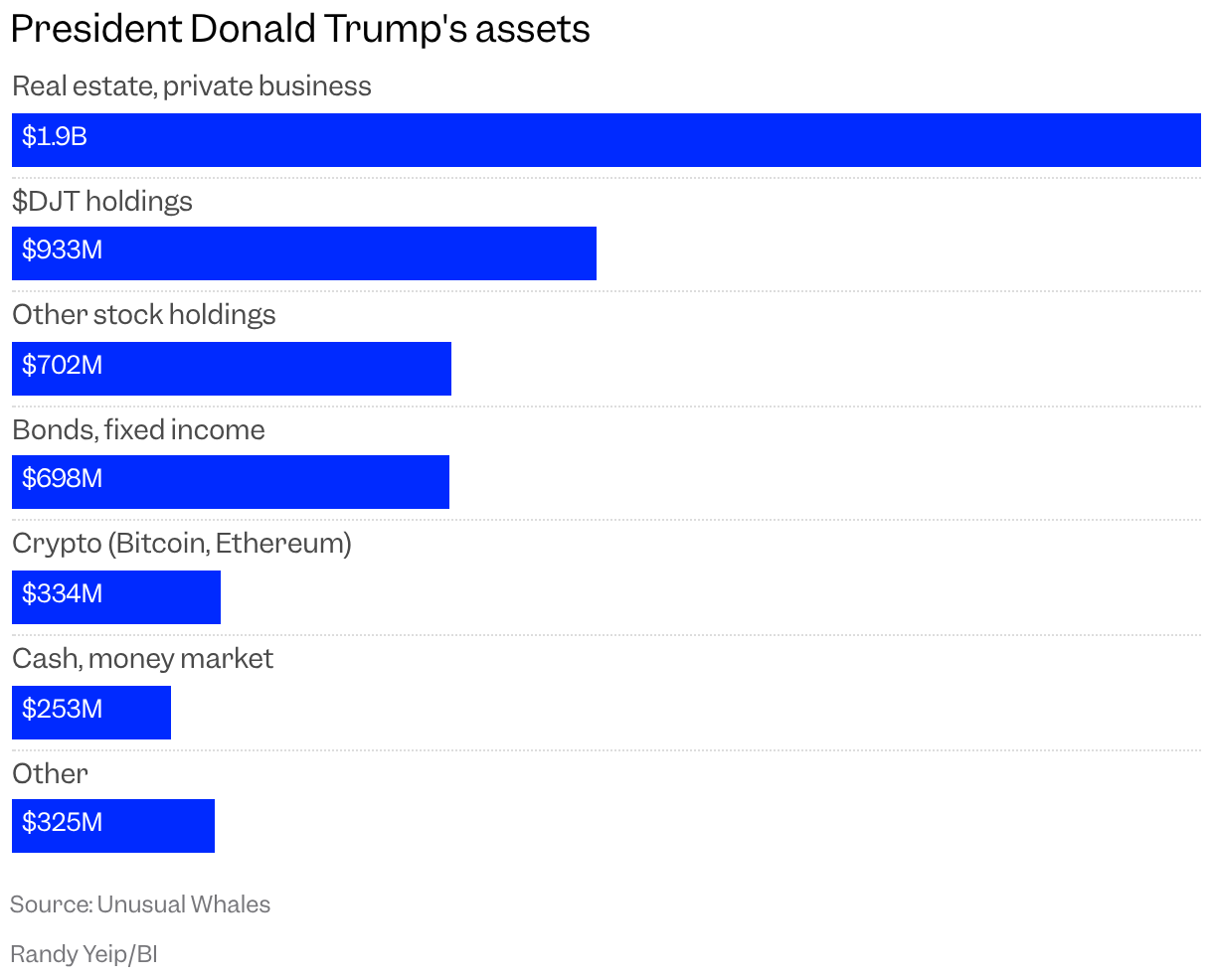
Trump’s wealth looks very different from the typical retirement account. An analysis by Unusual Whales estimates that Trump’s portfolio is worth roughly $5.2 billion. While his stock collection is a fairly conventional basket of large-cap companies, his massive stake in Trump Media and Technology Group, crypto assets, and commercial real estate holdings are less traditional nest-egg assets.
Trump has said he earned money because the market rose, but the biggest driver of his wealth wasn’t equities; it was crypto, with $1.4 billion in income from crypto assets.
Here is a breakdown of Trump’s assets, according to an analysis by Unusual Whales. The actual dollar amounts are estimates, as the data is disclosed in ranges.
His equity stock holdings make up almost a third of his portfolio. His largest stock holding by far is in Trump Media, which accounts for nearly 60%. His company’s value has been down massively since his inauguration, falling roughly 75%.
He also owns equity in nearly 1,500 companies in what Unusual Whales said looks like a standard diversified megacap portfolio. Most of these holdings are between $1 million and $8 million and span the usual bets in most portfolios, such as financial services, healthcare, and energy.
And like the rest of us, he is heavily invested in AI, with Alphabet, Nvidia, and Broadcom all making the top five equity holdings list, according to Unusual Whales.
Bonds and crypto
Complementing the equity bets is a nearly equally large bond book with thousands of small positions, most between $1,000 and $25,000.
He also has more than $300 million in crypto assets like bitcoin and ethereum, but the biggest drivers of his $1.4 billion in crypto income last year came from $500 million from World Liberty Financial, a venture run by the Trump family that launched the WLFI coin, and $635 million for a licensing fee from Celebration Coins, tied to the $TRUMP Coin.
Unusual Whales analyzes reams of political financial disclosures to keep track of politicians’ portfolios in a searchable database. These filings don’t disclose transaction sizes or holdings in exact dollar amounts, but in a range, which can be small, like $1 to $5,000, or as big as $25 to $50 million.
Unusual Whales uses the middle value of each range to estimate the composition of politicians’ portfolios, and allows investors to track not only the president’s portfolio but also those of politicians like Nancy Pelosi.
Trade like Trump
Trump’s professional investment manager has been incredibly busy over the past year. To understand more about it, Unusual Whales analyzed Trump’s monthly disclosures, which are released in real time but are less comprehensive than his annual disclosures.
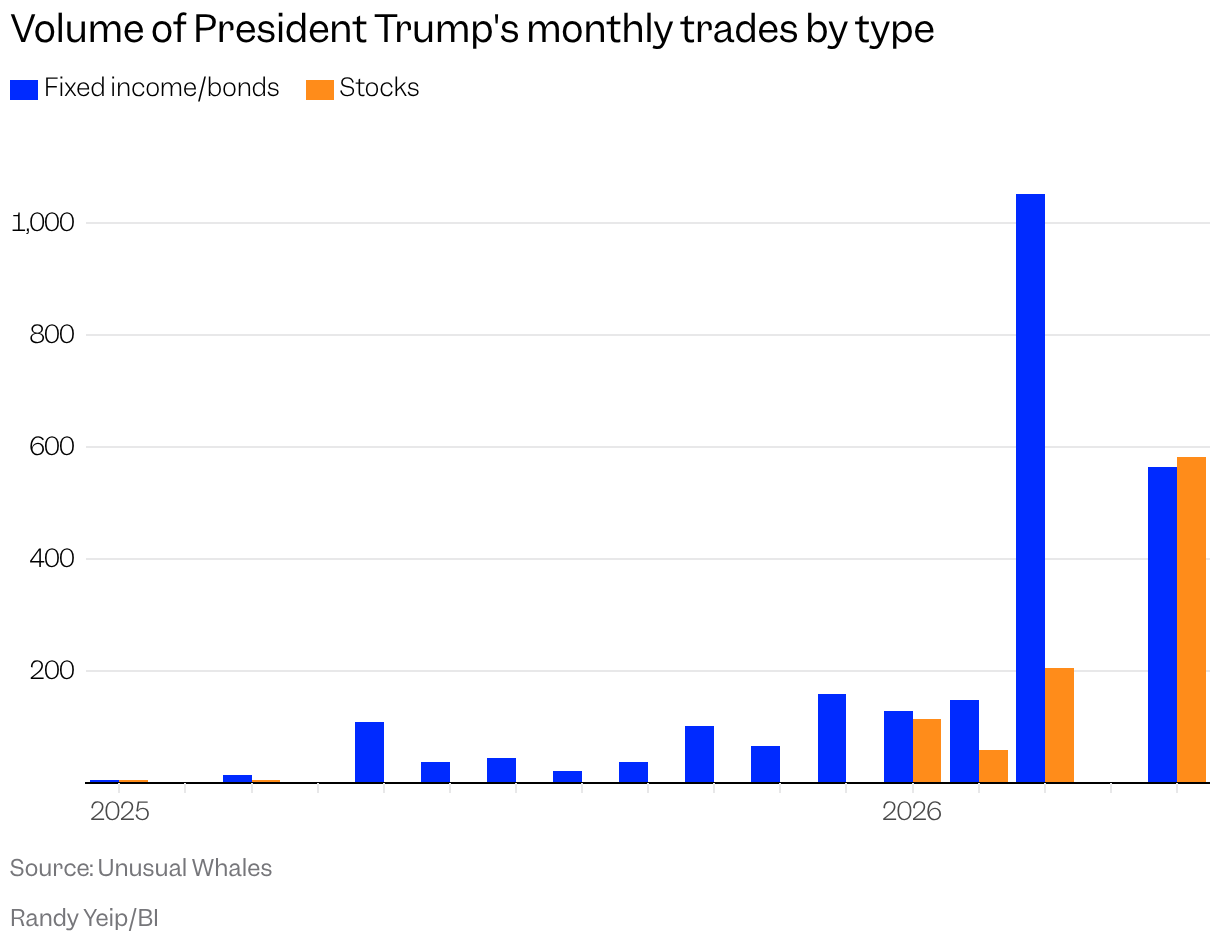
In 2025, Trump was almost entirely focused on bond-buying, but this year has been pouring money into equities too.
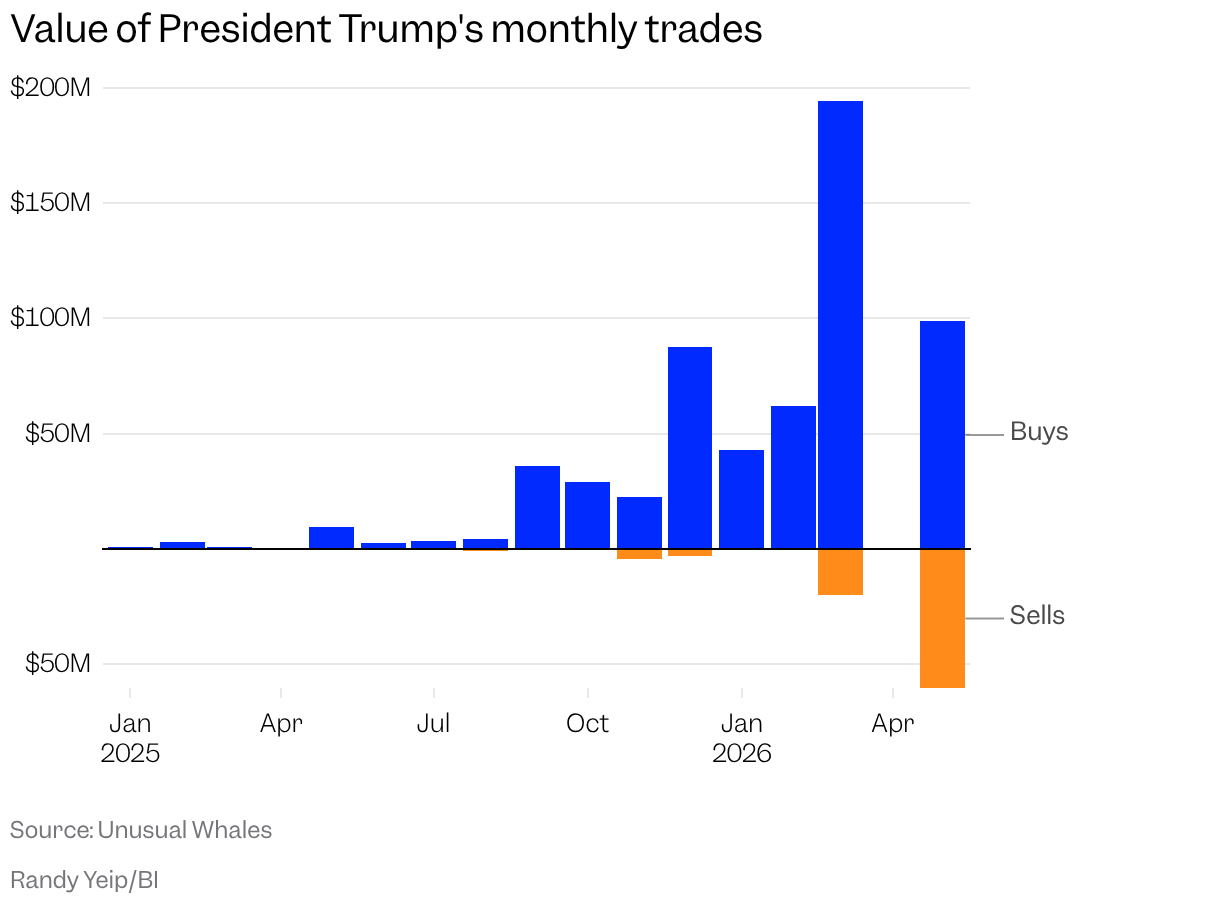
Trump’s trading activity spiked in March 2026, with $194 million in volume, and then again in May. May also saw a big pivot in behavior, with selling outpacing buying for the first time.
A former White House ethics lawyer sounds off
Other presidents are “nowhere close” to Trump’s trading volume, said Richard Painter, who served as the chief White House ethics lawyer in George W. Bush’s second term.
And Trump is trading heavily in industries over which he has direct regulatory powers. He has also promoted individual stocks, including Palantir’s stock ticker in a Truth Social post, and told consumers to buy Dell computers, whose CEO Michael Dell donated $6.25 billion to help seed Trump’s signature personal finance policy, Trump Accounts.
“We haven’t had a president with this big a financial conflict of interest since the Civil War,” said Painter. He said the closest parallel was the era before the Civil War, when presidents like George Washington and Thomas Jefferson owned plantations while they made decisions about slavery.
Painter, a law professor at the University of Minnesota, has long advocated for a ban on congressional and top executive branch stock trading. He says it’s “hypocritical” that there are criminal provisions against federal executive branch workers participating in any government matter that will directly affect their finances, but the president, vice president, and Congress are exempt.
Congress has attempted to ban or limit politicians’ stock trading, but all recent attempts have been unsuccessful.
“This thing is just getting worse and worse,” Painter said, adding that Congress needs to realize its own credibility is on the line if it doesn’t constrain politicians’ trades.