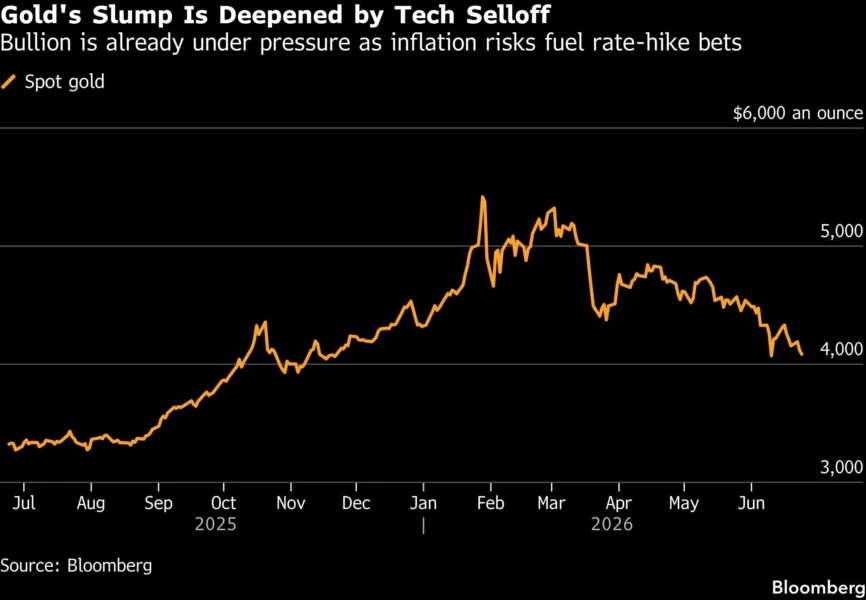
Gold prices extended their decline on Wednesday, slipping to the lowest level in nearly two weeks as investors grappled with a potent mix of rising US interest-rate expectations, a stronger dollar and a sharp technology-led equity selloff that has forced traders to raise cash by unwinding positions in precious metals.
Spot gold fell below $4,100 an ounce on Wednesday, extending losses after a 1.7 percent decline in the previous session. Bullion traded around $4,085 an ounce in early Asian trade, hovering near its lowest level in nearly two weeks, while US gold futures also moved lower.
The latest decline indicates a counterintuitive reality of financial markets: even assets considered safe havens can come under pressure during periods of broader market stress.
Why is gold falling?
One of the biggest drivers of the recent weakness has been a deepening selloff in global technology stocks. As AI-driven equities retreat from record highs, investors facing losses in stock markets have increasingly sold gold to raise liquidity and meet margin requirements elsewhere in their portfolios.
The tech-led rout on Wall Street accelerated the liquidation of bullion holdings, amplifying downward pressure on prices.
At the same time, expectations of tighter monetary policy in the United States have strengthened the dollar and reduced the appeal of non-yielding assets such as gold.
The Bloomberg Dollar Spot Index has risen since the Federal Reserve’s latest policy meeting, while the US currency climbed to a more than one-year high on Wednesday, according to Reuters. A stronger dollar makes gold more expensive for international buyers, often weighing on demand.
Fed outlook weighs on bullion
Investors are increasingly betting that the Federal Reserve may have to raise interest rates further to contain inflation.
Market pricing tracked by CME’s FedWatch tool suggests traders now expect as many as three rate hikes this year. Those expectations have intensified after the Fed signalled growing concern over inflation and new Federal Reserve Chair Kevin Warsh adopted a notably hawkish tone.
Higher interest rates typically reduce the attractiveness of gold because the metal does not generate income. As yields on competing assets rise, investors often shift away from bullion in search of better returns.
The next major test for markets will come from the US Personal Consumption Expenditures (PCE) index, the Fed’s preferred inflation gauge, due later this week. A stronger-than-expected reading could reinforce expectations of additional rate increases.
Geopolitics no longer driving prices
The weakness in gold comes despite continuing uncertainty surrounding the fragile diplomatic understanding between the United States and Iran.
US President Donald Trump said on Tuesday that Iran had agreed to indefinite nuclear inspections. Tehran, however, disputed that claim, raising fresh doubts about the durability of the agreement and highlighting continuing geopolitical tensions.
Ordinarily, such uncertainty would support safe-haven assets. However, analysts say monetary policy concerns are currently outweighing geopolitical risks.
The interim US-Iran peace arrangement signed last week initially helped ease fears of a broader Middle East conflict, reducing some of the risk premium that had previously supported gold prices.
A dramatic reversal after a historic rally
The recent correction marks a sharp reversal for precious metals after an extraordinary rally over the past two years.
Gold has fallen nearly 12 percent in the June quarter, putting it on track for its steepest quarterly decline since December 2016. From its record peak of $5,417 an ounce, the metal has retreated roughly 24 percent.
Silver has fared even worse. The metal has slumped around 17.6 percent during the quarter, its sharpest decline since mid-2022, and is now nearly 47 percent below the all-time high of $117 an ounce reached in January.
The declines follow a period of exceptional gains. Gold rose more than 65 percent in 2025 after advancing 28 percent in 2024, while silver surged 148 percent last year following gains of 22 percent in 2024.
What investors are watching next
While the near-term trend remains weak, investors are closely monitoring upcoming US inflation data and any further signals from Federal Reserve officials.
A softer inflation reading could revive hopes of policy easing and support bullion prices. However, if inflation remains stubborn and the Fed continues to signal tighter monetary conditions, gold may remain under pressure despite lingering geopolitical uncertainties.
Beyond macroeconomic factors, developments in the physical gold market are also drawing attention. Dubai’s commodities exchange plans to launch a same-day-settlement gold contract, while Ghana will begin aligning its gold-pricing mechanism with internationally recognised LBMA benchmarks from July 1, both measures aimed at improving liquidity and transparency in the global bullion trade, reported Reuters.
For now, however, investors appear focused on one overriding theme: the prospect of higher US interest rates and a stronger dollar, both of which continue to overshadow gold’s traditional safe-haven appeal.