FOR MUCH of 2025 America’s labour market was a source of anxiety for policymakers. Hiring slowed sharply, job openings tumbled and payroll growth slowed to a crawl. The economy added a meagre 10,000 jobs a month, prompting the Federal Reserve to cut interest rates three times. Christopher Waller, a Fed governor, captured the mood in a speech in January. Job growth last year, he said, amounted to “Zero. Zip. Nada”. It did not “remotely look like a healthy labour market”.
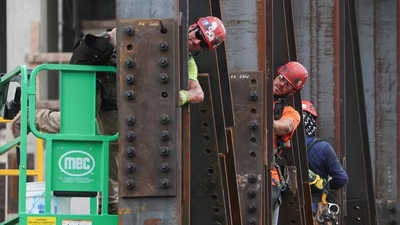
Hiring slowed sharply, job openings tumbled and payroll growth slowed to a crawl. (Reuters)
Those days now feel distant. Data released by America’s Bureau of Labour Statistics on June 5th all but buried last year’s labour-market gloom. Employers added 172,000 workers in May, nearly double the 90,000 or so that analysts expected. Upward revisions for the two previous months, of around 93,000 in total, made the picture brighter still. This pushed average payroll growth over the past three months to 188,000. The gains also spread well beyond health care, where much of the recent strength had been concentrated. Leisure and hospitality added 70,000 jobs and construction 17,000, evidence that demand remains sturdy in more cyclical corners of the economy.
Yet even these healthy headline numbers understate the labour market’s vim. America’s supply of workers has been squeezed, in general, by an ageing population and, in particular, by Donald Trump’s immigration crackdown. The Brookings Institution, a think-tank, estimates that net migration turned negative in 2025, for the first time in at least half a century, and expects the same in 2026. Since Mr Trump took office in January 2025 America’s overall labour force has shrunk, lowering the pace of job creation needed to keep unemployment stable—the so-called “breakeven” rate—which economists at the Federal Reserve reckon could be close to zero this year. Against that backdrop, jobs growth has been exceptionally strong.
It is too early to say the labour market is overheating. The jobless rate has stayed more or less flat at 4.3%. Labour demand is picking up: data released earlier this week showed a jump in job openings, and the number of vacancies per unemployed worker—a useful gauge of how demand and supply line up—has risen to just over one. Yet wage growth remains relatively subdued: nominal pay rose at an annualised pace of less than 4% in the past few months. Given America’s surprisingly decent productivity growth, these pay increases are easy for firms to absorb without passing them on to customers as higher prices. All this points to a comfortably warm labour market rather than a scorching one.
The Fed’s inflation problem nevertheless remains unresolved. The price index for personal-consumption expenditures, the Fed’s preferred measure, rose by 3.8% in the year to April. Even excluding fickle food and energy prices, inflation was 3.3%. Policymakers were already growing more concerned before this jobs report. Wage pressures usually arrive some time only after initial labour-market tightness. At the Fed’s April meeting, three officials dissented in favour of dropping the central bank’s “easing bias”—language suggesting that the next move in interest rates was more likely to be down than up. Since then, others have delivered speeches emphasising inflation risks.
That leaves Kevin Warsh, the Fed’s brand-new chairman, in an awkward position ahead of his first policy meeting on June 16th-17th. Mr Warsh may still make a doveish case, akin to that which won him Mr Trump’s favour, by pointing to softer readings from his preferred “trimmed-mean” measure of inflation (which ignores outlier prices that move the most in either direction). But the labour market offers almost zero, zip, nada in terms of justification for lower rates. With inflation above target for five years and counting, and job gains running above breakeven, Mr Warsh may need to start wondering not when to cut rates, but when to raise them.