Toplines
Japan and the Philippines are enhancing their bilateral partnership through military technology transfers and the resolution of outstanding maritime boundary disputes. Enhanced cooperation between Japan and the Philippines in these areas will likely strengthen both nations’ ability to withstand PRC coercive activities. Philippine President Ferdinand Marcos Jr. met with Japanese Prime Minister Sanae Takaichi in Japan on May 28 and announced several defense agreements to strengthen ties between the two states.[1] The two parties agreed to accelerate talks on military intelligence sharing and the transfer of Japanese naval vessels to the Philippines.[2] The Philippines seeks to acquire six Abukuma-class destroyers from Japan specialized for anti-submarine warfare.[3] Japanese Defense Minister Shinjiro Koizumi also stated on May 31 that Japan will begin discussions with the Philippines over the transfer of Japan’s Type-88 anti-ship missiles.[4] Marcos and Takaichi also agreed to upgrade Japan-Philippines relations to a “Comprehensive Strategic Partnership” during their meeting.[5]
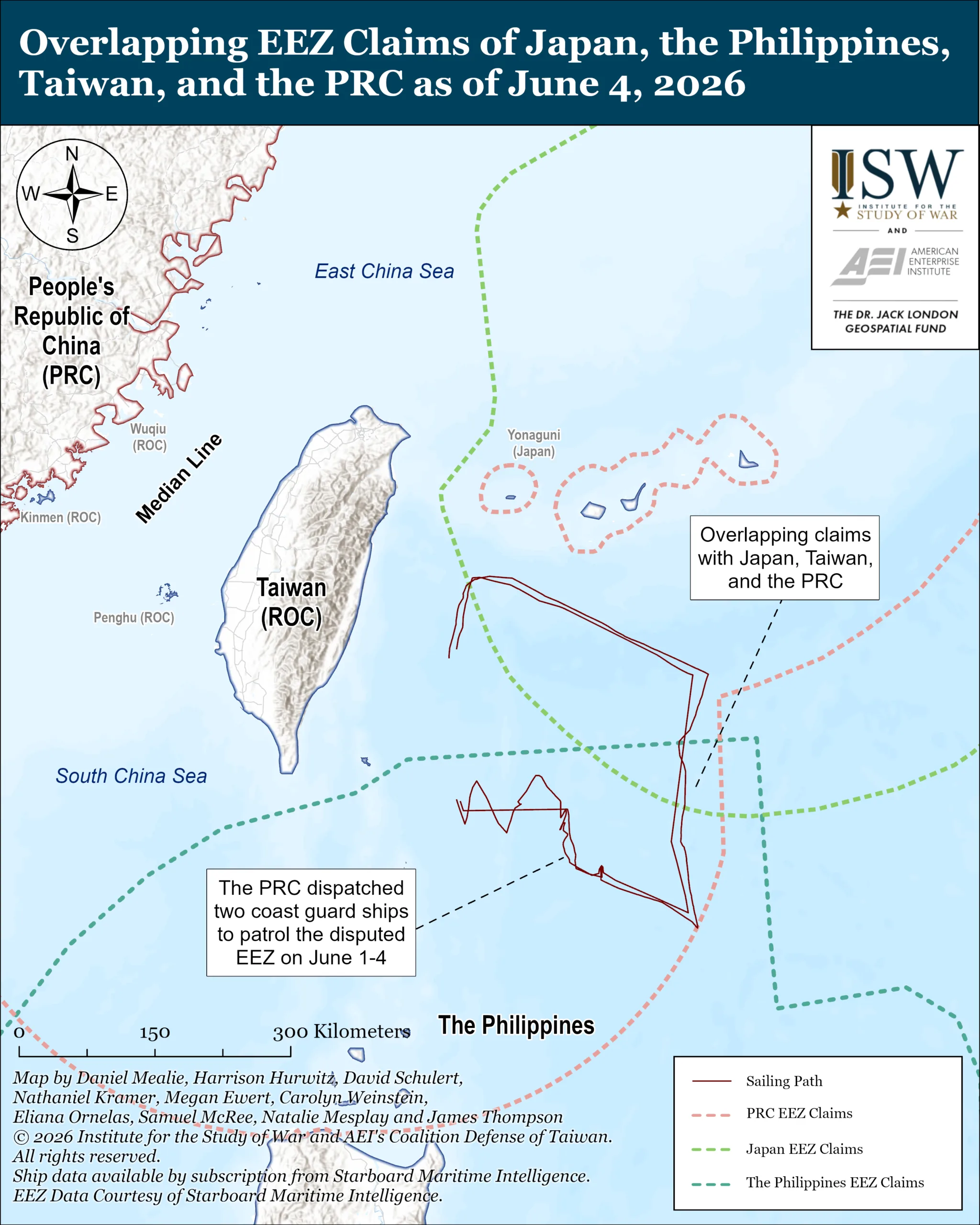
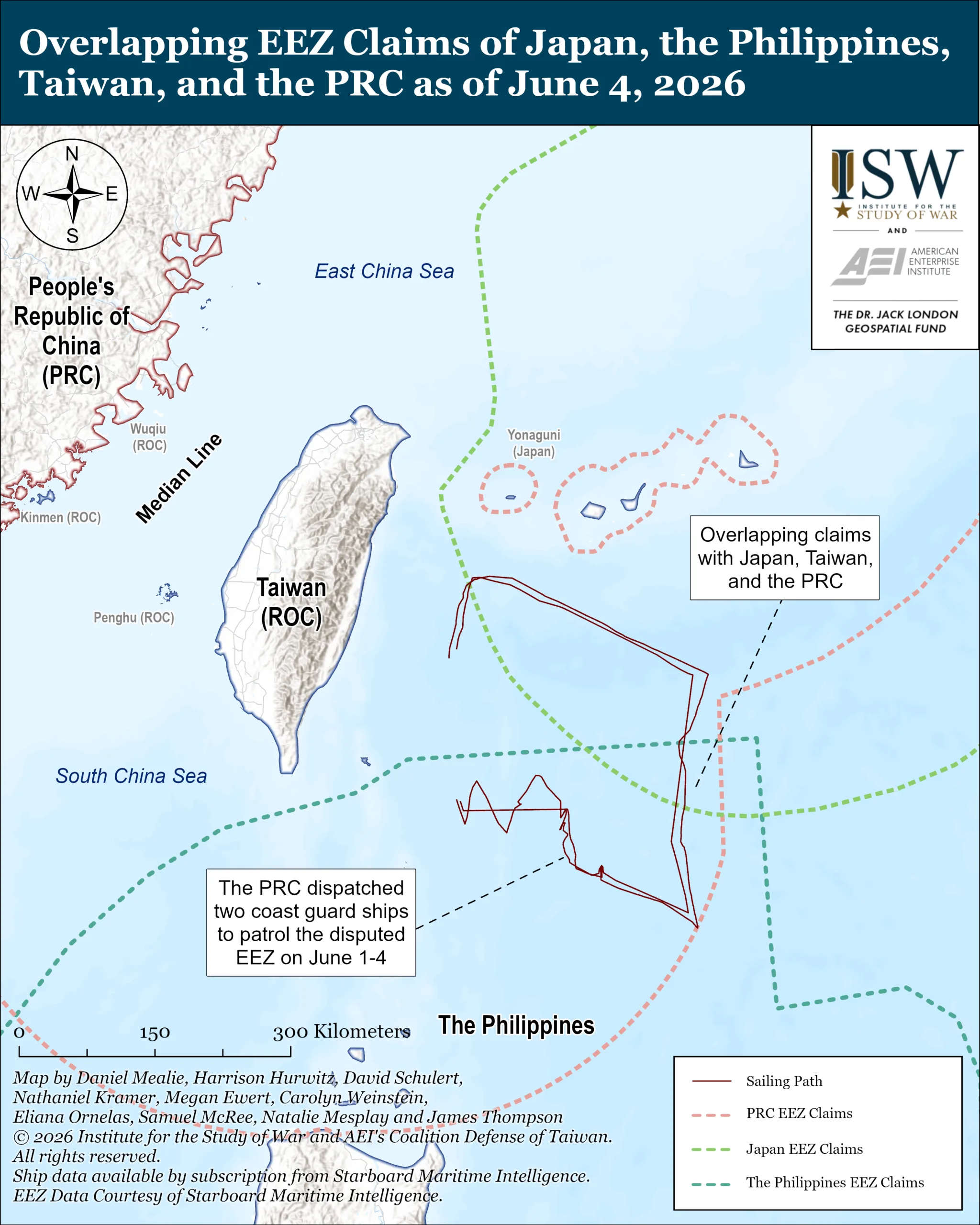
Marcos and Takaichi also announced the two states would work towards negotiations to delimit the exclusive economic zone (EEZ) between the Philippines and Japan in the Western Pacific.[6] An EEZ is an area extending up to 200 nautical miles from a nation’s coastline within which it may exercise exclusive jurisdiction over all resources.[7] Japan and the Philippines’ EEZ claims overlap east of Taiwan and partially coincide with the PRC’s and Taiwan’s claimed EEZs.[8] International legal precedent maintains that all claimant states must agree on the outcomes of negotiations to delimit EEZ boundaries.[9] Japan and the Philippines did not clarify if their delimitation negotiations would include Taiwan or the PRC. Japan and the Philippines both adhere to the one-China policy, making official engagement with Taiwan unlikely.[10] The intention to negotiate EEZ delimitation highlights the growing cooperation between Japan and the Philippines by ensuring no existing territorial disputes remain to create friction between the two countries.
Enhanced cooperation between Japan and the Philippines will strengthen both nations’ ability to combat PRC coercion. Philippine efforts to expand and modernize its surface fleet through Japanese technology transfers will likely provide the Philippine Navy with enhanced capabilities to confront PRC malign maritime activity in the South China Sea.[11] A military intelligence sharing agreement would also provide both nations with a more comprehensive operating picture of the first island chain, increasing awareness of PLA deployments and thereby diminishing PLA freedom of maneuver in the area. Strengthening relations between Japan and the Philippines could strain the PLA’s ability to maintain coercive military activity against both states, requiring additional PLA resources to offset improvements in intelligence and naval capabilities.
Taiwan’s Aerospace Industrial Development Corp. (AIDC) announced on June 1 it has developed a drone navigation system not reliant on GPS signals. The ability to navigate and strike targets under adversary electronic warfare (EW) conditions is a key capability for combat drones such as those Taiwan may use to defeat a PLA invasion. AIDC chairs the Taiwan Excellence Drone International Business Opportunities Alliance (TEDIBOA), an industry alliance of over 200 Taiwanese drone manufacturers and technology firms established by Taiwan’s Ministry of Economic Affairs in 2024 to foster Taiwan’s domestic drone industry and reduce its reliance on PRC-origin components.[12] AIDC developed the AIxVNAV navigation and positioning system using tools licensed from US drone software and geospatial intelligence firm Vantor.[13] The system uses visual navigation based on satellite 3D mapping data and artificial intelligence (AI) to allow drones to accurately navigate in areas where GPS navigation signals are disrupted or entirely jammed.[14]
Russia and Ukraine have used GPS jamming and spoofing techniques to disrupt the navigation of enemy drones and precision-guided munitions.[15] This has necessitated the development of EW-resistant drones that use cameras and onboard AI models to enable visual navigation without receiving radio signals from drone operators or GPS satellites or use fiber-optic cables to physically link drones to drone operators.[16] The PLA possesses advanced EW capabilities, including powerful land and sea-based GPS jammers, and it views dominating the electromagnetic spectrum as a key precondition for an amphibious invasion of Taiwan.[17] A successful defense of Taiwan from a PLA invasion will thus likely require Taiwan’s military to field EW-resistant drone systems at scale to effectively locate, surveil, and strike PLA forces.[18]
AIDC’s successful use of Vantor’s software tools to develop the system also indicates that collaboration between US and Taiwanese drone firms could have substantial benefits for Taiwanese efforts to build a domestic drone industry and create cheap, scalable, and effective combat drones. AIDC Chairman Tsao Chin-ping stated that the AIxVNAV system meets Taiwanese military requirements for “low-cost, high volume” systems resistant to adversary EW. AIDC aims to introduce the technology into Taiwan’s broader drone supply chain through TEDIBOA.[19] Other TEDIBOA firms have significantly increased production of components and full drones for domestic Taiwanese military use and for export to the United States and Europe.[20] Taiwanese firm Thunder Tiger’s “Overkill” combat drone was the first drone system in Asia to attain the US Department of Defense’s “Blue UAS Cleared” certification for US military use in 2025.[21] Taiwan’s drone industry would likely benefit significantly from continued government support and increased domestic drone procurements, decreasing Taiwan’s reliance on PRC-origin drones and components and strengthening the Taiwanese military’s asymmetric capabilities against the PLA. The reduced version of Taiwan’s Special Defense Budget passed on May 8 removed funding for domestic drone procurement and US-Taiwan joint drone development that was present in the Lai administration’s original proposal, however.[22] A lack of alternative funding for continuing and expanding domestic procurements and joint US-Taiwanese drone production will likely harm Taiwan’s military preparedness for a drone-heavy conflict with the PRC.
Note: A version of this text appeared in the Iran Update Special Report, May 30, 2026.
The PRC may have provided man-portable anti-air missiles and other systems to Iran in violation of a United Nations (UN) arms embargo on Iran. Iran may have used a Chinese-made man-portable air defense system (MANPADS) to target US aircraft during the Iran war, according to three individuals familiar with the matter speaking to Western media. The three individuals told NBC News on May 29 that Iran “probably” struck the US F-15 fighter jet over southwestern Iran on April 3 using a Chinese-made shoulder-launched missile.[23] Iran was reportedly in discussions with the PRC before the war began in late February 2026 to acquire MANPADS, though it is unclear when Iran acquired the system used to shoot down the jet.[24] The PRC may have also provided Iran with a radar system to bolster its integrated air defense system before the war.[25] One of the sources and a US official told NBC News that the PRC may have given Iran a YLC-8B long-range anti-stealth surveillance radar in the “early days of the war.”[26]
The possible PRC military transfers underscore the nature of the PRC’s military partnership with Iran. The PRC has demonstrated a willingness to bolster Iranian military capabilities without risking direct entanglement in the conflict. The PRC reportedly sold Iran an advanced reconnaissance satellite that Iran used to target US military bases across the region during the war.[27] The PRC is also a key partner helping Iran reconstitute its missile program and has continued this support by sending Iran missile fuel precursor during the conflict.[28]
PRC arms transfers to Iran would contradict Beijing’s claims about its arms export policies and may constitute a violation of UN sanctions on Iran re-imposed in 2025. The PRC has denied selling weapons to Iran and claimed to have a policy of not supplying weapons or military equipment to parties involved in war.[29] US President Donald Trump also claimed several times that CCP General Secretary Xi Jinping assured him that the PRC did not or would not send weapons to Iran.[30] The PRC was once a major arms supplier to Iran but cut off direct arms transfers in 2015, in compliance with a UN arms embargo.[31] The embargo expired in 2020, and the PRC vocally opposed Western countries triggering a “snapback” mechanism to reimpose the sanctions in 2025.[32] The snapback sanctions nonetheless went into effect in October 2025, including an arms embargo.[33]
Cross-Strait Relations
Taiwan
The PRC may be increasing its countermeasures against certain freedom-of-navigation operations (FONOP) in the South China Sea. The Dutch Navy frigate De Ruyter conducted a FONOP on May 28 around the PRC-controlled Paracel Islands, which are claimed by several other nations.[34] De Ruyter is currently on a five-month diplomatic mission in the Indo-Pacific and is scheduled to attend the US-led Rim of the Pacific naval exercises on June 24.[35] The PLA Southern Theater Command (STC) dispatched several surface vessels and fighter aircraft in response to De Ruyter’s movements and warned De Ruyter’s shipborne helicopter that it was violating PRC airspace.[36] PRC state-owned tabloid Global Times released a map that purported to show De Ruyter traversing through the PRC’s claimed territorial waters around the Paracel Islands.[37] An STC spokesperson stated on May 28 that the PLA used both verbal warnings and electronic jamming to expel the Dutch vessel from the area.[38] The STC further accused the Dutch of being reckless, stating De Ruyter’s movements were “extremely liable to trigger misunderstanding and miscalculation.”[39]
The PRC does not normally specify its method of expulsion of vessels in its claimed waters and may be seeking to demonstrate a resolve to use non-kinetic countermeasures against FONOPs in the South China Sea.[40] The PRC may seek to use more concrete countermeasures, such as electronic jamming, to deter maritime activity by non-Pacific states by imposing greater risks for such activity. The PRC has invested heavily in military infrastructure throughout the Paracel and Spratly Islands, including significant land-based electronic warfare (EW) systems to extend the PRC’s military control over the South China Sea.[41]
Canada is likely to maintain support for Taiwan’s de facto sovereignty despite PRC efforts to leverage stronger Canadian economic ties to dissuade Canada from helping maintain regional stability in the Taiwan Strait. Canadian Navy frigate HMCS Charlottetown transited the Taiwan Strait on May 22, a week before PRC Foreign Minister Wang Yi was scheduled to visit Canada for the first time in 10 years.[42] PRC Canadian Ambassador Wang Di stated in an April interview with Canadian media that Canadian transits of the Taiwan Strait or lawmaker visits to Taiwan could jeopardize the “strategic partnership” between the two states.[43] Canadian Foreign Minister Anita Anand stated on May 29, during Wang Yi’s visit, that Canada aims to markedly increase its exports to the PRC by 2030.[44] The PRC has also depicted Wang’s visit as evidence of deepening PRC-Canada relations.[45] The timing of HMCS Charlottetown’s transit of the Taiwan Strait indicates that Canada is unlikely to significantly alter its position toward Taiwan, despite PRC efforts to leverage both parties’ interest in stronger ties to dissuade Canada from engagement with Taiwan and supporting freedom of navigation in the Taiwan Strait.
The PRC embassy in Czechia harshly criticized Czech Senate President Miloš Vystrčil’s visit to Taiwan. The PRC has increasingly tried to restrict Taiwan’s official and unofficial exchanges with foreign officials, including legislators who are not normally bound by diplomatic conventions. Vystrčil led a 40-member delegation to Taiwan from June 1–4 to meet with representatives from Taiwan’s ruling Democratic Progressive Party (DPP) and opposition Kuomintang (KMT) to expand cooperation and exchanges in business, education, and culture.[46] This is Vystrčil’s first visit to Taiwan since 2020. The PRC’s embassy in Czechia condemned Vystrčil’s visit, claiming that it “seriously interfered in China’s internal affairs” and violated Czechia’s “political commitment to the one China principle.”[47] Czech Prime Minister Andrej Babis, who belongs to a different political party than Vystrčil, also criticized Vystrčil’s visit for potentially harming Czech-PRC business ties.[48] Vystrčil said that Taiwan and Czechia do not need to follow Beijing’s directives on diplomacy.[49] Vystrčil also noted that Czechia does not accept the One China Principle, which insists that Taiwan is part of the PRC, and instead has its own One China Policy that does not preclude unofficial exchanges with Taiwan.[50] The Czech One China Policy resembles the US equivalent, in that Czechia maintains diplomatic relations with only one “China” — the PRC — but does not take a stance on whether Taiwan is part of the PRC.[51] Vystrčil also invited Taiwan’s legislative speaker Han Kuo-yu to visit Czechia.[52] The PRC strongly condemned former DPP speaker You Si-kun’s visit to Czechia in 2022.[53] Han belongs to the relatively PRC-friendly KMT, however, and it is unclear how the PRC would react to a foreign visit by him.
The PRC intensified efforts to restrict Taiwan’s international engagement following the election of former DPP president Tsai Ing-wen in 2016 and even more under current DPP president William Lai Ching-te. Czechia is one of Taiwan’s closest unofficial allies in Europe, however. Czech officials frequently speak out in support of Taiwan and conduct unofficial exchanges with Taiwan.[54] Foreign legislative visits to Taiwan are relatively common, but the PRC often vocally objects when parliamentary speakers and other high-ranking officials meet with Taiwanese officials. Taiwan’s then-vice president-elect Hsiao Bi-khim visited Czechia in March 2024, angering Beijing. Beijing reportedly plotted to physically confront her and stage a car accident while she was there.[55] Czechia was also by far the largest foreign purchaser of Taiwanese drones in the first quarter of 2026, accounting for around 100 million US dollars (USD) in purchases.[56]
The PRC may be trying to protect its preferred faction of Taiwan’s KMT from a scandal that could impact the KMT’s cross-strait policy. KMT Vice Chairman Hsiao Hsu-tsen has been embroiled in a financial scandal that led to his ouster as CEO of the Ma Ying-jeou Foundation in March 2026.[57] Foundation founder and former Taiwanese president Ma Ying-jeou accused Hsiao of mishandling the finances of the foundation, including accepting cash donations while in the PRC without reporting or transferring the money to the foundation. [58] Hsiao alleged in response that Ma was suffering from cognitive decline to cast doubt on his accusations. The evidence against Hsiao includes a photo of him receiving one million New Taiwan Dollars (NTD) (roughly 32,000 USD) in cash from Taiwanese businessman Han Ying-huan, the executive vice president of the Association of Taiwan Investment Enterprises on the Mainland (ATIEM).[59] ATIEM is an organization of Taiwanese businesspeople in the PRC under the “guidance and supervision of the Taiwan Affairs Office [TAO]” which lobbies for closer cross-strait economic and political integration.[60]
Pan-Green (DPP-leaning) Taiwanese news outlet Mirror Media reported on June 2 that the CCP Central Committee was concerned about the impact of the controversy and ordered its Taiwan affairs apparatus to “protect Hsiao,” according to an unnamed source “familiar with cross-strait affairs.”[61] The source alleged that the CCP viewed the controversy as being orchestrated by a pro-US faction within the KMT and that the CCP was bolstering the narrative about Ma’s alleged health issues.[62] An unnamed Taiwanese businessman separately said that photos like the one of Hsiao receiving money from Han are a common way for Taiwanese businesspeople in the PRC to showcase their accomplishments in cross-strait affairs to PRC authorities.[63]
The PRC likely favors individuals like Hsiao and KMT chairwoman Cheng Li-wun as their preferred interlocutors in the KMT over more US-friendly figures in the KMT or older KMT conservatives who are declining in influence. Cheng and Hsiao have vocally advocated for cross-strait exchanges, criticized Taiwan’s dependence on the United States, and opposed major increases in Taiwan’s defense budget. The PRC previously pointed to Ma’s presidency in 2008-2016 as its preferred model for cross-strait relations and even invited Ma to meet with CCP General Secretary Xi Jinping in 2015 and 2024.[64] The CCP now likely sees Ma as declining in relevance, however, and is pinning its hopes on the younger Cheng Li-wun faction to lead the KMT in a more Beijing-friendly direction. Mirror Media’s reporting, if true, indicates that the PRC is attempting to directly interfere in KMT internal politics.[65]
Taiwanese Premier Cho Jung-tai announced on June 1 that Taiwan has finalized liquefied natural gas (LNG) shipping schedules through August and that LNG prices for residential use and electricity generation will not increase through August. The PRC is attempting to take advantage of global energy supply disruptions related to the US-Iran war to delegitimize the Lai administration and cause panic in Taiwan over potential LNG shortages. The Taiwanese Executive Yuan published Cho’s comments from a special Cabinet meeting on the US-Iran conflict and its economic effects on Taiwan.[66] Taiwan relies on imported LNG to generate around half of its total electricity supply, but its current LNG reserves only store enough for around 12 days of usage.[67]
The PRC exploits Taiwan’s vulnerability to LNG supply shocks to threaten Taiwan’s populace with the prospect of widespread electricity shortages unless Taiwan agrees to accept PRC annexation. The PLA published images of missile strikes on mock sites resembling Taiwanese LNG storage facilities and maps showing Taiwanese LNG terminals marked as missile targets during its large-scale “Strait Thunder 2025A” exercises.[68] The PLA practiced blockades of Taiwanese ports as part of the “Strait Thunder 2025A” and “Justice Mission 2025” exercises, and PRC state media explicitly identified “cutting off power” as one of the objectives practiced during “Justice Mission 2025.”[69] The PRC also launched an online social media disinformation campaign in March that claimed Taiwan would soon face LNG shortages and electricity blackouts due to Iran’s closure of the Strait of Hormuz and advocated for “peaceful unification” with the PRC to secure Taiwan’s energy supply.[70] The PRC may be attempting to inflame public fear of energy shortages in Taiwan now to intensify the psychological impact of a threatened or actual blockade in the future, making it more effective as a coercive tool to compel Taiwanese capitulation.[71]
The Lai administration has recently taken action to counter the PRC’s psychological warfare narratives around Taiwan’s LNG supply. Taiwan’s Interior Ministry announced in April that it would carry out joint exercises with the Taiwanese navy and coast guard to practice escorting shipments of imported natural gas and oil through a blockade of the island.[72] The Ministry of Economic Affairs has also repeatedly assured the Taiwanese public since the outbreak of the US-Iran war that Taiwan is not facing energy shortages.[73] Taiwan is also planning to increase its LNG reserves to 14 days and diversify the source of its LNG imports by purchasing more from the United States and Australia.[74] Taiwan’s continued reliance on imported LNG for electricity generation and its extremely limited LNG storage capacity remain significant vulnerabilities for PRC coercion and a potential PLA blockade, however.
Taiwanese President William Lai Ching-te made a public statement cautioning that TikTok and RedNote (Xiaohongshu) could be used to target Taiwanese youth to improve their perceptions of the PRC. The Lai administration is prioritizing countering PRC social media influence operations and cognitive warfare to reduce the threat posed by PRC disinformation campaigns. President Lai delivered his comments at a May 30 youth forum, warning that Taiwan could gradually “lose its will” to defend its democracy and eventually perceive China’s annexation and aggression attempts as “benevolent” if Taiwan does not counter PRC cognitive warfare and information operations.[75] President Lai proposed integrating lessons into school curricula to teach Taiwanese students about the “true Taiwan” and prevent “indoctrination” by TikTok and RedNote.[76] Taiwan passed a one-year ban on RedNote in December 2025, and banned the use of TikTok/Douyin on public sector electronic devices and equipment in 2019 due to national security concerns.[77] PRC TAO Spokesperson Zhu Fenglian responded to these comments, saying that these apps were creating positive Cross-Strait interactions and cultivating a feeling of “one family across the Strait.”[78] PRC state media framed President Lai’s comments as “intimidating and threatening” Taiwanese youth.[79]
These comments reflect concern within Taiwan’s government over PRC influence operations targeting Taiwanese youth and waged over social media platforms. Taiwan’s youth and the broader Taiwanese public currently overwhelmingly identify as Taiwanese regardless of PRC operations, however.[80] Reduced Taiwanese threat perceptions of the economic and political threat posed by the PRC could make Taiwan more susceptible to influence operations. Lai’s recognition of this threat represents a critical first step in raising awareness of PRC social media influence operations and defending against them.
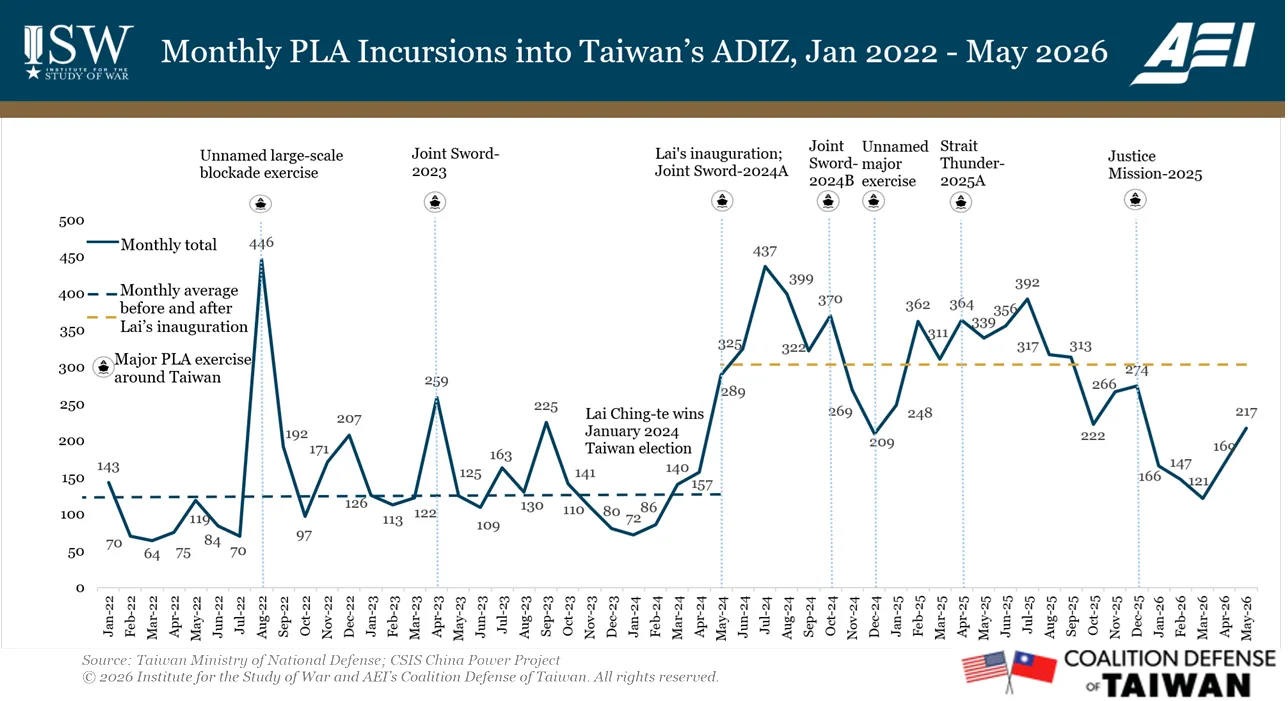
The PLA carried out a total of 217 aerial incursions into Taiwan’s Air Defense Identification Zone (ADIZ) in May, a slight increase from April. This total number of ADIZ incursions still represents a marked decrease from previous averages exceeding 300 ADIZ incursions per month in the year after Taiwanese President William Lai Ching-te’s 2024 election.[81] The PRC has not launched any high-altitude balloons into Taiwan’s ADIZ since February 2026.[82]
The continuous shifts in ADIZ incursion rates per month may indicate efforts by the PRC to maintain a level of unpredictability, requiring Taiwan to remain alert and prepared to scramble a response despite its decreased ability to predict PLA behavior. This appears to be consistent with previous efforts by the PLA to degrade Taiwan’s threat awareness by desensitizing it to frequent aerial incursions during the previously much higher incidence of ADIZ incursions.[83]
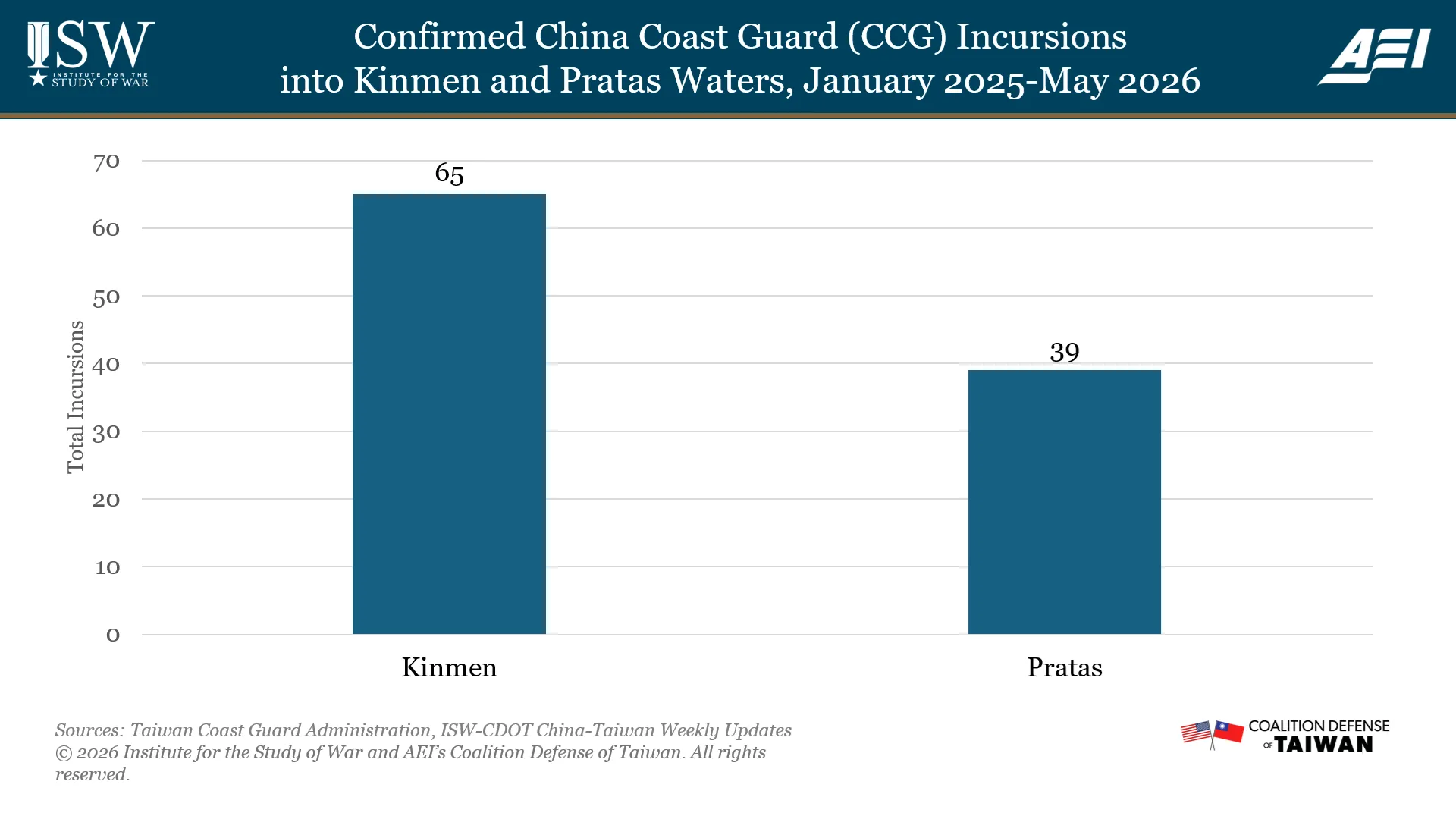
The China Coast Guard (CCG) made four incursions into Taiwan-administered waters near Taiwan’s Kinmen islands and one incursion near Pratas Island in May. Four CCG vessels entered restricted waters near Taiwan’s Kinmen islands on May 7, May 21, May 26, and May 27, and remained in the waters for two to three hours in all instances before exiting.[84] These incursions were reported in Taiwanese media, with the latter two then confirmed by CCG East China Sea Branch Spokesperson Zhu Anqing who labelled them “law enforcement inspections.”[85] The Taiwanese Coast Guard Administration (CGA) reported 39 CCG incursions in restricted waters around Pratas Island since February 2025, recording 33 incursions in 2025 and 6 incursions so far in 2026, including a 20-hour standoff between the CGA and a CCG vessel which began on May 23.[86] ISW-CDOT reported these incursions as totaling 36 in 2026 as of our May 1 report, however, these figures have been updated with the latest reporting from CGA.[87] The CGA announced that it plans to rotate larger patrol ships in the area in response to the increased presence of CCG vessels around Pratas and to ensure the safety of monthly resupply routes.[88]
Kinmen is a Taiwanese county comprised of several islands approximately two miles from the PRC, with Taiwan maintaining “prohibited” or “restricted” waters around these. These waters function similarly to territorial waters or a contiguous zone; however, Taiwan does not claim them as such due to Kinmen’s proximity to the PRC. Pratas is a Taiwanese atoll north of the South China Sea with no permanent population, which serves as a Taiwanese marine garrison. The CCG frequently intrudes into Taiwan’s restricted waters around these islands to boost PRC jurisdictional claims and erode Taiwan’s territorial sovereignty. The PRC also likely conducts these incursions to test the CGA’s monitoring and response capabilities while eroding Taiwan’s threat awareness by desensitizing it to repeated intrusions.
China
The PRC is expanding its land-based nuclear launching infrastructure to increase its resilience against a first strike. Improving the survivability of its nuclear forces will likely enhance the deterrence effects of the PRC’s nuclear armament. Reuters reported on May 29 that it has observed significant expansion of PRC nuclear missile facilities in Xinjiang, in the northwest of the PRC.[89] The Reuters investigation reported that the PRC has constructed a network of over 80 launch pads around its principal nuclear facilities in the Xinjiang desert, a key cornerstone of its land-based nuclear forces.[90] The Reuters report stated that the extensive launch pad network could host mobile air defense assets, EW capabilities, or road-mobile intercontinental ballistic missile (ICBM) launchers.[91] The US Department of Defense (DOD) has assessed that the PRC is significantly expanding its nuclear arsenal and is on track to field 1,000 warheads by 2030.[92] The PRC has refused to participate in US-Russia talks on nuclear arms control and likely conducted a secret nuclear test in 2020.[93] The expansion of infrastructure to potentially support more road-mobile launches suggests that the PRC is continuing to expand its nuclear capabilities despite continued PRC denials that it is rapidly adding to its nuclear arsenal.[94]
The PRC officially adheres to a no-first-use nuclear policy, meaning the PRC has renounced the use of nuclear weapons unless such weapons are used against the PRC.[95] The PRC’s expansion in Xinjiang may serve to increase the survivability of its nuclear deterrent against a first strike, either nuclear or conventional, to ensure its nuclear forces remain a credible deterrent. The PRC has also used its no-first-use policy to distract from its efforts to expand its nuclear arsenal on several occasions, including using the policy to justify its refusal to accept a nuclear testing moratorium in 1994.[96] The PRC’s expanded nuclear infrastructure suggests it will continue to build up its nuclear arsenal while refusing to engage in arms control discussions with other nuclear-armed states.
The PRC has likely been trying to acquire Nvidia AI chips in recent years, despite not approving the purchase of advanced H200 chips in 2026. It likely aims to copy the chips or use them to develop its own version to avoid dependence on foreign technology. The US Department of Commerce’s Bureau of Industry and Security (BIS) issued a guidance on May 31 that clarified that US firms need a license to export “advanced computing items,” such as chips, to subsidiaries of PRC companies, even when the subsidiaries are based outside the PRC.[97] Reuters reported that BIS issued the guidance in response to an anonymous report that alleged the PRC had exploited a US export control loophole to acquire advanced US chips through foreign-based companies.[98] The New York Times reported on June 1 that an investigation by software platform Wirescreen found that the PLA had openly sought Nvidia AI chips for advanced computing applications since at least 2019, even after the US government imposed restrictions on chip exports to the PRC.[99] The PRC likely also acquired Nvidia chips through illegal smuggling. Taiwanese authorities apprehended three individuals in mid-May for falsifying export documents to enable exports of servers containing advanced Nvidia chips to the PRC.[100] At least one shipment of the servers was exported to Japan and then re-exported to the PRC through Hong Kong.
The PRC likely is not heavily relying on Nvidia chips for its military modernization and instead is acquiring limited numbers of advanced chips to copy, study, or use in narrow applications. US Secretary of Commerce Howard Lutnick said on April 22 that the PRC has not approved any companies to purchase H200 chips, Nvidia’s second most powerful AI chips, despite the Trump administration approving the sale of such chips in January.[101] Nvidia spokesperson John Rizzo said that Wirescreen’s analysis showed that the PLA acquired far fewer Nvidia chips than the roughly 100,000 that would be required for a typical AI system.[102] Rizzo also said that the PLA was specifically acquiring chips from the PRC firm Huawei. Huawei announced on May 25 that it had developed a new technology that will enable it to produce industry-leading chips by 2031.[103] The United States, Japan, and the Netherlands have worked together to successfully prevent the PRC from gaining access to the most advanced lithography machines and other technologies used in manufacturing advanced semiconductors and chips.[104] The PRC’s domestic development of advanced AI chips, possibly aided by technology transfer and copying from US and other foreign firms, will reduce the effectiveness of sanctions and other measures in curtailing the PRC’s civilian and military AI advancement.
PRC Minister of National Defense Dong Jun skipped the Shangri-La Dialogue from May 29 to 31, but the PRC met with the United States to discuss maritime and air safety between May 28 and 29.[105] The PRC may be avoiding the Shangri-La Dialogue, interpreting it as a US-aligned bloc, while maintaining open communication with the United States alone. Dong did not attend the Shangri-La Dialogue, an annual Asian security forum, for the second year in a row.[106] US Secretary of Defense Pete Hegseth spoke on Pacific defense and coalition-building at the Shangri-La Dialogue. Hegseth did not directly mention Taiwan or the South China Sea in his speech, but he did express his “alarm regarding China’s historic military buildup and the expansion of its military activities in the region and beyond.”[107]
Hegseth emphasized during his speech that the United States and PRC would prioritize bilateral meetings to discuss issues of mutual concern. The United States and PRC met in Hawaii to discuss the Military Maritime Consultative Agreement from May 28 to 29.[108] The United States and PRC established the Military Maritime Consultative Agreement in 1998 to ensure periodic bilateral meetings on maritime safety.[109]
The PRC may be attempting to establish itself as a dominant power in the Pacific by engaging in bilateral meetings with the United States while avoiding sending high-level officials to the Shangri-La Dialogue. The PRC has protested the military build-up of several Shangri-La Dialogue participants, most notably Japan. The PRC’s participation in the Military Maritime Consultative Agreement indicates its ongoing willingness to engage in bilateral dialogue with the United States. The PRC seeks to impose its own terms on bilateral meetings, however. The PRC has delayed Hegseth’s visits over arms sales to Taiwan, which the PRC opposes and uses as a bargaining chip in US-PRC relations.
Northeast Asia
Japan
The PRC is using the 80th anniversary of the Tokyo Trials to advance information operations against Japan. This narrative is part of an ongoing effort to delegitimize Japan’s defense efforts as Japan takes military and legislative steps to counter PRC aggression. The Tokyo Trials took place following Japan’s defeat in World War II to prosecute Japanese war criminals. PRC State-backed tabloid Global Times published several articles covering the anniversary of the Tokyo Trials, including a May 25 piece calling the trials “a warning bell for Japan’s attempt to resurrect militarism.”[110] A May 28Global Times article described a Tokyo Trials commemoration symposium in Shanghai and noted that many participants “expressed deep concern over Japan’s ongoing political shift and the resurgence of militarism.”[111] PRC Ministry of Foreign Affairs (MFA) spokesperson Mao Ning expressed similar sentiments in a May 29 press conference.[112]
The PRC has waged a rhetorical, diplomatic, and economic pressure campaign against Japan since November 2025, when Japanese Prime Minister Sanae Takaichi stated that a Taiwan contingency would likely involve Japan. The PRC frequently references World War II in these information operations, attempting to link Japan’s contemporary coalition-building efforts to Imperial Japan. Japan has refused to retract Takaichi’s statement or pause its remilitarization efforts despite PRC pressure. Japan has taken military and economic steps to counter the PRC’s coercion campaign, including implementing a foreign investment screening body modeled after the Committee on Foreign Investment in the United States (CFIUS). Japan on May 29 passed legislation establishing revisions to its Foreign Exchange and Foreign Trade Act (FEFTA) meant to review foreign-owned investments and safeguard Japanese industrial secrets.[113] Japan has also loosened restrictions on defense article exports and conducted combined exercises with coalition partners, efforts that the PRC similarly criticizes.[114] PRC messaging aims to split Japan from its coalition partners, including the United States.
South Korea
The PRC may seek to exploit the South Korean Lee Jae Myung administration’s emphasis on sovereignty by portraying the discourse on US Forces Korea (USFK) strategic flexibility as conflicting with Lee’s stated goal of enhancing South Korean autonomy. USFK Commander Xavier Brunson said on May 22 that South Korea appears as a “dagger lodged in the heart of Asia” from the PRC’s perspective.[115] The PRC Embassy in Seoul stated on May 28 that Brunson’s remarks “crossed the line” and asked whether the United States intends to use South Korea as a weapon against the PRC.[116] The embassy questioned whether Brunson’s “hostile and aggressive remarks” had Washington’s approval or were intended to undermine the agreement made during the summit between US President Donald Trump and CCP General Secretary Xi Jinping.[117] Brunson explained on May 30 at the Shangri-La Dialogue that he was referencing a 19th century aphorism that had described South Korea as “a dagger against Japan.“[118] PRC state-owned tabloid Global Times on June 1 claimed that Brunson’s statement failed to consider South Korea’s own strategic calculations.[119] Global Times published a separate article, citing Chinese scholar Lü Chao, who argued that the United States is treating its allies as “subordinate states,” “tools” against the PRC, and undermined South Korean sovereignty.[120] Seoul-based outlet JTBC News reported on May 29 that several South Korean government officials — including Director of National Security Council Wi Sung-lac, Foreign Minister Cho Hyun, and Minister of National Defense Anh Gyu-back — requested Brunson to exercise “restraint.”[121]
Brunson has previously presented his “East Up Map,” which rotates the map of Northeast Asia to place the east at the top, suggesting that the Korean Peninsula could serve as a central node within a network of US allies in the region.[122] Brunson also proposed establishing South Korea as a Regional Sustainment Hub (RSH) on April 22 to enable maintenance, repair, and overhaul of certain US military assets at USFK bases.[123] Brunson’s statements likely reflect a potential expansion of USFK’s responsibilities beyond North Korea, aligned with the US 2026 National Defense Strategy (NDS), which proposed enabling US allies to take primary responsibility for their own defense while the United States prioritizes deterrence against the PRC.[124] The Global Times commentary’s reference to South Korean sovereignty likely seeks to invoke matters that the South Korean government has framed as matters of national sovereignty. South Korean President Lee Jae Myung emphasized on May 26 the need to “regain” wartime operational control (OPCON) from the United States to South Korea, adding that he hopes to restore South Korea’s status as a sovereign and independent nation.[125] The PRC may seek to portray a potential reorientation of USFK’s strategic posture as divergent from Lee’s policy priorities, thereby attempting to undermine United States-South Korea relations.