WHEN FOOTBALL’S World Cup expanded from 32 to 48 teams for the 2026 edition, one of the biggest beneficiaries was Asia. The continent received eight direct qualifying slots, plus the possibility of a ninth team via the play-offs—up from the previous arrangement of four direct plus another possible play-off team. With close to double the number of berths on offer for Asian teams in 2026, surely China—with its massive population, lavish football spending and a president long obsessed with the sport—could qualify for only its second ever World Cup?
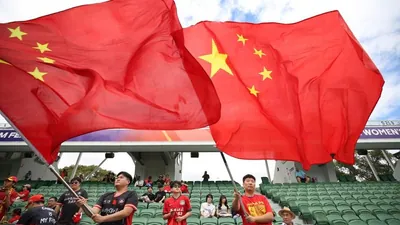
It wasn’t supposed to be this way. Xi Jinping famously declared his three wishes for Chinese football back in 2011 (AFP File Photo)
Not even close. Finishing below regional powerhouses Oman, Indonesia and, yes, Palestine, China didn’t even make it through to the fourth round, where the final two spots were up for grabs, limping out of qualifying with barely a whimper. The men’s team can only dream of being as passably successful as the country’s women, who have qualified for the past three tournaments and reached the final in 1999.
It wasn’t supposed to be this way. Xi Jinping famously declared his three wishes for Chinese football back in 2011, while still vice-president: to qualify for, host and win the World Cup. One of these wishes had, it is true, already been granted more than a decade earlier, when China qualified for the tournament in 2002. But that “golden generation” failed to score a goal, while conceding nine.
A 50-point plan was put in place in 2015, which made all the right noises and opened the floodgates for football investment, both for China’s domestic league and for a Chinese takeover of European clubs. Less than two years later, managers from England’s Premier League, including Arsenal’s Arsene Wenger and Chelsea’s Antonio Conte, were starting to worry publicly about the financial pulling power of the Chinese league and the threat posed to European leagues.
So, where did it all go wrong? In typically Chinese fashion, the answer lies less in excess than in control: corruption scandals, political interference and a football philosophy imposed from the top instead of built from the bottom.
Today, the domestic game is a mess. More than half the clubs in the Chinese Super League began the season on negative points after punishments linked to match-fixing, gambling and corruption. Ten games into the season, the team from Tianjin had still not moved into positive territory.
Meddlesome officials have done just as much damage. In China the sport sits firmly within the state bureaucracy, with the Chinese Football Association effectively answerable to the sports ministry. Under Mr Xi, football became a political project complete with targets, slogans and official directives. China can mass-produce high-quality electric vehicles. That’s harder with footballers.
As for top-down planning, Chinese leaders could, perhaps, be forgiven for applying the same approach that has helped the country excel in everything from building infrastructure to making EVs. But successful football cultures are usually messy, local and organic. They depend on children playing informally, community clubs taking root and talent rising gradually through a pyramid of interconnected leagues. So whereas China’s governing instinct is to standardise, supervise and scale up success, football tends to flourish precisely where authority loosens its grip, in communities that the system does not naturally tolerate.
And what of Mr Xi’s grand plans? Qualifying will need at least another four-year cycle, while the possibility of winning can safely be ejected into orbit. Which leaves hosting.
Gianni Infantino, president of football’s world governing body, FIFA, went to China in 2017 and met Mr Xi, with all the talk about when, not if, China would host the men’s World Cup. Chinese state media even went as far as to speculate whether it would be 2030 or 2034.
However, with those two World Cups already awarded to Morocco/Portugal/Spain and Saudi Arabia, respectively, the earliest China could realistically hope to host the tournament, given FIFA’s long-standing policy of rotating the hosting rights between continents, would be the summer of 2042. By then, Mr Xi would be 89 and coming towards the end of his sixth five-year term.
But even that seems unlikely. When Mr Infantino returned to China in 2024, he was greeted not by Mr Xi but by a vice sports minister—a fair reflection of football’s diminished status in China’s political priorities.
In an intriguing sub-plot, China’s cooling interest in the World Cup has reached such lows that, with a month to go until the tournament kicked off, no broadcast deal had been signed between China Media Group, the main state media company, and FIFA. It was finally agreed in mid-May, but with FIFA reportedly accepting around $60m—a mere one-fifth of what it had initially sought.
If I had a yuan for every time someone had asked why China couldn’t find a competitive XI from its population of 1.4bn, I’d probably be investigated for corruption. The paradox is familiar. China excels in individual Olympic sports where success can be engineered through repetition and centralised training systems. Football, by contrast, depends on improvisation, unpredictability and a deep grassroots base. The Chinese Super League’s brief spending boom a decade ago brought in high-profile foreign players, but it did little to raise domestic standards.
As a result, Chinese officials appear to have concluded that hosting the World Cup no longer makes political sense. A flawlessly organised tournament would earn limited credit if a humiliating performance on the pitch dominated global headlines. A decade ago, Chinese officials treated football as a strategic industry. Today it is closer to a reputational liability.
The World Cup would, of course, be richer for having China in it—and not just in a financial sense—but the real losers are the fans in that country, who remain as passionate as ever. When Lionel Messi’s Argentina played Australia in Beijing in 2023—arranged specifically, some speculate, to mark Mr Xi’s 70th birthday—demand for tickets was sky-high and the atmosphere, both inside the stadium and out, evoked memories of the city’s jubilant Olympic party in 2008. China still loves football, even if its leaders don’t.
Mark Dreyer is the founder and editor of China Sports Insider and the author of “Sporting Superpower: An Insider’s View on China’s Quest to Be the Best”.