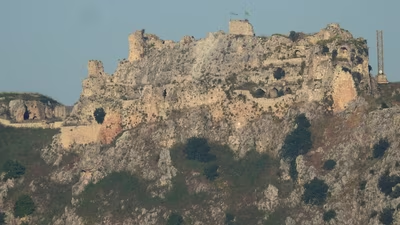
Israeli troops seized control of the 900-year-old Beaufort Castle and the surrounding strategic ridge in southern Lebanon, the military said on Sunday in what appears to be a huge gain against Iran-backed Hezbollah despite a ceasefire that came into effect more than six weeks ago.

The seizure of the medieval fortress and nearby ridge expands Israel’s presence in Lebanon at a time when clashes between Israeli forces and Hezbollah continue.
The development comes after one of the heaviest days of Hezbollah attacks on northern Israel since the April ceasefire.
The significance of Beaufort Castle
The capture of Beaufort Castle, located near the city of Nabatiyeh, comes after several days of airstrikes and fighting in nearby villages, where Israeli troops battled Hezbollah fighters.
The Israeli military’s spokesperson, Avichay Adraee, shared a photograph on X showing Israeli soldiers outside the fortress. The country’s defence minister, Israel Katz, also posted on X, saying troops had raised the Israeli flag over the site.
Israeli forces had previously captured the castle in 1982 and maintained control of it until withdrawing from Lebanon in 2000.
Situated high above Lebanon’s green hills and overlooking the Litani River, the Beaufort fortress has served as a key military position for various armies for nearly 1,000 years.
The site lies a few kilometres north of the Israeli border and provides views across large areas of southern Lebanon and northern Israel, Associated Press reported. In Arabic, it is known as Al-Shaqif Castle, a term derived from an old Syriac word describing the area’s steep and rocky landscape.
Originally built by Crusaders in the 12th century on the remains of earlier fortifications, the castle has been occupied over the centuries by the Crusaders, Saladin’s Jerusalem army, the Mamluks, the Ottomans, the French Mandate authorities, the Palestine Liberation Organization, and the Israeli military.
After partial restoration, it was later reopened to visitors. The Crusaders gave it the name Beaufort, an Old French term meaning “beautiful fortress”.
1982 capture of Beaufort Castle
The fortress’s capture from the Palestine Liberation Organization in 1982 was considered a major success for the Israeli military, which was then led by defence minister Ariel Sharon, who later became Israel’s prime minister.
Israeli forces used the castle, also known as Qalaat al-Shakif, as a military base during their earlier occupation of southern Lebanon, which lasted for nearly two decades before ending in 2000, news agency Reuters reported.
During the previous Israel-Hezbollah conflict in 2024, UNESCO granted protection status to 34 cultural sites across Lebanon, including Beaufort Castle, to shield them from potential damage.
With inputs from agencies