BERLIN—When President Trump said he would pull some U.S. troops out of Germany to punish the country for its leader’s criticism of the Iran war, Sevim Dağdelen thought: Finally!

“We’re extremely grateful for the help in defeating the Nazis,” said the far-left German politician. “But 81 years after the end of World War II—after the Russians, the British and the French, it’s also time for American soldiers to go home.”
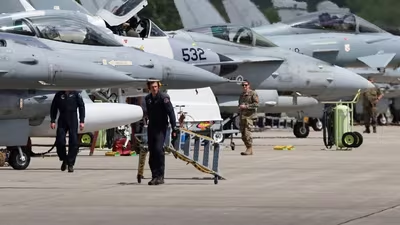
The Pentagon’s decision to pull 5,000 of its 35,000 troops out of the country within six to 12 months and to cancel a 2024 agreement to station long-range conventional missiles in Germany has caused consternation among mainstream politicians and security officials here.
While many see the drawdown as symbolic, they fear the canceled missile deployment will make Germany more vulnerable to Russian attacks. The impact on European security could be mitigated by U.S. troop deployments elsewhere. Trump said Thursday the U.S. would send an additional 5,000 troops to Poland.
Chancellor Friedrich Merz has spoken to Trump to try to clear the air over his earlier criticism of the war, according to a German official. In other quarters, however, the news is being feted as long overdue.
“For our sovereignty’s sake, we really shouldn’t be having foreign troops on our soil,” said Dağdelen, a lawmaker for 20 years and now a leading member of the newly created far-left Sahra Wagenknecht Alliance, or BSW.
Others have welcomed the news, including the far-right AfD, the far-left Linke and even some members of the center-left Social Democratic Party, or SPD. Parties that officially support pulling U.S. troops out represent about a third of voters, according to current polls.
And while more centrist groups continue to favor the U.S. presence, Germans are increasingly moving on from the trans-Atlantic alliance. Some 73% of voters see the U.S. as untrustworthy and 76% say it is time for Europe to “go its own way,” according to a survey earlier this month by the Bertelsmann Foundation, a think tank.
AfD co-leaders Tino Chrupalla and Alice Weidel were among the first to welcome Trump’s call to pull troops out. The party’s platform for last year’s election included the “withdrawal of all allied troops stationed on German soil, and especially of their nuclear weapons.”
Such military presence, said Weidel, “is unnecessary in our view.”
The reaction to Trump’s policies in Europe have defied the traditional left-right political spectrum, bringing together unlikely bedfellows.
As he welcomed the Pentagon’s announcement, Chrupalla praised Pedro Sánchez, the left-wing prime minister of Spain, for refusing to let U.S. aircraft on combat missions in Iran use U.S. military bases in Spain.
While not a fan of Trump, Dağdelen described herself as “pro-American,” noting she had campaigned with Tulsi Gabbard, Trump’s departing director of national intelligence, to free WikiLeaks founder Julian Assange.
Most advocates and opponents of the U.S. military presence in Germany agree on one point: While the presence is an economic boon for those regions, mainly in southwestern Germany, where the bulk of the troops are based, it isn’t macroeconomically significant.
Stephan Protschka, an AfD lawmaker, represents the state of Bavaria, which is expected to be hit hard by the planned drawdown. He said local party officials were generally supportive of the party’s line on wanting foreign troops out of the country.
“Of course there are specific regions that depend economically on the troops. But there is also a growing yearning for more national responsibility among voters,” he said. “We are in the process of growing the German military. Maybe the solution is for it to take over these barracks.”
One argument against the U.S. presence that has been made repeatedly since the Iraq war is that letting America conduct military operations from the country makes Berlin a party in these conflicts.
This is a problem for a country that has set onerous constitutional requirements to engage in military operations overseas, including a United Nations mandate and a vote in parliament. The U.S. has used Germany as a logistics node for its campaign in Iran, which many analysts here see as legally questionable.
Some also fear that any foreign troop presence specifically aimed at deterring Russia—like the planned and now-canceled long-range missile deployment—could do the opposite and invite retribution from Moscow.
“We opposed the planned stationing of U.S. long-range missiles in German from day one,” said Sören Pellmann, co-parliamentary leader of the Linke, or Left, party. “Not just because it is escalatory, but because it would have exposed this region to potential attacks…If you don’t make yourself a target, you’re less likely to be attacked.”
Following the same reasoning, many critics of the U.S. presence say its reduction could persuade Russia that Germany isn’t a threat and thus reduce military tensions in Europe, perhaps even hastening the end of the war in Ukraine.
This view is strong in the pacifist wing of the SPD, junior partner in Merz’s ruling coalition. Veteran SPD lawmakers Rolf Mützenich and Ralf Stegner both welcomed the cancellation of the missile deal in particular as a sign of de-escalation.
“This stationing would have started a new arms race and I very much doubt it would have made Germany safer,” Stegner told Der Spiegel weekly after the decision. Berlin, he said, should now start talks with Moscow about removing the nuclear-capable missiles it has deployed in Kaliningrad, the former German Baltic Sea port of Königsberg and now a Russian exclave.
Today’s pacifist arguments have some echoes of the debate that followed the North Atlantic Treaty Organization’s 1979 decision to match a Soviet military buildup in Europe. Many years later, unclassified Russian archives showed the U.S.S.R. had actively supported pacifist groups in the West that opposed the deployment of upgraded U.S. missiles across the region.
“To think that you can negotiate with Russia without any military backing is an illusion,” said James Bindenagel, a former U.S. diplomat under the Clinton administration. He points to the fruitless diplomatic efforts by the West between 2014 and 2022 to pre-empt a full-scale Russian invasion of Ukraine.
“My philosophy is different,” he said. “To quote Frederick the Great, diplomacy without weapons is like an orchestra without instruments.”
Write to Bertrand Benoit at bertrand.benoit@wsj.com