The Premier League has not seen much final-day drama at the bottom of the table in recent years, with the fates of the relegated clubs sealed well before the last game of the season.
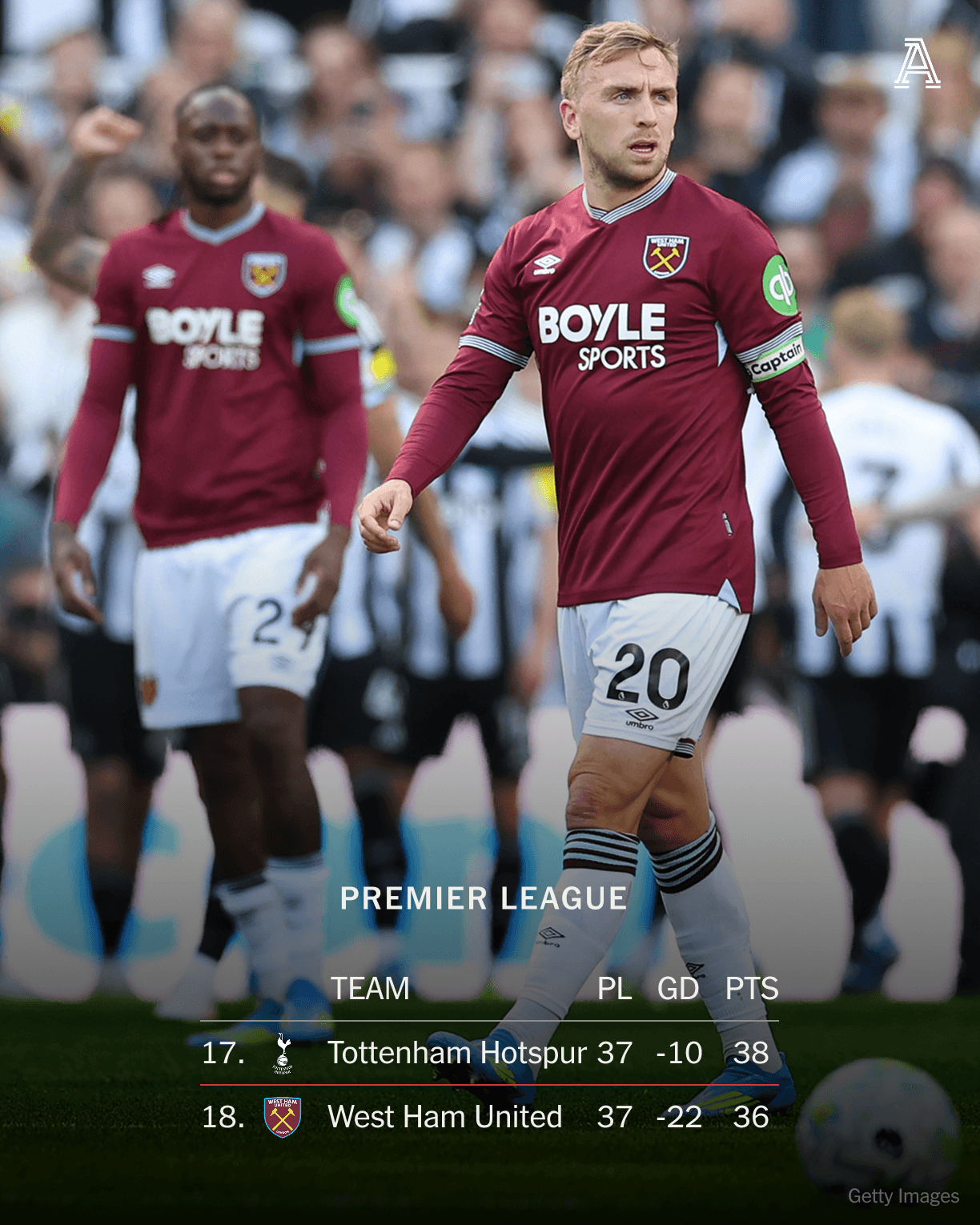
But ‘Survival Sunday’ is back this weekend, with Tottenham Hotspur and West Ham United fighting to stay in the top flight.
Tottenham, who had not won a league match in 2026 until Roberto De Zerbi took charge on March 31, are reinvigorated under the Italian, and only need a point against Everton on Sunday.
Spurs, however, have one of the worst home records in the Premier League, with just two wins at the Tottenham Hotspur Stadium this season. If David Moyes does his old side a favour by winning in north London, West Ham must beat Leeds United to end the day, and the season, on the right side of the relegation zone.

For whichever side drops down, the implications are massive. Relegation from the Premier League is not just a sporting penalty; its financial impact is arguably far more damaging to a club’s long-term health. Having qualified for the Champions League by winning the Europa League last term and thereby receiving a sizeable financial injection, Tottenham’s revenue next season is set to decrease by at least £200million should they suffer demotion. West Ham, who have been ever-present in the English top flight since 2012-13, will also suffer a serious financial impact.
With so much riding on the final day for both sides, contingency planning begins well before. Recruitment is one of the areas that will be seriously impacted by relegation. The Premier League is widely considered the best league in the world, and being part of it grants the opportunity to sign some of the world’s best players. Relegation to the Championship, however, often means a club’s most ambitious targets become unaffordable or more likely to sign elsewhere.
“You absolutely will already have blueprints of what your ideal squad is going to look like depending on either outcome on Sunday,” Paul Duffen, who was chairman of Hull City from 2007 to 2010, tells The Athletic. “A scouting list for the Championship and one for the Premier League. It’s highly irresponsible not to have that; having that as a contingency is important.”
The human impact should also not be understated. Clubs who have played in the Premier League for a long time build the infrastructure to meet operational demands, resulting in hundreds of staff on the payroll. In some cases, clubs may decide to cut costs and redundancies can be a terrible consequence.
“The size of the backroom staff, the ancillary support staff around the club; relegation is unthinkable for a club with the infrastructure built to play Champions League football,” says Duffen. “That brings a completely different set of sports science and training staff, consultants, big scouting teams — they are all very expensive. Logically working out how to justify that staff without Premier League money, given that now you’ve got to abide by financial restrictions and make the books balance, is not easy.
“Even if the shareholders wanted to, they couldn’t just jump in and fund it because you’re going to lose so much money and you’ve got to balance the books. It’s a totally different financial ecosystem and the reality of that is quite terrifying.”

West Ham United will start the final day of the 2025-26 season in the relegation zone (Ian MacNicol/Getty Images)
With so much riding on a single game, tensions at the boardroom level in the build-up to Sunday’s game are elevated.
“The backrooms will be filled with trepidation, anxiety,” adds Duffen. “Trying to pretend it’s business as usual but knowing it isn’t.
“It’ll be fear at every level. Players will have their agents on speed dial based on what happens at the end of the game, if those players have all got to take 40 or 50 per cent pay cuts. It’s a question of how the club sets itself up to survive. How do you build for the future? How do you stop the club from going into a spiral? That’s what will be keeping the backroom staff up the few nights before the game.”
Naturally, fans often wonder whether players are as invested in the implications and consequences as they are, knowing many will seek moves away from their club if they are relegated, but for Michael Turner, who went into the final day at Hull City in 2008-09 with relegation on the line before moving to Sunderland that summer, the possibility of leaving didn’t enter his mind during the build-up.
“I was desperate to stay up and win that game to maintain being a Premier League player,” says Turner, who was eventually relegated from the top flight with Norwich City in 2013-14. “No players, especially top players, are ever going to want a relegation on their CV. I understand fans will see it as: ‘They’re going to leave at the end of the season anyway’ but the focus on the final day was to do everything we could to stay in the league. Relegation is the last thing you want.”
Hull went into the last day of the 2008-09 season with their future in their own hands. If they beat Manchester United at home, they would be safe, and Newcastle United would go down regardless of their result away at Aston Villa. They were dealt a bonus when Alex Ferguson heavily rotated his side, who had been crowned Premier League champions the week before, for the Champions League final a few days later.
“We knew that we were ahead of Newcastle and it was in our hands,” says Turner. “We knew if we beat United, then we were safe. United had the Champions League final on the Wednesday after, so we knew they’d make changes to the team, which would have helped us. I think they changed pretty much the whole XI.
“Going into the game knowing it’s in your own hands gives you a little bit of comfort. Knowing that you just need to concentrate on your own team’s performance — that a result keeps you safe. So, I think that helped a little bit, but we felt slightly under pressure because of the start we had. We definitely felt it would have been embarrassing, getting relegated after that start.”

Phil Brown’s on-pitch half-time team talk is the enduring image of Hull City’s scrape with relegation in 2008-09 (Photo by Nick Potts – PA Images/PA Images via Getty Images)
Hull started their debut Premier League season on fire. They became the quickest promoted team to reach 20 points, doing so in just nine matches. They collapsed from then on, taking just 15 points from the following 28 games, leaving confidence low in the group — even with the boost from the rotated opposition on the final day. And, knowing Newcastle were playing a strong Villa side aiming to finish fifth in the Premier League, Duffen remembers Hull coach Phil Brown debating how he should approach the game.
“That morning before the last round of fixtures and a couple of days before, I remember the conversations with Phil Brown,” says Duffen. “I never had an opinion about how we should approach a game of football — it’s not my job — but he used to use me as a sounding board for his own benefit. It was always the question: do you try to get a point or do you try to win the game? There’s that danger of setting up any game of football to try and draw — it’s a ridiculously dangerous strategy.”
In the end, Hull survived despite losing 1-0 to a youthful United side, because Newcastle lost. De Zerbi will be quietly weighing up how to approach this Sunday’s game against Everton, knowing a point will secure Premier League status for next season. However, Nuno Espirito Santo knows that only a win will do for West Ham, who will still then have to hope Spurs lose.
It’s a situation Paul Robinson, who was part of West Bromwich Albion’s ‘Great Escape’ team in 2004-05, can relate to.
“We had togetherness and that was most important,” says Robinson. “If there’s a disconnect, you’re going into a game worrying that some of the players don’t feel the same way, but we had a lot of emotion in that group, and we had a lot of drive. We were going into the last game confident that we’d get our job done.”
West Brom went into the final day sitting at the bottom of the table and needing a minor miracle. Against Portsmouth, who were safe in 16th, West Brom could only survive if they won and Crystal Palace, Southampton and Norwich City didn’t.
“Every single individual player has got to turn up for that game knowing that they have got to win,” says Robinson. “Because if there’s a little bit of doubt or anxiety, the fans will pick up on that, and you’ll feel the nervousness. It filters down onto the pitch. You start to make silly mistakes: you might kick a simple pass out of play or you might turn it over when they’ve got a dangerous attack. Those little errors start to build when you feel the pressure.”
West Brom went 1-0 up through Geoff Horsfield, who scored with his first touch after coming off the bench as a second-half substitute. They then doubled their lead through Kieran Richardson, though the news of a goal for Crystal Palace against Charlton Athletic heard through radios on the terraces muted the celebrations.
“We scored and it turned into a party atmosphere, so we could work out that, at that point, we were safe,” says Horsfield. “And when AJ (Andy Johnson) scored for Palace (putting them 2-1 up), it all changed. We were waiting around at the end of the game.
“Thankfully, Charlton got the equaliser (the game ended in a 2-2 draw) and we could hear what had happened from the fans. The Portsmouth lads were absolutely brilliant. Linvoy Primus said to me: ‘Look, the game’s finished. We’re not going to do anything stupid’, so we knew that they weren’t really going to try and score. Don’t forget, it sent Southampton down.”

West Brom fans celebrate their Premier League survival in May 2005 (Paul Mcfegan/Sportsphoto/Allstar via Getty Images)
In modern times, where smartphones have replaced radios, fans are at the whim of the often patchy internet connection inside the ground. And when nobody can get a signal, it leaves fans open to the new final day “hoax celebration” phenomenon, when other people inside the ground pretend there has been a decisive goal elsewhere.
Leicester went into the final day of the 2022-23 season needing to beat West Ham United, while hoping Bournemouth could prevent Everton from winning at Goodison Park. Leicester did their bit, eventually winning 2-1, but Everton were also leading 1-0 — until a fake rumour circulated inside the stadium that Bournemouth had levelled the scores.
“There is zero signal at the King Power Stadium — you can’t ever receive anything on your phone,” says Leicester City fan Harry Gregory. “Everyone was checking the apps but you’re pretty much in the dark. The club used to update scores around the ground, but roughly a month before we were relegated, they stopped.
“There was a rumour that went round after we had gone 1-0 up that Bournemouth had equalised, and the crowd started jumping up and down. My phone didn’t work, there was nobody around me with a radio, and the only people you could rely on were the people sitting in the corporate boxes with live TV. You could see some of them waving their hands to say: ‘No, there’s not been a goal’.”
Whether it’s down to ghost goals or actual ones, this year’s Survival Sunday, featuring two close rivals desperate to secure safety, promises to be a thrilling one for everyone in the stadium and those watching around the world.