The conflict in Iran took a backseat to President Trump’s recent summit in China and we had relatively low expectations for that summit.
Neither the China summit nor negotiations with Iran have seen meaningful, concrete results. Expect that to start to weigh on markets again.
The Oil Curve
While Brent crude is most impacted by the ongoing problems in the Middle East, we will stick with WTI because that is what affects Americans the most.
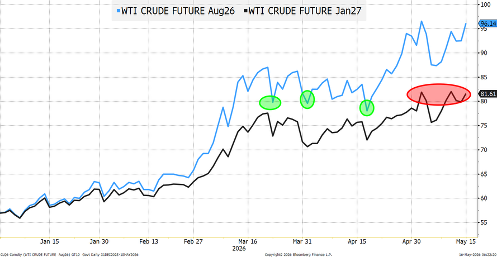
One of the talking points for the Trump administration had been that the oil market was predicting a “quick” resolution. Some officials pointed to the August contracts as demonstrating that $100 oil was a blip and things would “normalize” quickly.
While $80 was still higher than pre-war levels, the argument had some legs. But now, the August contract is up to $95, and we are seeing $80 priced in all the way into 2027. This is certainly “higher for longer.”
What is increasingly concerning is that it is difficult to tell if this is pricing in a re-opening or not. It was entirely plausible, a month or more ago, to believe that, with the Strait getting back to normal levels of transit, global energy prices would “normalize” quickly. It is increasingly unclear what the “new” normal is. How much damage has been done to the “organism” that is energy? How quickly can things be fixed? Is the “new” normal the same as the “old” normal?
Increasingly, there are more and more questions about how long the damage will last, and if that damage will continue to elevate not just the price of oil, but also gasoline, diesel, jet fuel, etc.
“Higher for longer” in the oil market is the single biggest issue for global affordability.
AI vs Affordability
We received some consumer spending data this week, which wasn’t too bad. It did seem to highlight, yet again, the problems facing people in the lower income brackets. I’m not convinced it doesn’t obfuscate that we are spending more to get less, but that is for another day. But here is a “simplified” version of a chart I’ve seen in various formats:
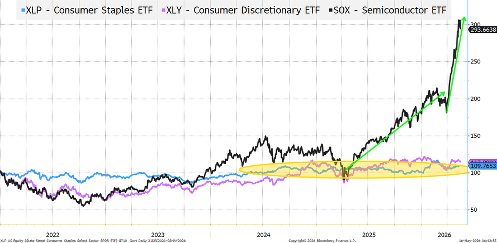
Companies servicing the consumer are not seeing much appreciation in their stock price.
And companies making chips are growing like gangbusters!
Is this sustainable? That question is being asked with increased urgency. The “parabolic” rise is raising some concerns. Without a doubt, this is the sector experiencing growth. It does seem to justify not only today’s prices, but also possibly even higher multiples. The earnings engine (and growth) is there, but this market has had a habit of hitting “high-conviction” trades.
Which Brings Us to Rates
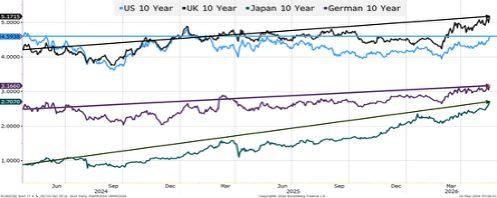
Yes, I “cherry picked” April 2024 as a starting point, because the 10-year U.S. Treasury yield is unchanged, while rates across the globe have risen, most noticeably for Japan.
In two years, the 10-year Japan government bond went from yielding less than 1% to almost 3%. This is incredibly important. Japan, as a “nation of savers,” has been funding much of the world’s debt. I remain convinced that “at or near-zero” bond buyers of all levels of sophistication will take steps to get positive yield. So, when Japan hovered near 0% on rate, many investors would find alternatives to their domestic market to get yield. That has changed.
Globally, U.S. Treasuries Fairly ‘Generic’
If you do not need dollar exposure, you have local FX bonds that can serve your needs.
All countries face a variety of risks to their economy. All central banks are trying to navigate the data, their expectations and their mandate. It is less certain today how the U.S. central bank will respond to data, than it was a few months ago — so that uncertainty should have a cost?
It is likely one reason why our agency debt team is seeing agency and super sovereign debt spreads to Treasuries at very low levels.
Defense Spending Requires Money
While “production for national security” is about far more than defense spending, it certainly incorporates the need to spend more. Japan: spending more. Europe/NATO: spending more and it seems inevitable that they will have to ramp that up.
AI and Data Center Build Out Competes for Money
The semiconductor valuations depend heavily on data center and AI spending. That is being funded in a large part by debt.
We have been arguing for “range-bound” Treasury trading, while slowly raising the midpoint of the range.
I’m a bit hesitant to be very bearish on bonds here, as 5% or so on 30s (we are well above 5.12% as of Friday’s close) has been a level where this administration has taken steps to drive yields lower.
I could see an “Operation Twist” sort of announcement (the Federal Reserve selling shorter-dated bonds that it owns to buy longer-dated bonds), but I’m not sure it is prepared to act.
What I find “interesting” is that Scott Bessent no longer seems to be able to do “no wrong, as many market participants seem to be waiting for some sort of “intervention” to helps bonds, I’m left wondering if they can accomplish that easily now?
Global bond yields are not helping. Higher for longer on oil is not helping (that seems easier to correct — via peace with Iran, but that doesn’t seem imminent).
I’m not “pound the table” bearish on bonds or stocks, but I’m certainly not bullish. I’m not even really bullish for a trade. With the president likely looking for some “wins” and the administration likely exploring what it can do on the yield front, we could see relief in bond yields and higher stock prices, but I want hedges and would fade any such bounce. Price action in stocks seemed almost “sickly” on Thursday and Friday where every bounce/rally met some serious selling.
Caution into the summer seems warranted. Markets have priced in a lot of good news (including around China, Iran and semiconductor firms), often multiple times (at some point, is an earnings surprise really a surprise when every one surprises the same way?).
Maybe it is time to “unprice” some of the good news?
Affordability remains an issue and it seems to be becoming increasingly entrenched, which is a problem for bonds and stocks as a whole, if not just for the AI/data center spend, where my bigger questions are around positioning, more than anything else.
Memorial Day is my favorite long weekend of the year, so we have that to look forward to!