IT IS SOMETIMES said, not least by President Donald Trump, that America and China are now the G2, a duo of superpowers leading the world. That is a grim thought. One has a leader who treats allies like patsies and is ripping apart the institutions that underpinned global stability for decades. The other has an authoritarian regime that bullies its neighbours and is quietly stoking foreign conflicts it could help defuse.
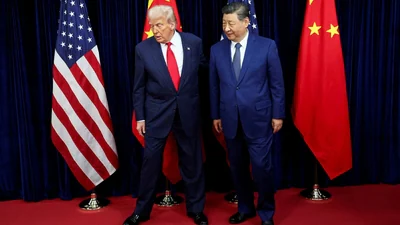
File photo of President Donald Trump and Chinese President Xi Jinping. (REUTERS)
Worse, the two countries treat their mutual entanglements on technology and trade as security risks. So the stakes will be huge when Mr Trump visits Xi Jinping, China’s paramount leader, in Beijing on May 14th and 15th, the first of four expected meetings before the end of 2026. The coming six months could shape ties for years, with consequences from artificial intelligence (AI) to supply chains and Taiwan to Iran.
Read the rest of our cover package
Tensions between the two governments run so deep that it would be naive to expect a breakthrough. Had they more skill and humility, Mr Trump and Mr Xi could head off the most harmful conflicts and find areas where they could work together for everyone’s benefit. It is unsettling that so much will come down to Mr Trump, who has veered between calling Mr Xi a dear friend and a foe. Mr Xi’s views are more settled, which is its own problem: he is convinced America is declining and that the world should bend to a rising China.
The talks in Beijing will focus on trade. For nearly a decade the countries have been locked in an on-again, off-again trade war. At the start of 2025 a full-blown rupture seemed inevitable as they jacked up tariffs on each other to more than 100%. Since then, they have lowered tariffs in what some call a truce, but is really a stalemate of mutual vulnerability. China can throttle global industry by choking off rare earths; America can wield devastating sanctions on high-tech goods and financial flows.
This stalemate is unstable. As America vies to break China’s grip on rare earths, China is backing semiconductor production and trying to free itself from the dollar. For now, a good result from the summit would be for the two to promise to be predictable. Mr Trump’s misplaced faith in tariffs makes cuts unrealistic, but holding them at current levels would at least let firms get on with business. The Americans want a Board of Trade to manage commerce between the two countries. That would be unwieldy and would do little to re-industrialise America. A mechanism for regular dialogue would be better.
An obvious risk is miscalculation. American trade officials are investigating industrial overcapacity and forced labour in China, which may be an excuse to impose higher tariffs within months. On May 2nd China deployed a “blocking measure” that threatens financial punishment against firms that comply with certain American sanctions. China has also threatened to go after companies that shift supply chains to other countries, precisely what America is urging. Beijing is thus setting up a test of compliance grounded not in law but power. Global executives must choose which government they fear more.
American negotiators have kept the summit’s lead-up focused on trade, not security. But the Chinese spot an opportunity in the American president’s unpredictability. They may be right. Just as Chinese advisers are afraid to contradict Mr Xi, so officials in the White House defer to Mr Trump on all things China, including Taiwan.
And it is there Mr Trump may think he can lower the temperature by going soft. Chinese officials hint that the more he bends on Taiwan, the more China will give on trade. They hope he might cut arms sales to the island or say he is against Taiwanese independence. He should not take the bait. It would be wrong to sell out a democratic partner and reckless to endanger the world’s essential chipmaker. Besides, the current arrangement works, even if Mr Xi would never admit it: Taiwan is prosperous, China ascendant, Asia mostly peaceful.
Moreover, the world faces other pressing security concerns. For America to attack Iran was a strategic blunder, and China has been content to let it reap what it has sown. China has now begun to dabble in diplomacy, meeting Iran’s foreign minister this week. It should press the Iranian regime to negotiate; or tempt it to give up its nuclear programme with the offer of security guarantees, but its allergy to foreign messes holds it back. And whatever moral high ground China thinks it holds on Iran is undercut by its role enabling Vladimir Putin to fight in Ukraine, by buying Russia’s gas and selling dual-use technology. Mr Trump should press Mr Xi to use his weight in Moscow to help end the Ukraine war. Instead, it will barely figure in their discussions.
True statesmen would also find much else to deal with. American and Chinese companies are at the frontier of AI. Their governments should therefore be leading on its risks, such as biosecurity. Climate, once a rare area of co-operation, will be a blind spot because the Trump administration shuns all policy on global warming. And joint work on pandemic prevention, once routine, has become fraught because China dislikes questions about whether the covid-19 virus leaked from a Wuhan laboratory.
Pining for the cold war
The superpowers need not be friends to talk about all this. At the height of the cold war, America and the Soviet Union hammered out deals over nuclear arms, science in space, borders in Europe and cancer research. America’s commercial ties to China are far tighter than its ties to the Soviets ever were. Alas, the two leaders both think that co-operation is a trap in which rules could be foisted on them by the other side. That logic makes dominance the priority, not global public goods.
So the summit will probably yield little besides forced smiles. Such a lack of ambition is troubling. Advisers on both sides argue that at least they are talking, yet to sustain co-operation beyond the Trump administration, they need results. Instead, the only thing keeping America and China at the table is fear of the economic damage each can inflict on the other. The G2 is not leading the world so much as holding it to ransom.
For subscribers only: to see how we design each week’s cover, sign up to our weekly Cover Story newsletter.