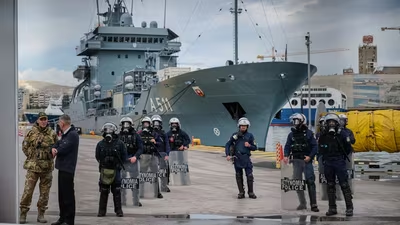
Some 1,200 kilometres north of Egypt’s Suez Canal lies the Port of Piraeus on the coast of Greece. The country possesses more shipping capacity than any other, and the port, majority-owned by COSCO, a Chinese state-owned firm, is one of Europe’s busiest, with more than 4m containers moving through it every year.

Just 30km west, the American government is backing a bid to develop a commercial port at Elefsina. About 500km to the north, Russian and Chinese investors have taken a stake in the Port of Thessaloniki. And farther north-east American and NATO forces have built a logistics hub at the Port of Alexandroupolis.
The scramble for ports in Greece is part of a global contest to control the plumbing of maritime trade, from Argentina to Thailand. In some places, like the Panama Canal, the competition has taken a nasty turn, part of a geostrategic battle between America and China. In others, multiple countries and firms are vying for port and logistics deals as geopolitical insurance, as a business proposition—or both. In sum, spending on port infrastructure will rise by more than a third to $90bn annually by 2035, says PwC, a consultancy.
About 80% of the world’s trade by volume travels by sea. Governments naturally worry about keeping goods moving. A series of crises in recent years, from the covid-19 pandemic to the current closure of the Strait of Hormuz, has shown how easily the global trading system can be thrown into chaos. The desire to reduce dependence on particular chokepoints for both commercial and geopolitical reasons is only natural. And in the long run more competition between ports probably means lower shipping costs.
Yet the rush to build port infrastructure is likely to result in huge inefficiencies (see chart). Many investors, including both American and Chinese taxpayers, will see disappointing returns. And political pressure for shipping firms to use particular ports and sea routes, in defiance of all commercial logic, is bound to grow.
As with so many modern geopolitical contests, this one has been driven by anxiety about China’s ambitions and its tightening hold on global supply chains. Chinese firms now operate or have a financial stake in at least 129 ports outside China (see map), and have spent at least $80bn on port construction from Antigua to Tanzania, with many of the investments tied to bilateral trade and regional shipping agreements.
Terminal ferocity
More than a third of China’s overseas ports are near maritime chokepoints, including the Strait of Malacca, the Strait of Hormuz and the Suez Canal, making them indispensable operators in strategic areas.
China’s firm grip on global ports has rattled Western governments. MERICS, a think-tank in Berlin, found that after a terminal operating contract is signed, total trade with China rises by more than a fifth, while countries that allow Chinese firms to run all their terminals at one of their ports see a 19% drop in exports to the rest of the world. Operating ports allowed Chinese firms to prioritise their cargo and vessels and speed up customs and logistics.
Were the global trading system flowing smoothly, China’s dominance of sea lanes would be less worrying. But a rerouting of shipping networks, most recently due to the closure of the Strait of Hormuz, has left ports more prone to congestion, punitive fees on cargo sitting idle and sharp rises in freight rates. Container ships in the Indian subcontinent are facing particularly bad congestion, while waiting times at the Panama Canal have been lengthened by increased volumes of energy exports to Asia, according to Clarksons, a research firm. No one has come up with a good strategy to deal with the chaos at ports, says an American maritime official.
Non-Chinese shipping companies have been rapidly beefing up their own networks. Since 2021 such firms have announced about $140bn of acquisitions in various parts of the maritime supply chain. Hapag-Lloyd, a German shipping giant, signed a deal in January to acquire 50% of a container-terminal operator in Brazil; more recently it raised its stake in JM Baxi Ports, an Indian firm, and announced plans to acquire ZIM, an Israeli shipping line.
In January Stonepeak, an American investment firm, formed a $10bn joint-venture, United Ports, with CMA-CGM. And in February APM Terminals, a subsidiary of AP Moller-Maersk, a shipping giant, and Eurogate, a container-handling firm, announced a plan to invest €1bn ($1.2bn) to expand a terminal in the North Sea.
Governments are also paving the way for their country’s firms to secure maritime routes and berths. India is in the midst of a vast port-building effort that is expected to continue until 2047; in October Saudi Arabia signed a $450m deal for the Jeddah Islamic Port. Singapore is building a $20bn automated port and shipping hub. DP World, Dubai’s port company, has signed deals to invest and expand its positions at ports in Dar es Salaam and Callao in Peru.
Many investments are taking place alongside Chinese ones without directly threatening China’s interests. But America has taken a more antagonistic approach.
Take its battle for control of the Panama Canal. After his election in 2024 Donald Trump said the operation of two ports at the canal by CK Hutchison, a Hong Kong conglomerate, posed a threat to American interests. During his inaugural address last year Mr Trump threatened to take “back” control of the canal, which America built in the early 20th century and which handles around 40% of America’s cargo, equivalent to about 5% of global sea trade annually, or $270bn.
BlackRock, an American asset manager, and Mediterranean Shipping Company (MSC), the biggest ocean-going carrier, then stepped in to buy Hutchison’s non-Chinese ports, including its two Panama Canal terminals, in a $23bn deal that angered the bigwigs in Beijing. In February Panamanian authorities handed temporary operation of the terminals to Maersk and MSC after the country’s top court ruled that CK Hutchison’s contracts were unconstitutional. China detained dozens of Panama-flagged ships in retaliation, and told Maersk and MSC to cease operations at the Panama port. Hutchison has sued Panama for billions; the long-term management of the port remains in question.
Seas the means of production
Elsewhere America’s Federal Maritime Commission (FMC) is stepping up its efforts to protect the country’s shipping. “If US cargo has an interest in that area and is at risk, we can take action,” says Laura DiBella, the chairwoman of the FMC. “We have some serious teeth,” she adds, including sanctions, tariffs and fines. Ms DiBella says America should be “paying attention to our backyard more” and that the FMC is watching for “anti-competitive” behaviour at ports. Officials are keeping a close eye on ports in Latin America, including Puerto de Chancay in Peru.
Even at ports that are not owned or operated by China, Chinese firms are deeply embedded in port supply chains. Shanghai Zhenhua Heavy Industries, a Chinese state-backed firm, makes more than 70% of ship-to-shore cranes, large and mostly automated machines which unload and stack containers. Chinese companies also make 95% of shipping containers used for the moving of goods.
China’s reach extends beyond physical infrastructure. LOGINK, a Chinese government-run logistics-management software, is used in at least 24 countries and 86 ports (America banned its use in 2023). LOGINK shares data with CargoSmart, another shipping-management software firm owned by COSCO, and in turn gives it access to the whereabouts of 90% of the world’s container ships. It also has a tie-up with CaiNiao, a logistics provider with hundreds of warehouses around the world.
And Chinese firms will keep expanding overseas in response to the surge from competitors. “The intensifying international geopolitical competition has profoundly affected our industry,” Zhu Tao, chairman of COSCO, said in March. “Expanding our port footprint remains a critical response.” The firm plans to invest more in Piraeus and Abu Dhabi. China Merchants Port, another large Chinese firm, is in the process of acquiring Vast Infrastructure, a Brazilian port operator. Chinese firms are also building industrial parks and manufacturing facilities close to their existing ports in Africa and Europe.
All this jockeying has led to a nascent bifurcation of networks of Chinese and Western-owned ports. That will generate some long-term benefits for all shippers: ports can no longer behave as monopolies and charge what they want; they will have to give shippers better service, at better rates. Operators will need to reinvest in costly services like port dredging so big vessels can enter, and maintain better upkeep so they aren’t replaced. “There is always an unhappy customer at a big port,” says one executive. Having another port nearby will give them options.
But at least some of the builders (and the taxpayers who finance them) will be losers. India’s ambitious plans are at risk because the country is bracketed by major ports in Singapore and Salalah (in Oman). And its own ports risk cannibalising each other, a terminal executive points out.
“Every port, every country wants to be a logistics hub, and they all can’t be that,” says an executive at a European maritime firm. Since an expansion of Tanger Med, a Moroccan port in the Strait of Gibraltar, in 2019, volumes at the nearby Port of Algeciras in Spain have struggled to grow.
A duplicative network of ports will also come with higher fixed costs. That risks saddling shippers with more debt-laden operations, potentially inefficient sea routes and some risk of ending up on the wrong side of one or another country’s geopolitical interests. In times of disruption, like now, consumers may be hit with higher prices and delays despite the overall increase in shipping capacity.
Still, port duplication is not all bad. The ports under development in Greece serve different, if slightly overlapping, markets. And ports have some room for inefficiency. Historically ports have commanded hefty operating margins of, on average, more than 40%, and those margins have ticked up over the past decade. As countries and firms begin to compete more for volume, their returns will be lower. That is probably not the prize they were seeking when they launched the port wars.