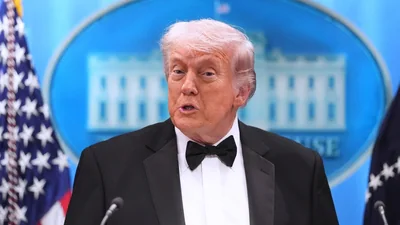
US President Donald Trump has told his aides to prepare for an extended blockade of Strait of Hormuz, amid an already sensitive ceasefire situation between the two countries, the Wall Street Journal reported, citing US officials.

In a discussion in the situation room on Monday, Trump reportedly opted to continue “squeezing” Iran’s economy and oil export by preventing shipping to and from its ports. His other options included – stopping the war or resume bombing – both carrying more risk than the blockade, officials said.
Continuing the blockade has driven up oil prices across global markets crossing the $100 mark. Brent crude traded near $111 a barrel after rising 2.8 per cent on Tuesday, and West Texas Intermediate was above $99, as reported by Bloomberg.
Since the beginning of the two-week ceasefire between US and Iran that began on April 7, Trump has repeatedly walked away from escalating the war using bombs and ammunition. When talks between the two countries failed, he extended the ceasefire hours before it was set to expire despite earlier claiming that he will not do so. He also had vowed to decimate the entire population of Tehran if no deal is reached.
Also Read: If US, Iran fail to reach a ‘peace’ deal, what comes next? Here’s what Marco Rubio said
However, Trump has not shied away from using his navy to continue imposing a blockade in Strait of Hormuz, and will continue to do so until the Iranian regime caves into his key demands: ending nuclear enrichment and vowing to never having any nuclear weapon in its possession ever.
Iran’s 3-point plan ‘not in good faith’: Trump
Iran sent a new 3-point proposal to Washington via Pakistan, a key mediator in talks between US and Tehran. The proposal primarily focuses on reopening the crucial waterway, lifting the US naval blockade on Iranian ports, and delaying negotiations over Tehran’s nuclear programme to a later stage.
Trump told his aides that the proposal from Iran is not dealing in “good faith’ or being willing to meet his key demands.
The US president is comfortable continuing his blockade, which also seems to be a safer option as compared to returning to bombing or walking away from the war. He also believes that this blockade is sending Iran into a “state of collapse” as he mentioned in his Truth Social post on Tuesday.
Also Read: The US-Iran war could be entering its deadliest phase
“Iran has just informed us that they are in a ‘State of Collapse’. They want us to ‘Open the Hormuz Strait,’ as soon as possible, as they try to figure out their leadership situation (Which I believe they will be able to do!). Thank you for your attention to this matter!”.
The US Central Command reported on Wednesday that, before the blockade, an average of at least five ships were typically anchored or docked at Iran’s Chabahar port. However, with US forces now restricting maritime trade to and from Iran, the number has risen to over 20 vessels currently stationed there during the ongoing blockade.
“Prior to the U.S. blockade on Iran, 5 ships were moored or anchored in the Iranian port of Chah Bahar on an average day. Today, more than 20 vessels remain in Chah Bahar as U.S. forces cut off economic trade going into and coming out of Iran during the ongoing blockade,” it said in a post on X.
The Strait of Hormuz has become almost unusable since the conflict erupted in late February, disrupting the movement of crude oil, natural gas, and refined products and pushing energy prices higher. The war has intensified concerns about a potential inflation crisis, with the International Energy Agency calling it the biggest supply shock in history, reports Bloomberg.
Also Read: ‘Can’t bring IRGC terrorists’: US draws red line on Iran World Cup entry, flags ‘pretend trainers’
Where does the situation stand now?
The second round of negotiations, which was scheduled to take place in Islamabad, was called off after Iran declined to send its delegation. Following this, US Vice President JD Vance also cancelled his visit.
Shortly thereafter, Iran’s Foreign Minister Abbas Araqchi arrived in Pakistan but left before the US delegation, involving Steve Witkoff and Jared Kushner could reach there. Trump called off the visit, saying too much time will be wasted in travelling.
“If they want to talk, all they have to do is call!!!,” he said, adding, “Too much time wasted on travelling, too much work!”
According to officials cited by the Wall Street Journal, Trump is not currently prepared to ease his demand that Iran commit to halting its nuclear enrichment for at least 20 years and accept continued restrictions thereafter.
“I am not surprised that he hasn’t taken the deal because it doesn’t address the nuclear issue at all,” said Eric Brewer, a former senior analyst for Iran in the U.S. intelligence community. “Why would you accept the Iranian deal while you are still waiting to see if you can cause some serious economic problems to Iran through this bet on the blockade?”
US secretary of state Marco Rubio also said that additional pressure could be imposed on Iran if no deal is reached, stressing that the final decision rests with US President Donald Trump.
“That’s POTUS’ decision to make… the level of sanctions on Iran is extraordinary, the level of pressure on Iran is extraordinary, and I think more can be brought to bear,” said Rubio in an interview with Fox News.
Rubio accused Iran of using the Hormuz as an “economic nuclear weapon” to stop the energy flow to the world. “The Strait is basically the equivalent of an economic nuclear weapon they are trying to use against the world, and they are bragging about it… imagine if those same people had access to a nuclear weapon—they would hold the whole region hostage.”
On the US blockade, he said, “The blockade is not against shipping broadly; it’s against Iranian shipping, because they cannot be the sole beneficiaries of an illegal, unlawful, and unjustified system of control in the strait.”
Rubio also identified another complication in a Fox News interview, reported WSJ, which is: the internal battle for control in Iran that complicates any diplomatic effort.
“The hard-liners, with an apocalyptic vision of the future, have the ultimate power in that country,” Rubio said. “One of the impediments here is that our negotiators aren’t just negotiating with Iranians. Those Iranians then have to negotiate with other Iranians in order to figure out what they can agree to, what they can offer, what they’re willing to do, even who they’re willing to meet with.”