By Will Jackson and Hellena Souisa, ABC

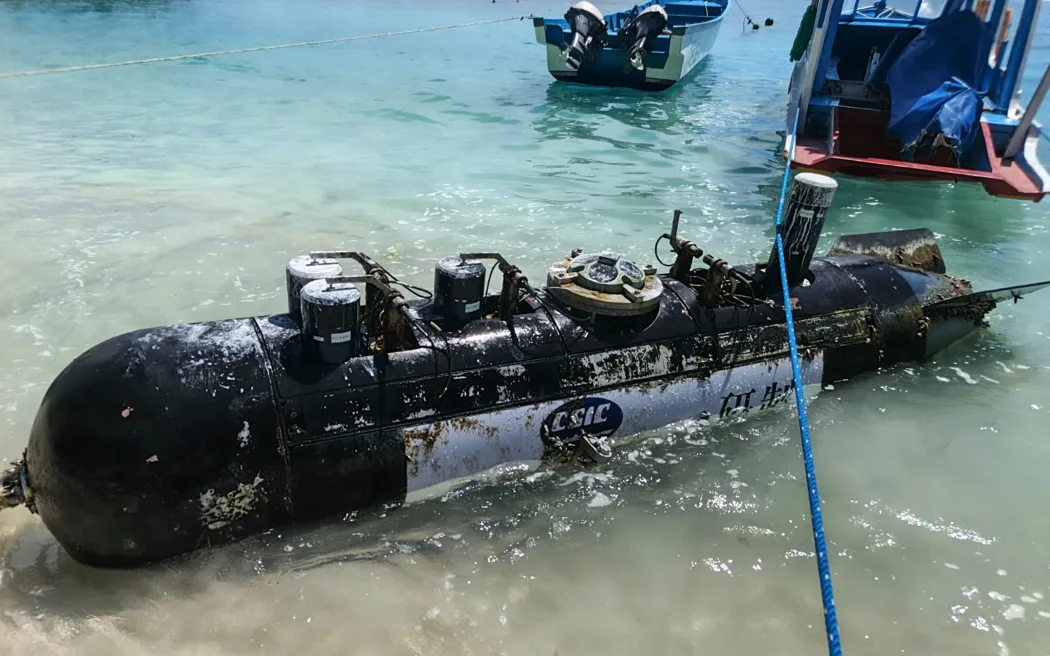
A picture taken on April 6, 2026, shows a torpedo-like 3.7-metre-long and 65-centimetre-wide object, discovered by a fisherman near the Lombok Strait after being towed ashore onto a beach on Gili Trawangan, West Nusa Tenggara.
Photo: AFP
A large torpedo-shaped device discovered near an island in a strategically important strait between Bali and Lombok has been identified by defence analysts as a Chinese undersea monitoring system.
However, Beijing has dismissed concerns, saying, “there is no need for excessive interpretation or suspicion”.
A fisherman found the 3.7-metre-long object north of Gili Trawangan island in the Lombok Strait last week, according to Indonesian state news agency Antara.
The Indonesian Navy took the device to the Mataram naval base on Lombok for further investigation.
“The navy will carry out an in-depth examination to identify the device, including its origin, purpose and stored data,” said navy spokesperson Rear Admiral Tunggul.
Location of Chinese underwater sensor

The Lombok Strait (indicated by the dotted line) is a key strategic waterway.
Photo: ABC
‘Chinese sensor buoy’
The device was identified by maritime defence analyst HI Sutton as a Deep-Sea Real-Time Transmission Mooring System developed by the Chinese 710 Research Institute.
“The institute focuses on underwater attack and defence,” Mr Sutton wrote.
The system is designed to be moored to an anchor on the sea floor while sending data home via communication buoys deployed to the surface.
Sensors monitor things like temperature, depth, current and “sound and target information”, according to Mr Sutton’s analysis.
Such systems are not unique to China with similar capabilities used by other countries, including the United States, Japan and India.

The object was discovered by a fisherman near the Lombok Strait.
Photo: AFP
“It is likely concerning to Indonesian authorities that a Chinese sensor buoy has been found in the area,” Mr Sutton wrote, while contending that they could have a military use.
“It suggests that China may have a network of these sensors providing real-time information on underwater conditions in the strategic waterways which would aid their submarine operations.”
The 710 Research Institute was part of the Chinese state-owned China Shipbuilding Industry Corporation (CSIC), now merged into the China State Shipbuilding Corporation (CSSC).
The device featured the letters CSIC and the corporation’s logo.
The ABC’s emails to the to CSSC bounced back and calls went unanswered.
A Chinese Ministry of Foreign Affairs spokesperson said it did not have specific details on the matter.
However, the spokesperson said China had always conducted marine scientific research activities and used related equipment in accordance with international law.
“Based on international practice, it is not unusual for marine research equipment to drift into the territorial waters of other countries due to malfunctions or other reasons,” they told the ABC.
“There is no need for excessive interpretation or suspicion.”
Potentially ‘dual-use’
Collin Koh, an expert in maritime security and naval affairs, said the system’s array of sensors combined with its ability to communicate back home made it “undersea warfare capable”.
He said its acoustic sensor could be used to detect submarines but the signal would need to be transmitted back to a shore station for processing.
However, he noted the type of data the system would collect had both military and civilian uses.
“This is often the problem that we face when it comes to these sort of dual-use technologies that concern marine scientific research and data collection,” said Dr Koh, a senior fellow at the S Rajaratnam School of International Studies in Singapore.
He said China had long been undertaking sea-floor mapping research in the region, often in collaboration with South-East Asian states.
“So therefore it’s actually not so strange if you encounter research and survey vessels from China passing through South-East Asian waters,” he told the ABC.
Several Chinese underwater drones have been picked up by Indonesian fishermen in recent years.
However, Dr Koh said this was the first time he was aware of that a moored sensor buoy had been deployed in the region.
He said it was consistent with China’s growing interest in Indonesia’s territorial waters and archipelagic sea lanes, especially since Australia’s AUKUS deal with the US and UK to acquire nuclear-powered submarines.
Australian Strategic Policy Institute (ASPI) senior analyst Malcolm Davis said Beijing recognised that understanding the maritime geography in the Indonesian archipelago was important for undersea warfare in a potential conflict.
“So my guess what has happened is a Chinese ship or a submarine has deployed this thing into a specific location so that it can monitor submarine activity going through that particular strait,” he said.
“Their goal is to be able to track submarines so that in wartime, they’re better placed to be able to attack and sink [them].”
Strait’s ‘crucial strategic importance’
The Lombok Strait is a key economic and military corridor between the Indian and Pacific oceans.
With a minimum depth of 250 metres and 18 kilometres at its narrowest, it is an important route for ships that have too deep a draft to go through the Malacca Strait and it could serve as an alternative if the Malacca Strait were to be blocked.
Dr Koh said the Lombok Strait was also a critical route for Australian military forces – or allied forces stationed in Australia – to transit through South-East Asian waters to reach the South China Sea and possible flashpoints such as Taiwan.
“So this is, I believe, of crucial strategic importance to Australia,” he said.
Legality under maritime law unclear
Whether the device was operating legally under maritime law is a complex question, as outlined by University of New South Wales PhD researcher Dita Liliansa in an article for the Lowy Institute.
Under international law, ships may enjoy certain rights of passage, Ms Liliansa writes.
“This raises the threshold question: does the object found off Lombok qualify as a ‘ship’ under international law, and is it therefore entitled to any navigation rights through Indonesian waters at all?” she asks.
The question was also muddied by uncertainty around what it was doing, where it was deployed and whether it was being operated by a civilian organisation or government.
Dr Koh pointed out that the issue was complicated even further by the Lombok Strait being part of Indonesia’s designated archipelagic sea lanes where the scope of activities allowed remains contested.
“The question is, could Indonesia tolerate such activities that could potentially be seen as undermining [their] national security?” he said.

HMAS Stirling near Fremantle is Australia’s primary submarine base.
Photo: ABC News: Dave Weber
Should Australians be worried?
ASPI’s Dr Davis said the discovery of the device was concerning and suggested a “level of aggressive behaviour” by China in anticipation of military activity in the future.
“We need to keep a watch on this sort of stuff and we need to realise that it may not be just in the South-East Asian archipelago,” he said.
He said monitoring devices could also be located, for example, off the coast of Western Australia where Australia’s primary submarine base at HMAS Stirling was located.
Dr Davis said Australia needed to know where the devices were.
“I think that demands a greater undersea warfare capability, greater situational awareness,” he said.
“I think that we probably do need to be thinking about, how do we find these sorts of objects on the ocean floor? How do we deal with them once we’ve found them?”
Australia’s Department of Defence was contacted for comment.
The department’s 2026 Integrated Investment Program is understood to include $5 billion to $7 billion in undersea warfare and uncrewed maritime systems and $62 billion to $77 billion in surface maritime capabilities over the next decade.
Indonesians ‘do not want to draw premature conclusions’
Brigadier General Rico Sirait, head of the Information Bureau at Indonesia’s Ministry of Defence, said this week that examination of the device was continuing.
“At this stage, we do not want to draw premature conclusions or engage in speculation before official findings are available,” he said.
Brigadier General Sirait added that the government would respond to the discovery with enhanced monitoring of national waters.
He said that any further communication with relevant parties, if required, would be carried out through appropriate channels, while prioritising Indonesia’s national interests and regional stability.
Dr Koh said the Indonesian government would likely want to quietly let the issue drop.
He said that when another unmanned underwater vehicle was discovered near Selayar Island in South Sulawesi in December 2020, the government tried to quell public disquiet by offering assurances they would conduct a thorough probe.
However, despite “quite clear evidence that the device was Chinese” eventually “it all just went quiet”, he said.
“Indonesia is not in a position, from a political and economic perspective, to actually beat the gong loudly about this problem,” he said.
“It is something that I think they would prefer to resolve in as low-profile manner as possible, without undue public scrutiny.”
-ABC
