Explorers have dreamed of harvesting deep-sea metals since the 1870s, when the British scientific ship HMS Challenger pulled up mineral-laden rocks on its round-the-world voyage.

The first commercial effort to exploit these riches failed a century later. In 1970, a U.S. company hoisted 60,000 rocks from the seafloor off the coast of Charleston, S.C., and then dumped most overboard because they didn’t have enough mineral content.
Today, deep-sea mining—off-limits in international waters since 1982—has the backing of the Trump administration. Ocean scientists are racing to determine whether marine life can coexist with machines that rake their habitat for undersea treasure.
The aim is to vacuum up rocks containing cobalt, nickel, copper and manganese—elements used in electric-vehicle batteries, smartphones, medical devices and artificial-intelligence hardware.
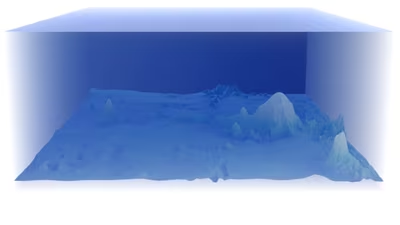
The potato-size polymetallic nodules are found on vast flat areas of the seafloor called abyssal plains. The most valuable region is a 1.7 million square mile part of the Pacific Ocean between Hawaii and Mexico known as the Clarion–Clipperton Zone.
Other mineral deposits known as polymetallic sulfides collect around hydrothermal vents, fissures that discharge water from geothermal hot spots, while cobalt-rich crusts are found on underwater seamounts in shallower water.
Last month, President Trump directed the National Oceanic and Atmospheric Administration to grant permits to mining companies in both U.S. and international waters over the objections of the International Seabed Authority. The agency has legal authority over seabed resources under the U.N. Convention of the Law of the Sea, a 1982 treaty that has been signed by more than 160 countries. The U.S. isn’t a signatory.
In April, five days after Trump’s executive order was issued, The Metals Co. of Vancouver, British Columbia, applied for permits to conduct deep-sea exploration and mining in the Clarion-Clipperton Zone.
The sought-after nodules formed slowly over millions of years as minerals dissolved in seawater and aggregated in thin layers around fragments of shells, bits of sand and even fish teeth.
“The nodules sit on the seafloor like cobbles in a street,” said Diva Amon, a marine biologist at the Benioff Ocean Science Laboratory at the University of California, Santa Barbara.
Assessing the value of these minerals is difficult because the cost of bringing them to the surface is unknown and market prices fluctuate. A 2024 analysis by the consulting firm Arthur D. Little put the potential commercial value of the undersea minerals at $20 trillion.
The forbidding areas of the ocean where minerals are found are home to a surprising variety of marine life—mostly small, slow-moving creatures that have evolved to get most of their food from dead animals and plankton falling from above.
“When you get to the bottom, it really does appear like there’s not that much life, but that’s because a lot of the life down there is much smaller than elsewhere in the ocean,” said Amon, who has captured video of these areas with robotic submersibles. “But small doesn’t mean insignificant.”
A 2023 survey of marine life in the proposed mining area by the Natural History Museum of London found that 90% of marine creatures living near the nodules are new species, challenging the idea that the vast mining area is an ecological wasteland.
Conservationists say that sea mining will destroy this bottom-dwelling sea life, while mud and debris from the mining process will disturb shallower parts of the ocean.
Thomas Peacock, professor of mechanical engineering at the Massachusetts Institute of Technology, spent several weeks at sea in 2021 during a test, allowed by the International Seabed Authority, of methods of mining the seafloor. He measured the plumes of sediment stirred up by mining machines and found that the sediment didn’t travel as far as originally believed, and might do less damage to some kinds of marine life.
More recently, a team from the U.K.’s National Oceanography Center discovered that marine life is returning to areas of the Clarion-Clipperton Zone that underwent similar tests in 1979, suggesting that the environmental impact might be limited to the mining site.
If deep-sea mining companies get the green light, Peacock said, scientists should work alongside them to monitor their activity. Peacock’s team developed models to estimate where the sediment would be deposited, a step in figuring out potential damage.
“What is really needed is running these operations at an increasingly larger scale, monitoring those operations, testing and showing that the models do indeed have the ability to predict as you scale up these operations,” Peacock said. “That’s the prudent scientific thing to do.”