INDIANAPOLIS, Ind. — On the eve of the tipoff to the Final Four, the president of the United States may be making a splash.
College leaders are bracing for a Friday release of President Donald Trump’s latest executive order to regulate college sports.
Advertisement
Multiple sources with knowledge of the order spoke to Yahoo Sports under condition of anonymity as they were not authorized to divulge details of the document. Though it is scheduled for release Friday, it is common for such plans to be delayed.
Either way, the order is expected in the coming days, at the very least, as the NCAA’s crown jewel — the men’s basketball tournament — reaches its pinnacle event here in central Indiana.
The order intends to limit athlete transfer movement, cap player eligibility, require funding requirements for women and Olympic sports, and regulate NIL collectives. As an enforcement lever, past iterations of the order relied on the reduction of a university’s federal funding — an incentive for schools and conferences to abide by the concepts.
However, some of the order’s provisions have been already struck down by federal and district courts, putting college sports leaders in an awkward position — follow orders from the executive branch while ignoring the judicial system.
Advertisement
Many — including the president himself — expect the order to be challenged legally.

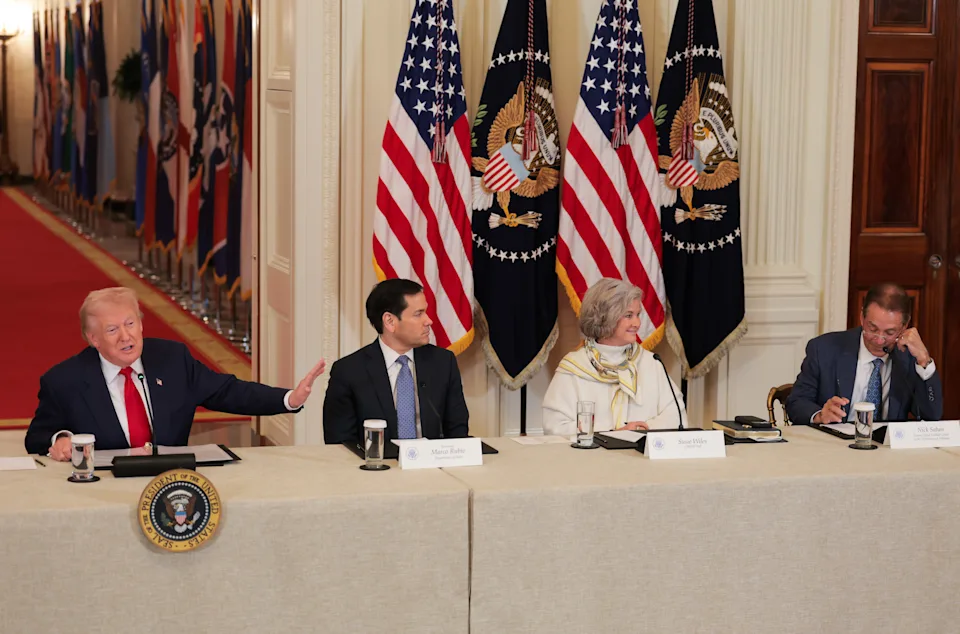
President Donald Trump gestures as former head coach Nick Saban (R) speaks alongside U.S. Secretary of State Marco Rubio and White House Chief of Staff Susie Wiles during a roundtable discussion on college sports on March 6. (Anna Moneymaker/Getty Images)
(Anna Moneymaker via Getty Images)
Perhaps the most significant concepts in the document are efforts to regulate athlete movement and compensation.
The order is expected to place strict guardrails around booster-backed NIL collectives and limit the movement of transfers, possibly even reinstating the NCAA’s “one-time” transfer rule — one that courts have deemed unlawful. The rule would permit athletes to transfer once before requiring them to miss one season as a penalty for any subsequent moves.
The order’s exact language around transfers is unclear as the document has undergone several iterations and drafts over the last month. The language is key as thousands of players — some of whom have already transferred once — are preparing to enter the basketball portal, which opens Tuesday.
Advertisement
The order is expected to define an athlete’s length of eligibility as well — a critical topic that even the most ardent NCAA detractors believe should be regulated. In the last year, more than 70 athletes have filed suit against the governing body, as players use state and local judges to grant them an extension of their eligibility beyond the NCAA’s standard four seasons of competition over five years. The NCAA has spent $16 million alone on eligibility cases.
The order is expected to require schools to fund women’s and Olympic sports at a certain level — a focus for Trump, who believes that non-revenue programs are being eliminated or at least defunded, as schools shift more resources to football and men’s basketball in an intense and competitive recruiting environment where compensation has been legalized.
But the order’s true impact remains unclear and is in doubt considering that Trump’s previous executive order, released in July, has created no real results within the industry. This one, however, is more comprehensive and direct as opposed to the last one, which only directed his cabinet members to create rules — which never materialized.
Executive orders are subject to legal scrutiny, especially those that disregard court orders. In fact, courts have struck down several of the president’s orders over the last several months, rendering them moot and unenforceable. In a White House roundtable event last month, the president himself predicted that any order would be legally challenged. He said that he “hoped” for a favorable judge.
Advertisement
Why can’t the industry “go back to the old system?” Trump asked a room of dignitaries at the March 6 roundtable event. “I’d like to go exactly back to what we had and ram it through a court.”
Like the roundtable event itself, the order is likely geared toward bringing attention to the issue in effort to pressure Congressional lawmakers to reach an agreement on a more concrete solution: legislation. That’s something of which lawmakers have failed to do in seven years of lobbying from the NCAA for a bill to, most notably, permit college sports leaders to enact and enforce rules without them being legally challenged — in other words, an antitrust exemption.
However, divide rages among those on either side of the aisle over an issue that many originally thought to be bipartisan in nature. That hasn’t proven to be true.
Republicans support a more narrow NCAA-leaning bill with athlete restrictions; Democrats, many of them harsh critics of the NCAA and power conference leadership, are supporting a more broad bill with athlete freedoms.
Advertisement
Despite confidence from Republican leadership in the House, the Republican-authored SCORE Act — the one piece of all-encompassing legislation to emerge from a committee — has twice failed to reach the House floor for a vote. Lawmakers are working to bring SCORE to the floor by the month’s end, but they continue the process of whipping votes. Holding a slim House majority, Republicans cannot afford to lose their own members, some of whom oppose portions of the bill.
Even if it advances out of the House, SCORE needs significant modifications to pass a U.S. Senate that requires a 60-vote margin for approval of legislation. That means seven Democrats voting in favor of the measure — a tall task.
Advertisement
In the Senate, Sens. Ted Cruz (R-Texas) and Maria Cantwell (D-Wa.) are holding separate negotiations over a bill, though if past discussions are any indication, the two disagree on a wide variety of bill concepts, most notably government oversight of college sports, athlete employment and the breadth of antitrust protections.
Meanwhile, five presidential committees — made up of college sports stakeholders, business executives and other dignitaries — began meeting this week with the goal of informing congressional legislation. Each committee is charged with studying an issue, plus a sixth group, an oversight committee, to review their work.
The oversight committee includes six presidents/chancellors from Georgia, Nebraska, Tennessee, Kansas, Utah and North Carolina, plus former Clemson president Jim Clements, Cody Campbell, Randy Levine and Gov. Ron DeSantis. The five “issues” committees are Legislative (work with Congress for federal antitrust protection), Rules (determine NIL, portal, eligibility standards), NCAA Reform (future governance), Media (media rights and SBA), and Player-Agent relationship issues.
Commissioners from the SEC, ACC, Big 12, Big Ten and American and Notre Dame AD Pete Bevacqua are assigned to Rules, Media and NCAA Reform committees as well as many other notable names, including Nick Saban, Condoleezza Rice and Adam Silver.