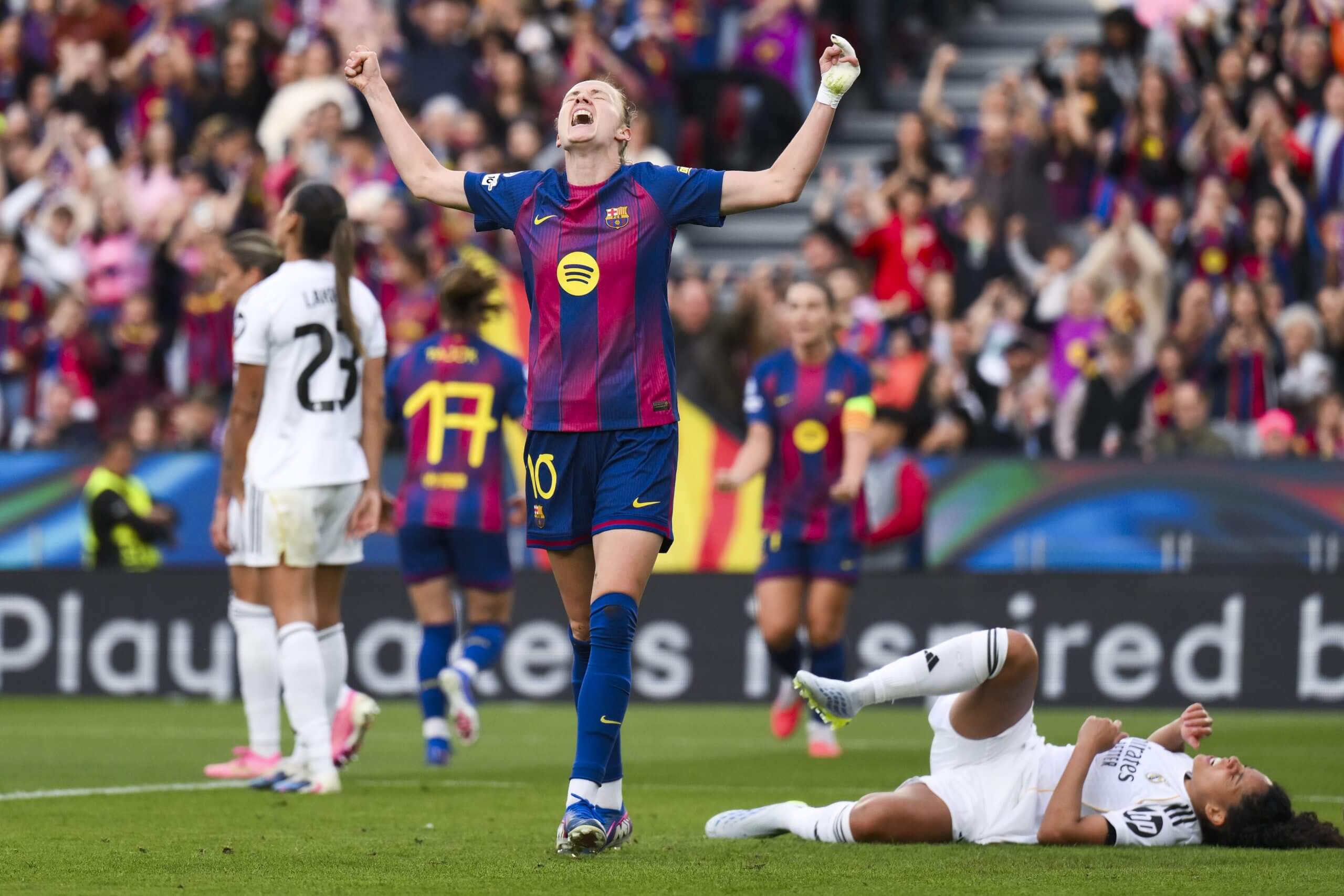
There was a familiar feeling for Barcelona fans this week as their women’s side thrashed Real Madrid.
Pere Romeu’s team beat Madrid 6-0 in the Champions League quarter-final second leg at the Camp Nou on Thursday. They progressed to the semi-finals with an aggregate 12-2 win against their arch-rivals.
Barcelona Femeni and Real Madrid faced each other three times in the last week, including a 3-0 win for Barca in Liga F, the Spanish top-flight. Across those three matches, Barca scored 15 times and conceded just twice. Their goalkeeper Cata Coll did not have to work in the last two matches; Madrid did not manage a single shot on target across the league meeting and the quarter-final second leg.
Those lopsided results are no longer surprising for those who follow Spanish football. The sides have faced each other 27 times now, although for the first two of those Real Madrid were still known as CD Tacon, the club they absorbed upon their 2019 formation. The record stands at 26 wins and 101 goals for the Catalans, with just one win and 13 goals for the team from the Spanish capital.
In the men’s game, the match-up is called El Clásico and is one of the biggest matches in world football. But can its women’s equivalent really be called by the same name, given the gap between the teams?
Madrid were one of the last major European clubs to establish a women’s team. By the time they were formed seven years ago, Barca had already won four league titles. The year of Madrid’s formation was the first in which Barca reached the Women’s Champions League final, losing 5-1 to Lyon.
But Barca have only been on the rise since then. Since 2020, they have not lost a single league title and their dominance in Spain is absolute. They have reached six Champions League finals, including the past five in a row, and have won the competition three times. This week, they advanced to their eighth consecutive semi-final appearance in Europe’s premier tournament.

Caroline Graham Hansen celebrates scoring against Real Madrid (David Ramos/Getty Images)
The gulf between the two projects is vast in a league that is far from fully professionalised. Barca are still playing against teams who are striving for that goal and others who commit to women’s football and invest in it, but are still no match for a team that has been well established for years.
Just take a look at this Champions League quarter-final.
Barca hosted the second leg at the revamped Camp Nou, setting a record attendance for both the men’s and women’s teams this season with 60,067 fans. The first leg was played at Real Madrid’s stadium dedicated to their reserve sides, the Alfredo di Stefano stadium on the outskirts of the capital. They were the only side of the eight left in the competition that did not host the game at their men’s main stadium.
The atmosphere was also completely different. In Madrid, club president Florentino Perez did not attend the first leg, the league match or the second leg.
Barca players were seen signing autographs for travelling fans at the end of the match, unlike Madrid players at the Camp Nou.
In the Camp Nou box, longtime club president Joan Laporta, the women’s team director Xavi Puig and the club’s vice president (who is acting president until the end of the season due to the recent elections) Rafa Yuste were present, along with the men’s team manager Hansi Flick.
In a 2025 interview with the Kicker FE:male podcast, Madrid midfielder Melanie Leupolz said Perez had told the women’s team they could play at the Bernabeu “when you win the first title”. At Barcelona, the players showered at the Camp Nou in a dressing room reserved exclusively for them. For the past two seasons, they have been the only women’s team to have their own private jet.
The differences do not end there. There was no presentation of the Real Madrid players when the team was set up. The manager does not hold pre- or post-match press conferences unless required to by UEFA in the Champions League. Players generally do not give interviews, even when on international duty (although this is also true of the men’s side).
“My dream was always to play for Real Madrid, but when I got there it felt like they wouldn’t let me say it. I didn’t understand it; I wanted to say I played for Real Madrid because that was what I’d always wanted,” a former Real Madrid player told The Athletic in 2023, speaking anonymously to protect relationships.
Madrid have invested in the team since their creation, which has enabled them to play regularly in the Champions League and sign stars such as Colombia forward Linda Caicedo. But their growth is slower than Barcelona’s, and the gap remains too wide to prevent thrashings like those seen this week.
“Real Madrid are improving, but so are we,” 19-year-old Barcelona player Vicky Lopez said before the first leg.
The Catalan side have the psychological edge over Real Madrid, too.

Real Madrid goalkeeper Misa Rodriguez apologised to fans after the latest drubbing (David Ramos/Getty Images)
“There might be a mental aspect to it, but it’s not just that,” Madrid coach Pau Quesada told his post-match press conference. “They’re a cut above in every respect. They’re better; they have many of the world’s best players, and we need to start closing that gap. We’re in the European top eight, but that’s not enough when your main rival is so far ahead.
“We’ve competed against every team except Barca. Development comes through the youth academy and by continuing to bring in talent, but creating the momentum to beat them takes time. You can criticise, but the foundations and the work are there.”
In the second leg, Caicedo stood out as a rare bright spot. She was the only Madrid player who could leave with their head held high, along with goalkeeper Misa Rodriguez, arguably her side’s best player despite conceding six times. On Friday, Rodriguez posted on Instagram to apologise for her side’s performance, saying: “It hurts us and it embarrasses us not to be up to the level”.
The gap seems insurmountable in the short term. Real Madrid may attract players through their badge and their status as record 15-time European champions in the men’s game, but Barca attract them with their badge and, above all, their project. They have a fruitful youth academy, some of the best players in Spain and bring in top signings.
According to both clubs’ accounts, Barcelona’s total salary budget for the women’s team this season is more than €14.3million ($16.4m; £12.5m). Madrid’s is €7.2m.
The players who join know they will compete for every title and are in a position to challenge for individual awards, too. The last five Ballons d’Or have been won by Barca players: Alexia Putellas in 2021 and 2022, followed by Aitana Bonmati in 2023, 2024 and 2025.
So El Clasico remains a term that does not quite fit with the reality of the women’s rivalry. Barca are simply light years ahead.